
Sauce Application Skills
A pool of thick sauce sits lifeless on a plate until a chef guides it into a deliberate shape. You likely notice when a sauce looks messy, but you might not see how simple movements transform that same sauce into an elegant visual feature. Controlling the flow of liquid requires more than just a steady hand; it demands an understanding of how viscosity and surface tension dictate the final shape on the plate. When you treat the plate as a canvas, every drop of sauce becomes a calculated stroke of art that directs the guest toward the main elements of the dish.
Mastering Fluid Dynamics and Tool Selection
When you apply sauces to a plate, you must account for the thickness of the liquid to ensure it holds its intended shape. A sauce that is too thin will spread uncontrollably, while a sauce that is too thick will resist the movement of your spoon or bottle. Think of this process like managing a budget; if you spend your resources too quickly, you lose control over the outcome, but careful planning allows you to allocate your assets exactly where they are needed most. By selecting the right tool for the specific job, you gain the mechanical leverage required to execute clean lines and precise droplets.
Key term: Viscosity — the measure of a fluid's resistance to flow, which determines how much a sauce spreads once it hits the plate.
Different tools offer unique ways to manipulate the sauce for visual impact:
- Squeeze bottles allow for high-speed, consistent lines because the narrow opening forces the sauce out with predictable pressure and speed.
- Offset spatulas provide a wide surface area for dragging or smearing sauce across the plate to create broad, textured backgrounds for the food.
- Precision spoons offer the most control for creating individual dots or droplets because the bowl shape holds a specific volume of liquid.
Executing Precise Application Techniques
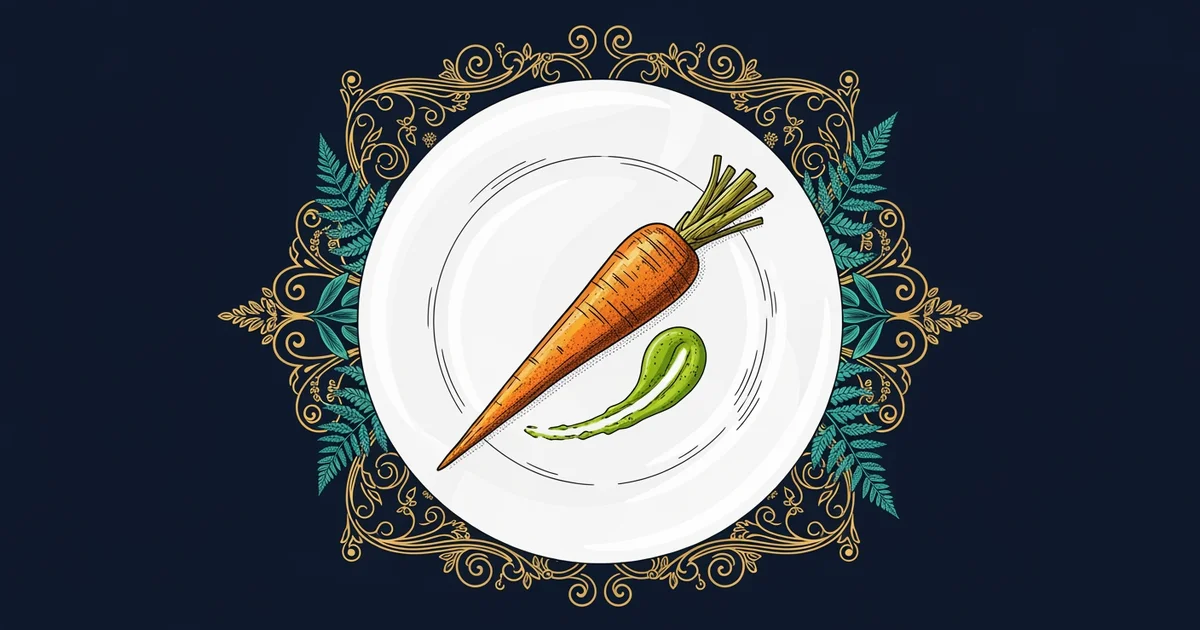
After choosing your tool, you must master the physical motion required to place the sauce without creating unintended drips or blurred edges. The drag method involves placing a pool of sauce on the plate and using the back of a spoon to pull it into a tail. This motion relies on the friction between the spoon and the plate surface to create a gradient of thickness. If you move too quickly, the sauce will break into uneven segments, but a slow, steady pull creates a smooth, professional finish that highlights the quality of the reduction.
Droplet application requires a different set of skills focused on timing and height. When you release a small amount of sauce from a height, the impact creates a perfect circle that stays contained within its own boundary. This technique is useful for adding color accents that do not interfere with the texture of other components. You should practice these motions on a flat surface to build the muscle memory needed to replicate the same shape consistently across multiple plates. Because consistency is the hallmark of a professional kitchen, your goal is to ensure that the tenth plate looks exactly like the first.
# Standard Reduction Sauce Ratio
Stock: 500 ml
Wine: 150 ml
Shallots: 20 g
Butter: 50 g
Consistency remains the most important factor in your plating success because it signals to the guest that the kitchen maintains high standards. When you repeat the same motion, you reduce the chance of errors that could ruin the visual balance of the dish. Keep your workspace clean so that any stray drops do not clutter the final presentation. By focusing on the mechanics of the wrist and the speed of your movement, you elevate the sauce from a mere side element to a core part of the design.
Visual impact in cooking relies on the precise control of fluid movement through the correct choice of tools and consistent physical technique.
Now that you understand how to control the sauce, we must look at how to place garnishes to complete the visual composition.
Want this with sources you can check?
Premium Learning Paths for Culinary Arts & Gastronomy are researched against open-access libraries — PubMed, arXiv, government databases, and more — with their distinctive claims cited to real sources and independently checked.
See what Premium includes