
Radar Anomaly Identification
A radar screen shows a sudden bright spot that appears to move faster than any known jet. Pilots often face this exact scenario when they scan the empty skies for unidentified aerial objects. Finding the truth requires more than just looking at the screen because digital noise can easily mimic a physical target. Experts must learn to separate real echoes from electronic ghosts that haunt the sensor data.
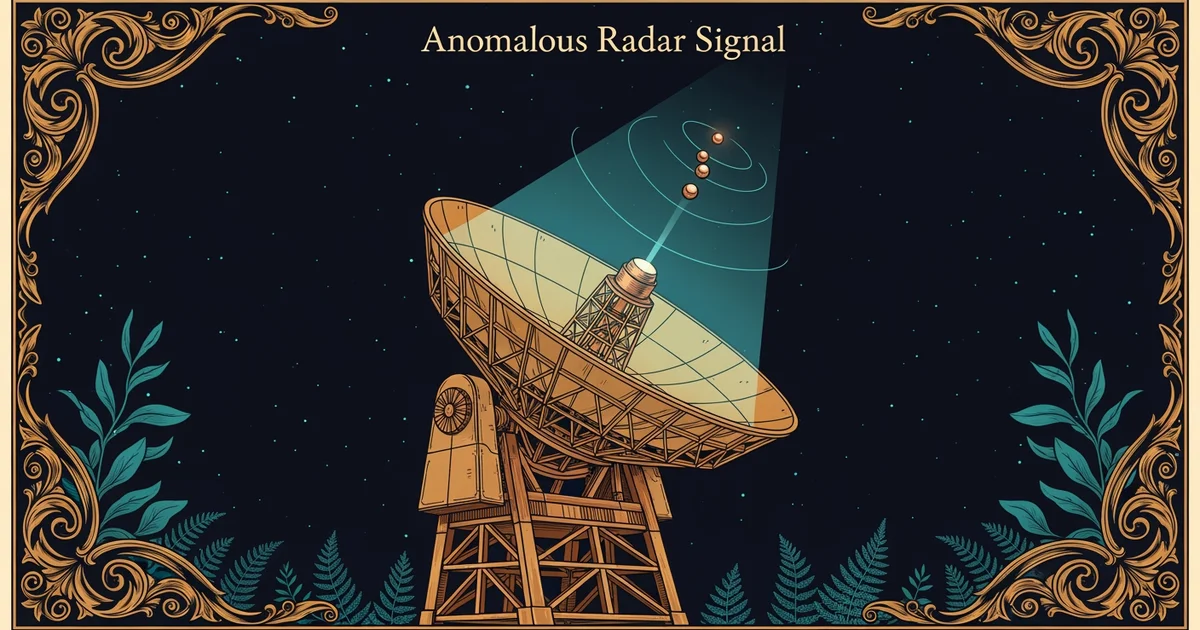
Understanding Radar Signal Processing
Modern radar systems function by bouncing radio waves off distant objects to measure their exact distance and speed. When the signal hits a solid surface, it returns to the antenna and creates a visual blip on the display. However, the atmosphere is rarely a perfect vacuum for these radio waves to travel through. Temperature shifts or high-altitude moisture can bend the beam in ways that create false returns. These artifacts often appear as solid objects because the computer interprets the scattered energy as a physical reflection. Think of this process like looking through a foggy window where water droplets create blurry shapes that might look like a person standing outside in the dark. You must learn to distinguish the actual person from the optical illusion caused by the wet glass surface.
Key term: Radar clutter — the unwanted echoes from weather, birds, or ground objects that obscure the detection of actual aircraft.
Identifying False Positives in Data
Once the system processes these incoming signals, operators must apply strict filters to remove the common sources of interference. Electronic sensors are highly sensitive to external energy sources that can bleed into the frequency band. A nearby radio tower or even a malfunctioning electrical grid can inject noise into the radar feed. This noise manifests as erratic movement or stationary blips that defy standard flight laws. Analysts use a specific set of criteria to determine if a signal represents a genuine physical craft or just a system error. These criteria help ensure that the final data set remains clean and reliable for further study by the ground team.
To manage these complex datasets, technicians categorize the anomalies based on their unique signature traits:
- Ghost targets appear when multiple radar stations receive reflected signals that bounce off buildings or mountains before returning to the receiver — this creates a phantom location that does not exist in reality.
- Electronic jamming occurs when an external energy source floods the receiver with noise to hide real activity — this forces the radar to display a wide cloud of random data points.
- Atmospheric ducting happens when air temperature layers trap radar signals close to the horizon — this causes the beam to travel much further than intended and creates false long-range detections.
| Anomaly Type | Primary Cause | Visual Characteristic | Reliability Risk |
|---|---|---|---|
| Ghost Target | Signal bounce | Erratic jumpy motion | High interference |
| Jamming | Active noise | Wide random cloud | Total data loss |
| Ducting | Heat layers | Distant false blips | Misleading range |
By comparing these patterns against known flight behavior, investigators can quickly rule out most false positives. The goal is to reach a state where only verified physical objects remain on the screen for analysis. If a signal does not match the known signatures of birds, weather, or electronic interference, it earns further investigation. This systematic approach prevents costly mistakes and keeps the focus on genuine aerial mysteries that require deep scientific inquiry. Accurate identification relies on the ability to filter out the noise while keeping the signal clear for the human eye to judge.
Reliable identification of aerial objects depends on the ability to filter out environmental noise and electronic artifacts from the raw sensor data.
But what happens when the radar confirms a physical object that appears to break the laws of physics?
Want this with sources you can check?
Premium Learning Paths for Astronomy & Space Exploration are researched against open-access libraries — PubMed, arXiv, government databases, and more — with their distinctive claims cited to real sources and independently checked.
See what Premium includes