
System Evolution Models
Why do some solar systems stay stable while others fall apart over billions of years? Astronomers often view our cosmic neighborhood as a clockwork mechanism that will eventually run down or reset itself. If we look at the history of our system, we see a chaotic past that slowly shifted into a predictable dance of gravity. This evolution suggests that planetary positions are not permanent fixtures but temporary results of complex orbital interactions. Understanding these shifting patterns helps us predict how our home might change as the Sun enters its final stages of life.
The Mechanics of Orbital Migration
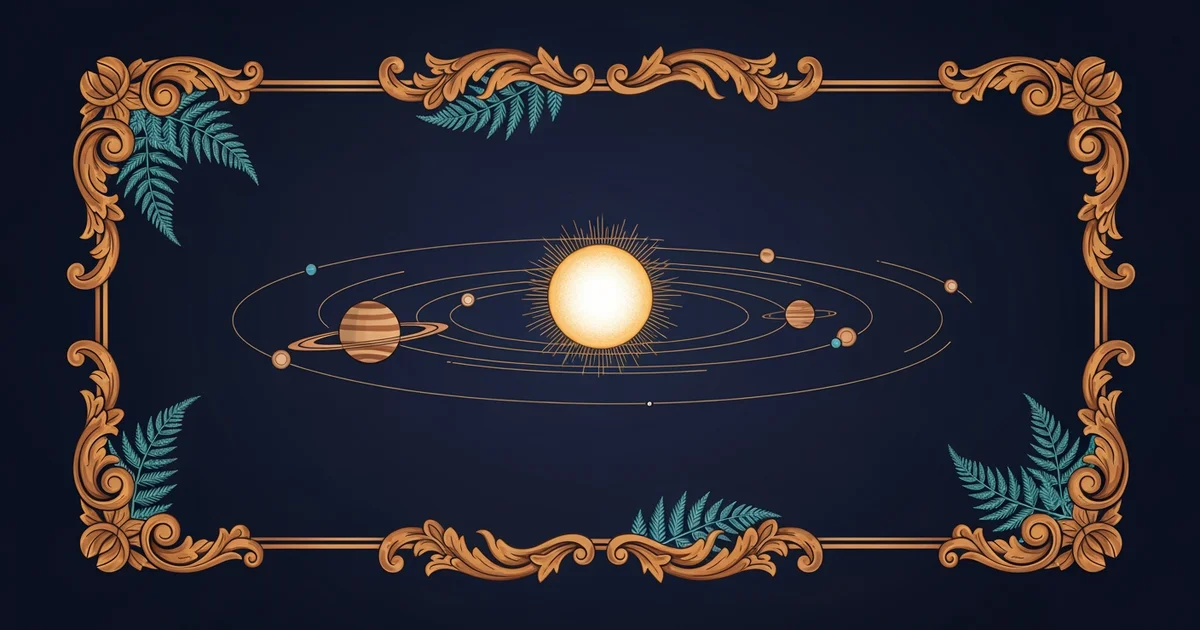
Planetary systems evolve through a process called orbital migration, where giant planets shift their positions due to gravitational tugs from smaller debris. Imagine a crowded dance floor where larger dancers push through the crowd, causing smaller people to scatter toward the edges or the center. In our early system, the gas giants moved significantly, clearing out leftover planetesimals that formed the structure we see today. This movement explains why the inner planets are rocky and the outer planets are gaseous giants. Without this early migration, the distribution of materials would look entirely different from our current neighborhood.
Key term: Orbital migration — the process by which planets change their distance from a central star due to gravitational interactions with other bodies.
This migration phase settled into the stable configuration we observe now, but stability remains a relative term in space. The interactions between planets act like a delicate balancing act where every minor pull has a long-term consequence. If the mass of a planet were slightly different, the entire system might have ejected that planet into deep space. Our system acts as a survivor of these early violent events, showing us that survival is often a matter of precise gravitational timing.
Long-Term Evolution and Future Decay
Looking toward the future, the Sun will eventually exhaust its hydrogen fuel and expand into a red giant. This expansion will alter the gravitational pull on every planet, potentially pulling inner worlds into the star’s atmosphere. The outer planets may drift further away as the Sun loses mass, effectively loosening its grip on the distant reaches of the system. We can model these changes by looking at the following stages of system decay:
- Main Sequence Stability: Planets maintain current orbits while the Sun burns hydrogen steadily for billions of years.
- Red Giant Expansion: The Sun grows larger, consuming the inner planets while pushing outer planets into wider, colder orbits.
- White Dwarf Transition: The Sun sheds its outer layers, leaving a dense core that exerts very weak gravitational influence.
- Final System Dissolution: Remaining objects drift away from the central core as the system loses its primary gravitational anchor.
These stages show that our solar system is a temporary arrangement rather than a permanent structure. The system evolution model provides a framework for understanding how stars and planets interact over immense time scales. By applying these models, we can infer that our current stable state is merely a brief chapter in a much longer narrative. This perspective forces us to reconsider the foundation question of why our system looks the way it does today. We are currently living in the most stable period of our system's long, chaotic life cycle.
| Phase | Solar State | Planetary Impact | Expected Duration |
|---|---|---|---|
| Current | Stable | Predictable orbits | Billions of years |
| Expansion | Red Giant | Inner world loss | Millions of years |
| Final | White Dwarf | Orbital escape | Infinite duration |
By comparing our system to others, we see that many stars host planets in highly unstable orbits that change rapidly. Our own history of astrobiology potential, discussed in previous stations, depends entirely on this long-term stability. If the system had remained chaotic, the conditions necessary for life would never have had the time to develop. We exist here because the clockwork of our solar system allowed for a long, quiet period of relative peace.
The current configuration of our solar system represents a temporary state of gravitational balance that will eventually transition into a new phase as the Sun evolves.
The future of space exploration depends on our ability to navigate these long-term changes while searching for other stable homes among the stars.