
The Architecture of Our Solar System
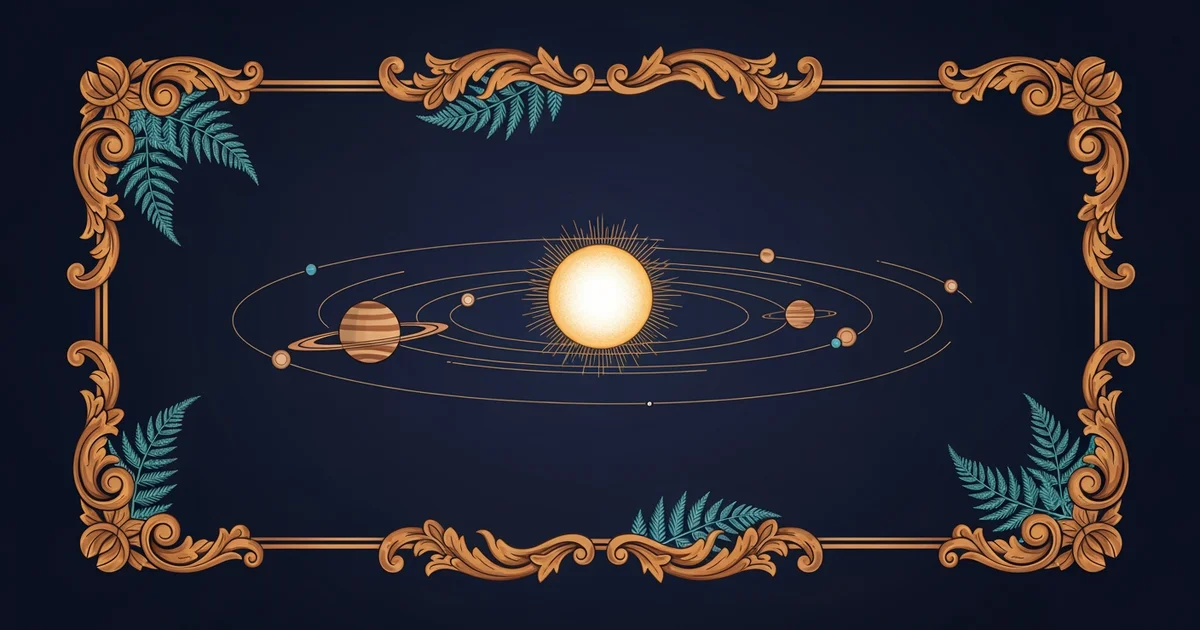
Imagine you are standing in a crowded city square watching people move toward a central fountain. Our solar system functions like this busy plaza where every object orbits a central star. The sun holds the vast majority of all mass within our local cosmic neighborhood. Gravity acts as the invisible tether that keeps every planet in its proper lane. Without this pull, every object would drift away into the cold, empty void of space. Understanding this layout helps us grasp why we occupy such a unique, stable position.
The Gravity of Our Neighborhood
Gravity serves as the primary architect for the structure of our entire solar system. Massive objects exert a stronger pull on smaller objects that pass through their vicinity. The sun contains over $99.8%$ of the total mass within our local system of planets. Because the sun is so heavy, it dictates the movement of every other orbiting body. Think of the sun like a massive anchor holding a fleet of ships in place. If you removed the anchor, the ships would scatter in random directions across the open ocean. This gravitational dominance ensures that planets follow predictable paths known as orbits around the central star.
Key term: Orbit — the curved path of a celestial object or spacecraft around a star, planet, or moon.
Planetary motion remains orderly because of this constant gravitational tug of war between the sun. The planets do not collide because they maintain specific speeds that balance their inward gravitational fall. If a planet moved too slowly, it would spiral inward toward the intense heat of the sun. If it moved too fast, it would escape the sun and drift into deep space. This delicate balance creates the stable environment required for life to flourish on our home planet.
Organizing the Cosmic Layout
We categorize the components of our system based on their composition and their distance from the sun. The inner region contains small, rocky worlds that are dense and solid under our feet. The outer region contains massive, gaseous giants that lack a solid surface for us to land. Between these two zones lies a vast belt of debris that acts as a divider. We can visualize the organization of these components by looking at their physical characteristics and locations.
| Object Category | Primary Composition | Relative Distance | Physical State |
|---|---|---|---|
| Inner Planets | Rock and Metal | Close to Sun | Solid Surface |
| Asteroid Belt | Debris and Dust | Middle Region | Fragmented |
| Outer Planets | Gas and Ice | Far from Sun | Fluid/Gaseous |
This structure reflects the conditions present during the early formation of our local stellar neighborhood. The heat near the sun prevented light gases from condensing into solid planets in the interior. Further out, the colder temperatures allowed massive amounts of gas to gather around rocky cores. We observe these distinct patterns across the entire solar system as we look toward the distant edges.
- Inner Planets represent the rocky core of our system where temperatures remain high enough to prevent gas buildup.
- Asteroid Belt serves as a natural barrier separating the small, rocky worlds from the massive, distant gas giants.
- Outer Planets function as massive reservoirs of hydrogen and helium that grew large due to the cold environment.
These components define the architecture of our home. We fit into this neighborhood as a small, rocky planet orbiting in the habitable zone. This specific location allows liquid water to exist on our surface, which is essential for life. By mapping these regions, we gain a better understanding of our place in the wider universe.
The solar system is a structured collection of objects held in stable, predictable paths by gravity.
By exploring these foundations, we will soon investigate how clouds of gas and dust collapse to create stars like our own sun.