
Gravitational Interactions
Imagine a heavy ball resting on a soft mattress that pulls smaller marbles toward its center. This familiar scene describes how massive objects in space shape the paths of nearby bodies. Gravity acts like a cosmic tether, keeping satellites in their place while they orbit a larger host. Without this constant pull, every moon and planet would drift away into the dark void. Understanding these interactions reveals why our solar system remains stable over billions of years. We must look at how mass and distance dictate the dance of celestial objects.
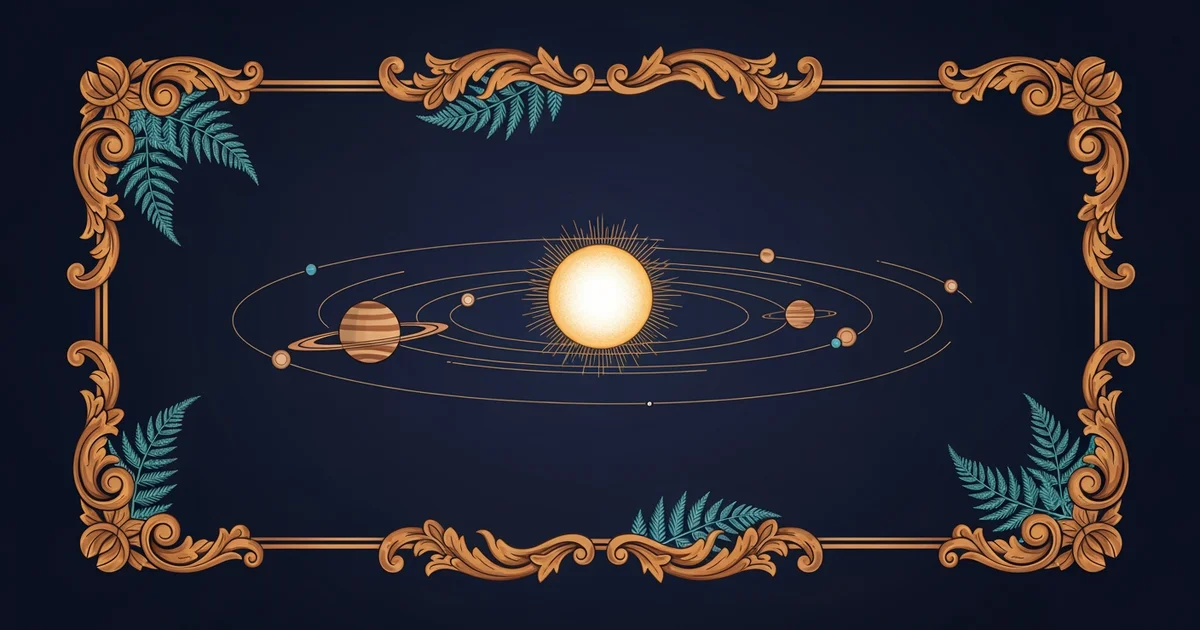
The Mechanics of Gravitational Attraction
Gravity functions as an invisible force that draws all objects with mass toward each other. When a planet is much larger than its moon, the planet dominates the gravitational field. The moon stays in a steady path because its forward speed perfectly balances the inward pull. If the moon moved too slowly, it would spiral inward and crash into the planet. If the moon moved too quickly, it would break free and escape into deep space. This delicate balance creates the stable orbits we observe in our local neighborhood today.
Key term: Orbital resonance — the gravitational relationship where two orbiting bodies exert regular, periodic influences on each other due to their orbital periods.
Think of this relationship like a parent holding a child’s hand while spinning in a circle. The parent provides the anchor, while the child leans outward to maintain the circular motion. In space, gravity replaces the grip of the hand, while velocity provides the outward lean. If the parent lets go, the child flies off in a straight line. If the child stops leaning, the parent pulls them into the center. This analogy shows how two bodies stay linked even when they never touch.
Tidal Forces and Satellite Evolution
Beyond simple orbits, gravity creates complex interactions known as tidal forces between a moon and its host. Because gravity weakens with distance, the side of a moon facing the planet feels a stronger pull. This difference in force stretches the moon, often causing it to bulge outward. Over time, these forces can lock a moon so that one side always faces the planet. This process is common throughout our solar system and changes how moons rotate and evolve.
| Interaction Type | Primary Effect | Resulting Change |
|---|---|---|
| Orbital Locking | Tidal braking | Synchronous rotation |
| Gravitational Tug | Energy transfer | Internal heating |
| Orbital Decay | Path shrinkage | Potential collision |
These interactions are not just theoretical, as they shape the physical geography of moons. When a large planet pulls on a smaller moon, the friction from the shifting interior generates heat. This heat can melt ice or keep volcanic vents active on moons far from the sun. The following list explains how these forces influence the long-term survival of satellites:
- Tidal friction converts the energy of motion into heat, which keeps the interior of a moon warm enough to host liquid water or volcanic activity.
- Gravitational tugs from other nearby moons can alter the shape of an orbit, turning a circular path into a more stretched oval shape over time.
- Constant tidal stretching eventually slows the rotation of a moon until it reaches a state where it shows only one face to its parent.
These forces ensure that no satellite remains static, as every interaction leaves a mark on the celestial body. By observing these patterns, scientists can track how old a moon is or predict its future path. Gravity serves as the ultimate architect, building and refining the structures we see in our solar system through steady, relentless pressure.
Gravitational interactions act as the primary engine for orbital stability and internal geological activity by balancing motion against the relentless pull of mass.
But what does it look like in practice when we consider the chemical makeup of these planets?