
Orbital Mechanics Fundamentals
Imagine you are spinning a heavy ball on a string around your head. If you let go of the string, the ball flies away in a straight line instead of curving. This simple act reveals the hidden tension governing every planet in our solar system. Planets stay in their paths because gravity acts like an invisible tether pulling them toward the sun. Without this constant pull, every planet would drift into the dark void of space forever. Understanding this balance is the first step toward mastering the way that celestial bodies move through our local neighborhood.
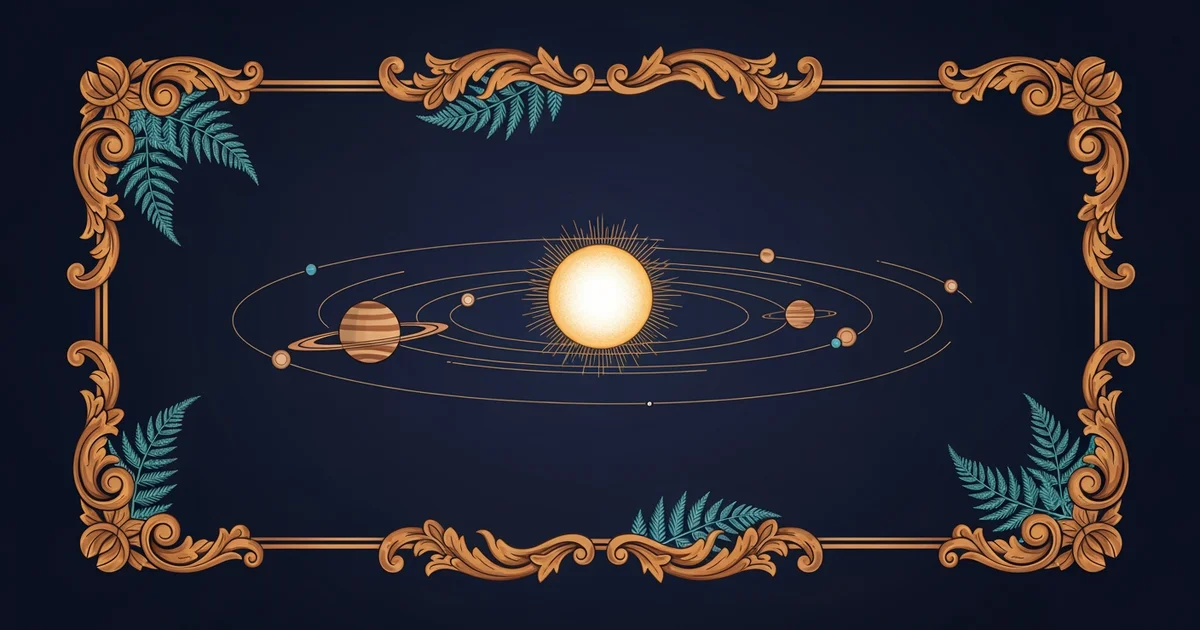
The Physics of Elliptical Paths
Planets do not travel in perfect circles when they orbit a massive star. Instead, they follow an orbital ellipse, which is a slightly stretched circle with two central points called foci. The sun sits at one of these two points, while the other point remains empty space. Because the sun is not in the center, the distance between the planet and the sun changes constantly. When a planet gets closer to the sun, it speeds up significantly to avoid falling into the star. When it moves further away, the planet slows down as gravity loses some of its grip.
Key term: Orbital ellipse — the oval-shaped path a planet follows around a star where the star occupies one focus point.
This movement follows specific rules that describe how objects behave in space. These rules explain why planets cover equal areas of space in equal amounts of time during their journey. Think of it like a gardener sweeping a path around a tree. If the gardener walks closer to the tree, they must walk faster to sweep the same amount of ground. If they walk further away, they can move slowly while still covering the same area. This relationship ensures that planetary motion remains predictable and stable over billions of years.
Velocity and Gravitational Pull
Gravity is the primary force that dictates how fast a planet must travel to maintain its stable path. If a planet moves too slowly, the sun pulls it inward, causing the orbit to collapse toward the center. If the planet moves too fast, it overcomes the gravitational pull and escapes into deep space. A stable orbit requires a perfect balance between the forward speed of the planet and the inward tug of gravity. The following table shows how distance from the sun impacts the required speed for a stable orbit:
| Planet | Average Distance | Orbital Speed |
|---|---|---|
| Mercury | 0.39 AU | 47.4 km/s |
| Earth | 1.00 AU | 29.8 km/s |
| Neptune | 30.1 AU | 5.4 km/s |
As the table shows, planets further from the sun travel much slower than those near the center. This happens because the gravitational influence of the sun weakens as the distance increases significantly. A planet in a distant orbit does not need high speed to avoid the sun because the pull is quite faint. Conversely, inner planets must maintain extreme speeds to counteract the intense gravitational force found near the sun. This delicate dance of speed and distance defines the structure of our entire solar system.
We can summarize the factors that influence how a planet maintains its position in space through these three main principles:
- Gravitational attraction provides the inward force that prevents the planet from flying off into the deep cosmos.
- Orbital velocity represents the forward momentum that keeps the planet moving around the star instead of falling inward.
- Conservation of angular momentum dictates that the planet must speed up when it reaches the point closest to the sun.
These principles work together to create the stable, repeating patterns we observe in the night sky. By applying these concepts, astronomers can calculate the exact location of any planet at any time. This predictive power allows us to send probes to distant worlds with incredible precision. Every mission into space relies on these fundamental laws of motion to navigate the vast distances between the planets. Mastery of these mechanics is essential for anyone hoping to understand the clockwork nature of our cosmic home.
Planetary orbits are governed by a constant balance between the forward motion of the planet and the inward pull of gravity.
But what happens when two or more massive bodies pull on each other at the same time?
Want this with sources you can check?
Premium Learning Paths for Astronomy & Space Exploration are researched against open-access libraries — PubMed, arXiv, government databases, and more — with their distinctive claims cited to real sources and independently checked.
See what Premium includes