
Stellar Origins and Nebula Formation
Imagine a massive, swirling cloud of dust and gas floating in the cold silence of deep space. If you were to watch this cloud over millions of years, you would see it slowly pull itself together into a glowing, spinning structure. This process is how every star in our night sky begins its life. The universe does not just create stars at random, but follows a strict physical process of collapse and heating. Understanding this cycle helps us see how our own home planet came to exist within the vast cosmic neighborhood.
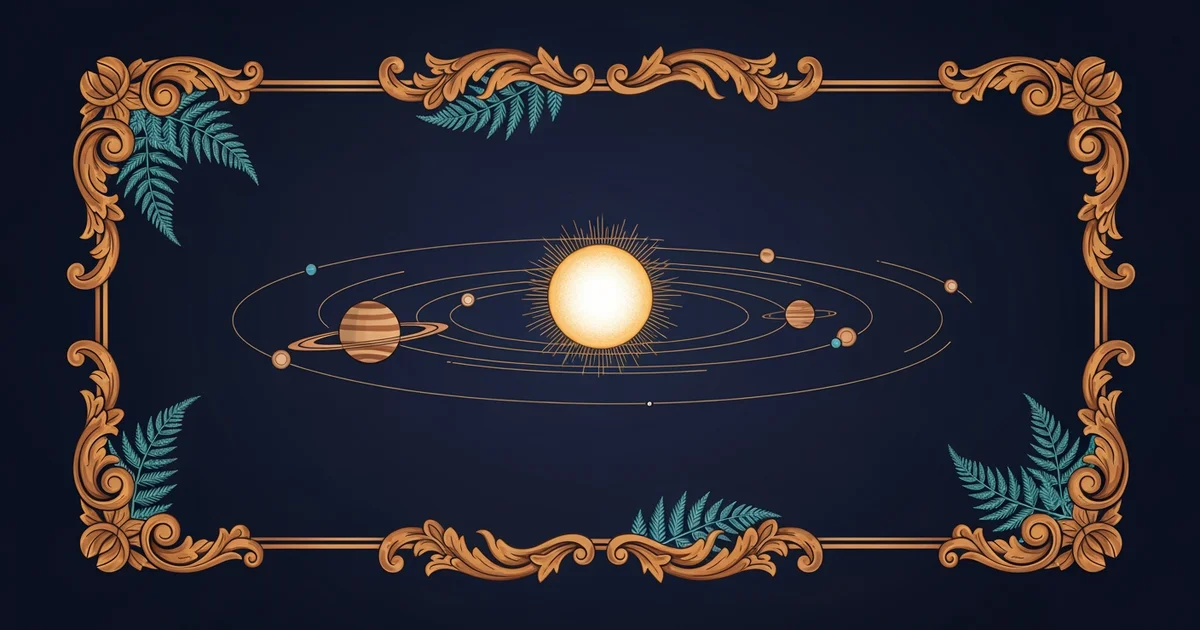
The Mechanics of Stellar Birth
Giant clouds of interstellar gas and dust, known as a nebula, serve as the nurseries for new star systems. These clouds contain mostly hydrogen and helium left over from the early universe. Gravity acts as the primary force here, pulling the loose particles toward a common center of mass. As the cloud shrinks, it begins to spin faster, much like an ice skater pulling in their arms to increase their rotation speed. This spinning motion causes the cloud to flatten into a wide, rotating disc shape. This flat structure is essential, as it eventually becomes the foundation for all planets that might form around the central star.
Key term: Nebula — a vast, cold cloud of gas and dust in space that provides the raw material for forming new stars.
As the center of this spinning disc grows denser, the temperature climbs rapidly due to the intense pressure. Think of this like pumping air into a bicycle tire; the pump gets warm because the gas molecules are crowded together and moving fast. Eventually, the core becomes hot enough to ignite nuclear fusion, which marks the official birth of a star. The material left in the outer parts of the disc continues to orbit the new sun. This leftover debris will eventually collide and clump together to form planets, moons, and asteroids over long periods.
From Disks to Solar Systems
Once the star ignites, the remaining material in the proto-planetary disk begins to organize itself into distinct patterns. This disk acts like a cosmic assembly line where tiny grains of dust stick together to form larger rocks. These rocks grow into bigger bodies, eventually becoming the planets we see today. The composition of these bodies depends on their distance from the heat of the central star. Closer to the star, only materials that can withstand high heat remain solid, while further out, ice and gas can accumulate to form massive planets.
| Stage of Formation | Primary Process | Resulting Structure |
|---|---|---|
| Cloud Collapse | Gravity pulls gas | Dense central core |
| Disk Flattening | Conservation of momentum | Rotating flat disk |
| Ignition | Nuclear fusion | Active young star |
| Accretion | Particle collision | Solid planetesimals |
We can observe this process happening in other parts of our galaxy today using powerful telescopes. By looking at these distant systems, we confirm that our solar system formed through these same physical laws. The leftover gas and dust that did not become planets or the sun were eventually cleared away by solar winds. This clearing process left us with the clean, organized layout of planets we see in our current neighborhood. Our existence is a direct result of this ancient, orderly collapse of interstellar material into a stable, sun-centered system.
Stars and their orbiting planets emerge from the gravitational collapse of massive gas clouds that flatten into spinning, heat-generating disks.
Next, we will explore how these diverse planetary bodies are classified by their size, composition, and distance from their parent star.