
Orbital Mechanics Overview
Imagine you are driving a car on a highway where the road curves constantly. You must balance your speed and steering to stay in your lane without crashing. Space travel works just like this, but your path is defined by gravity instead of pavement. Navigating the void requires a deep understanding of how objects move through the vast emptiness. You have to predict exactly where a target will be when you arrive.
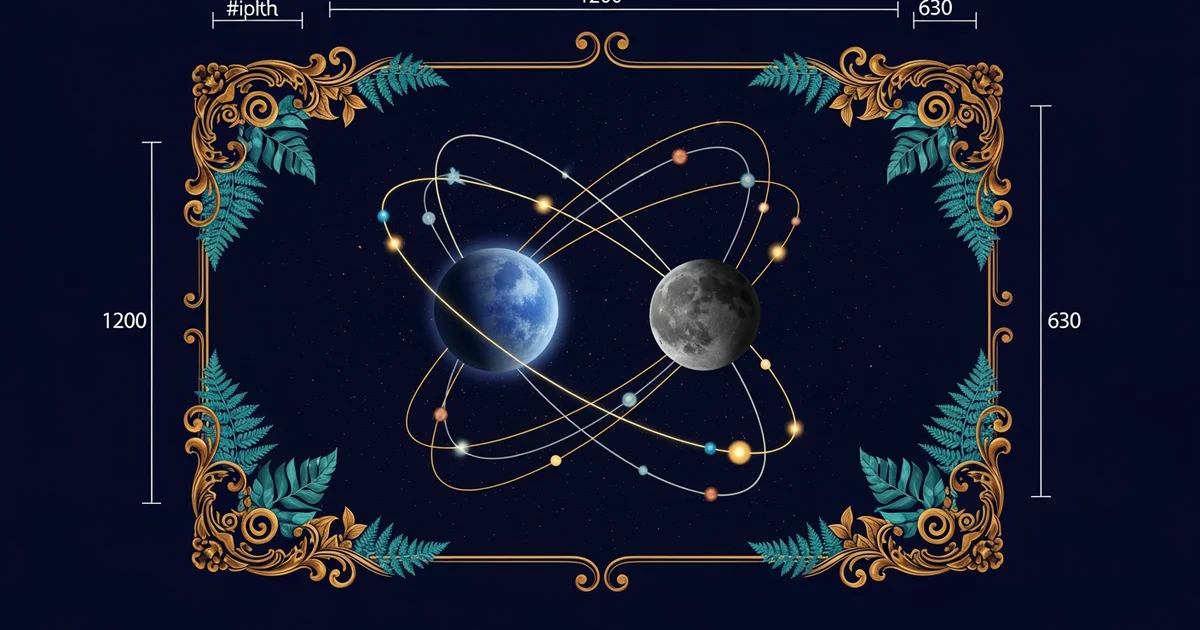
The Mechanics of Circular Motion
To keep a spacecraft in orbit, you must balance the pull of gravity against velocity. Gravity acts like a tether that constantly pulls the craft toward a central body. Without enough speed, the craft falls straight down into the planet or moon. If you go too fast, the craft escapes the pull and drifts into space. This delicate balance creates a stable path that we call an orbital trajectory. Think of this like swinging a ball on a string. If you spin the ball fast enough, the string stays tight and creates a circle. If you stop spinning, the ball falls down. If you cut the string, the ball flies away in a straight line forever.
Key term: Orbital trajectory — the specific curved path an object follows through space under the influence of gravity.
Managing these paths requires us to use specific math to ensure that ships arrive safely. We rely on the concept of orbital velocity to maintain a steady distance from a central body. This speed is calculated based on the mass of the planet and the distance of the orbit. A low orbit requires much higher speed because gravity is stronger closer to the surface. A high orbit allows for slower speeds because the gravitational pull is much weaker there. We calculate this speed using the gravitational constant and the mass of the central body. The formula for a circular orbit is represented by the following equation:
In this equation, is the velocity, is the gravitational constant, is the mass, and is the radius. By adjusting these values, mission planners can design paths that keep satellites and ships in the right spot. This math is the foundation for every single mission that leaves our home planet.
Calculating Paths and Maneuvers
When we plan a mission, we must account for the fact that orbits are rarely perfect circles. Most objects follow an elliptical path that changes speed depending on their distance from the center. A craft moves faster at the closest point and slower at the farthest point away. To change your orbit, you must perform a maneuver that shifts your total energy. These changes are usually done by firing engines to increase or decrease your current velocity. We track these changes to ensure that we do not collide with other objects in space. The following list outlines the primary factors that influence how a craft moves through its path:
- The total mass of the central planet determines how strongly it pulls on the craft.
- The distance from the center of the planet dictates how much speed you need.
- The current velocity of the craft determines if it will climb or descend.
- The timing of engine burns dictates the final shape of the new orbital path.
We use these factors to build a map of the space between the Earth and the Moon. Every maneuver consumes fuel, which is a limited resource for any space mission. Engineers work to find the most efficient paths that use the least amount of energy. This process is similar to planning a long road trip with limited gas stations. You must calculate every turn and acceleration to ensure you reach your final destination safely. By mastering these calculations, we can manage the growing traffic in the busy space near our moon.
Understanding orbital mechanics allows us to predict and control the movement of spacecraft through gravitational fields.
The next Station introduces Lagrangian Point Dynamics, which determines how gravity from two bodies creates stable parking spots for spacecraft.