
Navigating in Twilight
TL;DR: The "sweet spot" for celestial navigation is nautical twilight, a brief window where the horizon is still visible against the dark sky while the brightest stars have already appeared.
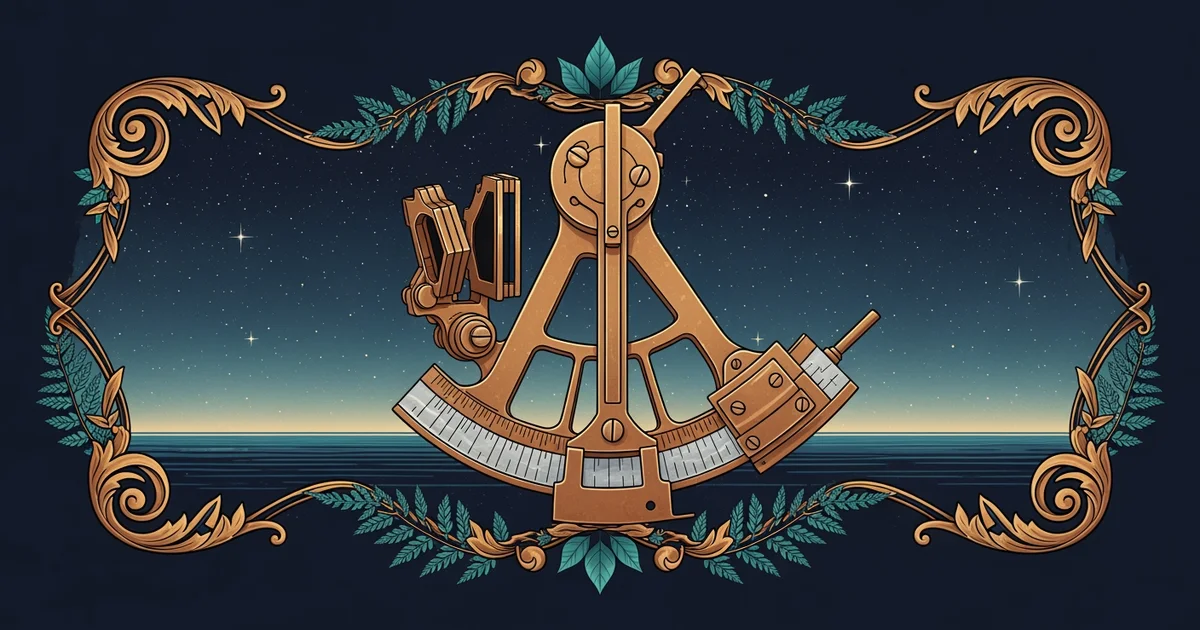
The Goldilocks Zone of the Sky
In our journey through celestial navigation, we have mastered how to use multiple bodies to fix our position. But there is a hidden trap: you cannot measure the angle of a star if you cannot see the horizon beneath it. If it is too dark, the horizon vanishes into a black void. If it is too bright, the stars are washed out by the sun. You need the perfect middle ground, a time known as .
Think of this as the sky’s "Goldilocks zone." During the day, the sun is a brilliant beacon, but it blinds you to the celestial map. At night, the stars are crisp, but you are effectively blind to the horizon line required for your sextant measurements. Nautical twilight is the transition phase where the atmosphere scatters just enough light to keep the sea line sharp, while the dimming blue allows the navigational stars to pop into view. This is when the most skilled navigators do their work.
Timing the Window
Calculating your window is not just about convenience; it is about precision. If you miss this window, your sextant sight will be a guess rather than a measurement. The duration of nautical twilight depends on your latitude and the time of year. As you move toward the poles, the sun sets at a shallower angle, meaning the transition from day to night takes significantly longer. Near the equator, the sun plunges vertically, making this window fleeting and intense.
To schedule your observation, you must track the sun's depression angle. When the sun is below the horizon, civil twilight ends. When it reaches below, nautical twilight ends and the horizon becomes too difficult to distinguish from the sky. Your goal is to complete your series of sights while the sun sits between and below the horizon. This gives you roughly 30 to 40 minutes in most temperate regions to capture your data.
The Practical Observation
When you step onto the deck, you are not just looking for any star. You are looking for the "navigational stars" you previously studied. In the dim light of twilight, your eyes need time to adjust. A common mistake is rushing to the sextant the moment the first star appears. Instead, practice "averted vision"—looking slightly to the side of the star to detect its faint light with the more sensitive peripheral rods of your retina.
Once you have identified your star, bring the horizon into view. Because the light is fading, you must be decisive. If the horizon is becoming fuzzy, stop. A blurry horizon line introduces an error that ripples through every calculation you make. It is better to have one perfect, crisp observation during the peak of twilight than five shaky ones taken in the dark.
Twilight Sight Protocol
Procedure · 6 steps- 1Determine the exact time of sunset for your current coordinates.
- 2Wait for the sky to shift from blue to deep violet.
- 3Identify the brightest navigational stars using a star chart.
- 4Align the star with the visible horizon using your sextant.
- 5Record the time and the altitude reading immediately.
- 6Repeat for a different celestial body to create a cross-fix.
Navigating in twilight is the ultimate test of a sailor's patience and preparation. It requires you to be ready before the light begins to fail, ensuring that when the stars arrive, you are already waiting for them. You have mastered the geometry of the stars and the mechanics of the sextant; now, you are learning to master the clock of the heavens itself.
Nautical twilight provides the essential balance of visible horizon and clear starlight, requiring you to plan your observations within the specific window when the sun is between 6 and 12 degrees below the horizon.
Now that you can capture the stars at the perfect moment, the next step is ensuring those measurements are accurate; in the next station, we will explore how to troubleshoot and correct the inevitable errors in your sight.