
Future City Projections
Imagine a skyline where every building surface generates power while residents grow their own food in vertical gardens. Modern cities face a massive challenge as populations grow and space for new housing shrinks rapidly.
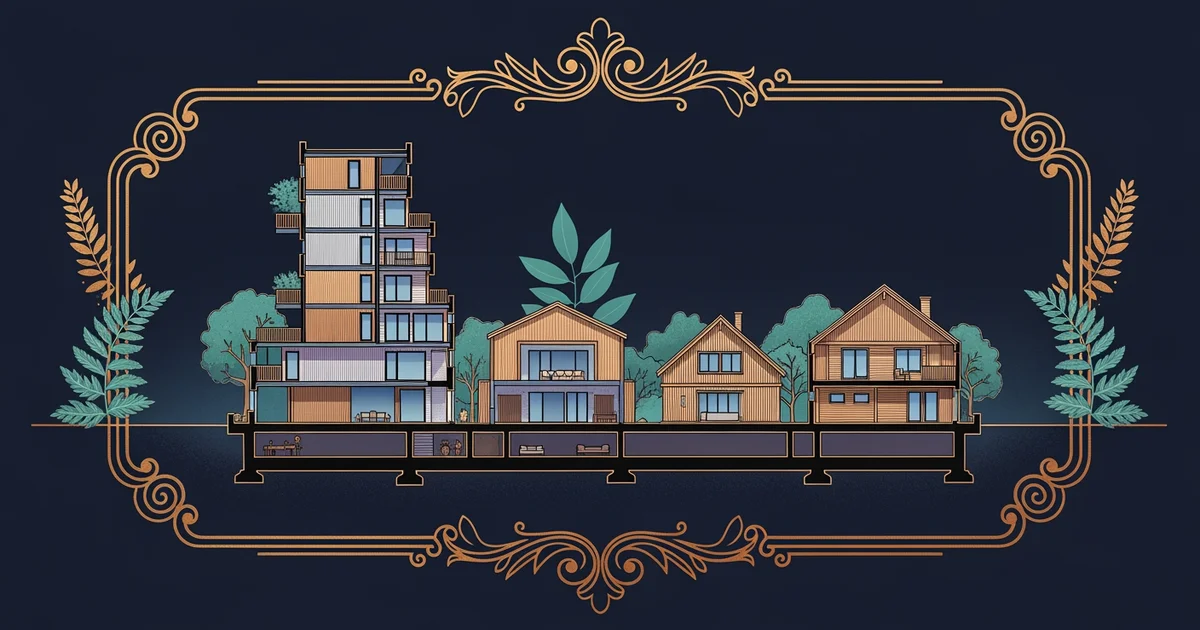
The Evolution of Urban Density
To understand where we are going, we must look at how past housing styles evolved into our current urban landscape. Early housing focused on simple protection, but modern needs require complex systems that balance density with personal comfort. We previously explored how disaster resilient housing protects structures from extreme weather events, yet future cities must also solve the problem of limited land availability. By stacking living spaces vertically, architects now create high-density zones that preserve the surrounding natural environment. This transition represents a shift from sprawling suburbs to efficient, self-contained living hubs that prioritize shared resources over individual ownership. Think of this process like a crowded pantry where you reorganize shelves to fit more items by using vertical space instead of buying a larger kitchen.
Key term: Vertical urbanization — the architectural practice of designing tall, multi-use buildings that stack residential, commercial, and agricultural spaces to maximize limited land area.
This method allows cities to grow upward, which reduces the need for long commutes and lowers the carbon footprint of daily life. When we integrate these vertical systems into our planning, we solve the core question of why housing costs change across regions. High costs often stem from land scarcity, but vertical design effectively increases the available supply within the same physical footprint.
Integrating Future Technologies
Future city projections rely on the seamless integration of smart infrastructure that adapts to the needs of its residents in real time. We must move beyond static construction methods to embrace dynamic buildings that change based on environmental feedback. These structures will likely feature modular components that allow residents to expand or shrink their living areas as their families grow or change.
| Feature | Current Standard | Future Projection |
|---|---|---|
| Energy | Grid-dependent | Self-generating |
| Food | Imported produce | Vertical gardens |
| Layout | Fixed walls | Modular partitions |
By utilizing these modular designs, cities can remain flexible enough to handle sudden population shifts without requiring massive demolition or new construction projects. This adaptive capacity addresses the tension between permanent architecture and our temporary, ever-changing social needs. As we synthesize our knowledge from previous stations, we see that the future of housing is not just about building stronger walls, but about creating systems that breathe and grow.
- Automated climate control monitors internal air quality and temperature to reduce energy waste while maintaining comfort for all residents.
- Integrated hydroponic systems provide fresh produce directly within the building, which eliminates the need for long-distance shipping of food supplies.
- Modular living units allow for rapid reconfiguration of interior spaces to suit changing family sizes and professional needs over several decades.
These three trends work together to create a sustainable cycle where the building provides for its occupants while minimizing its impact on the planet. By combining these technologies, we move closer to a model where housing is a service rather than just a static asset. This approach forces us to rethink our relationship with the spaces we inhabit, as we transition from passive consumers of housing to active participants in a living, breathing urban ecosystem. As we look at the global housing trends discussed throughout this path, we must ask ourselves how these smart systems can bridge the gap between expensive urban centers and affordable, high-quality living spaces for everyone.
Future cities will rely on vertical, modular, and self-sustaining designs to solve the dual pressures of rising population density and limited land availability.
The next step in our learning path involves reviewing these concepts to synthesize a complete understanding of global housing dynamics.
This concludes our exploration of future city projections, highlighting how innovation shapes our residential future.