
The Complete Figure
Imagine you are building a complex bridge that must support its own weight while looking graceful. Artists face this same challenge when drawing the human form by connecting bones and muscles into a unified whole. You cannot simply draw parts in isolation because a body acts like a single mechanical system. Every limb movement relies on the foundation of the skeleton and the pull of muscle groups. By viewing the body as a complete unit, you gain the power to draw figures that feel alive and grounded in physical reality.
Integrating Anatomical Systems
Drawing the human form requires you to synthesize the skeletal structure with the soft tissue layers. You previously learned about surface rendering, which focuses on how light hits the skin to create volume. Now you must combine that depth with the underlying framework of bones and muscles. Think of the skeleton as the steel beams of a skyscraper and the muscles as the concrete walls. If the steel beams are crooked, the concrete walls will eventually crack and fail to hold their shape. You must map the skeleton first to ensure your figure has a solid base for all other details.
Key term: Proportional alignment — the process of ensuring that skeletal landmarks remain consistent across the entire body to maintain structural integrity.
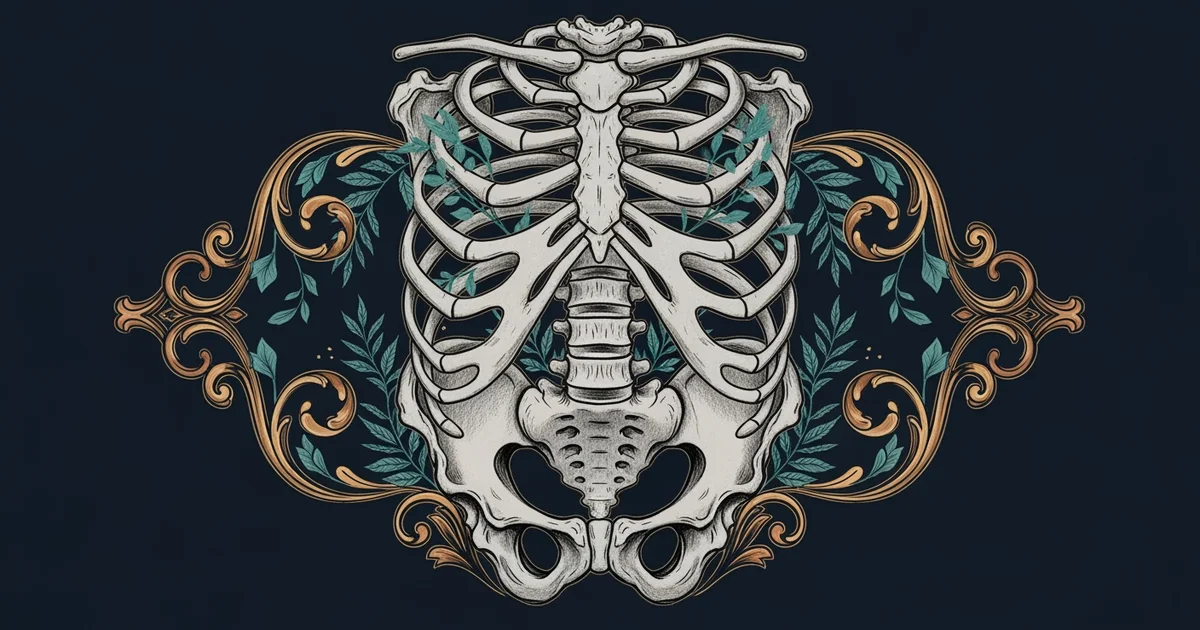
When you master this integration, you stop drawing flat shapes and start building three-dimensional volumes on your paper. You must check how the rib cage connects to the pelvis through the spine's natural curves. This connection dictates how the torso twists and bends during movement. If you ignore the spine's role, the figure will look stiff or broken. By focusing on the core, you create a natural flow that guides the viewer's eye across the entire drawing.
The Mechanics of Movement
Once you establish the core, you must consider how muscles wrap around the bones to create motion. Muscles are not just lumps of clay attached to a frame; they are active engines that pull on bones. When a muscle contracts, it changes the silhouette of the limb significantly. You should observe how these changes occur during different poses to improve your realistic figures. Understanding these mechanics helps you avoid common mistakes like drawing muscles that do not attach to the correct joints.
| Anatomical Part | Primary Function | Interaction Effect |
|---|---|---|
| Skeletal Frame | Provides support | Dictates overall pose |
| Muscle Groups | Create movement | Change surface volume |
| Skin Surface | Protects interior | Shows light and shadow |
The interaction between these systems is essential for achieving a natural look in your artwork. You might notice that a flexed bicep creates a specific bulge that affects the shoulder's silhouette. These small changes show the observer that your figure has internal weight and tension. Consider the following checklist for every full-figure study you attempt:
- Establish the spine's line of action to define the torso's overall movement and energy.
- Verify that major muscle groups connect to the correct bone origins to ensure realistic tension.
- Check the balance of the weight-bearing leg to prevent the figure from looking like it might fall over.
- Use light to emphasize the transition between bone and muscle to give the figure a tactile quality.
By following this process, you transform your ability to draw realistic figures from guessing to informed construction. You are no longer just copying lines but understanding the engine beneath the skin. This knowledge answers the foundation question of our path by proving that anatomical structure is the key to artistic freedom. When you know how the body works, you can draw it in any position with total confidence. You have moved beyond surface details and are now building characters that possess true physical presence.
Understanding the internal mechanical connections of the human body allows an artist to construct figures with structural integrity and realistic movement.
Your next step involves exploring how to purposefully distort these anatomical rules to create expressive and stylized character designs.