
Joint Mechanics
Imagine you are trying to bend a stiff metal wire into a complex shape without a hinge. The wire resists your efforts because it lacks a natural point of rotation to allow for smooth movement. Your body avoids this rigid struggle by using specialized connections that act like sophisticated mechanical pivots. These structures permit the skeletal system to move with grace while maintaining the necessary strength to support your weight. Understanding these pivots provides the foundation for drawing figures that look natural rather than stiff or broken.
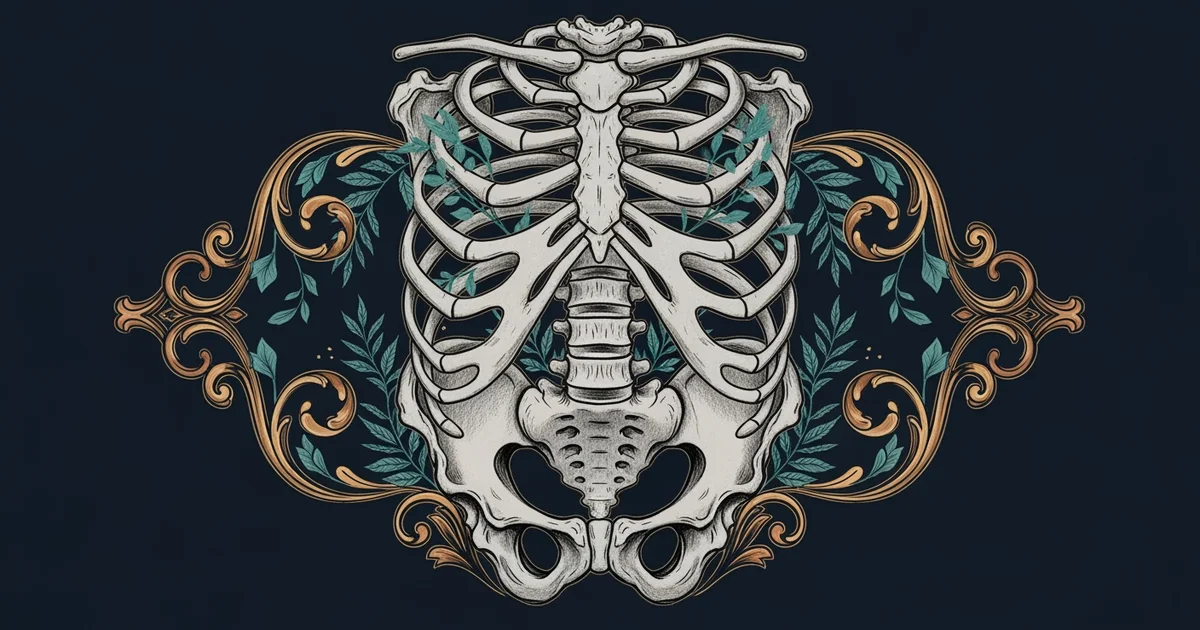
The Mechanics of Natural Movement
When you examine the human body, you notice that movement relies on specific points where bones meet. These points are known as joints, and they function much like the hinges on a heavy door. A door hinge allows the door to swing open or closed along one specific path. Similarly, your elbow acts as a simple hinge that permits only back and forth motion. This restricted path prevents the arm from bending in ways that would cause injury or structural instability. By limiting the direction of travel, these joints ensure that your limbs remain strong even when you are carrying heavy objects.
Key term: Joints — the physical points where two or more bones meet to provide stability and allow for skeletal movement.
Beyond simple hinges, your body utilizes complex pivots to achieve a wide range of motion. Think of these joints like the swivel mechanism on a high-end office chair. While a hinge only moves in one plane, a swivel allows for rotation in multiple directions. Your shoulder is the perfect example of this mechanical flexibility. It allows your arm to reach, rotate, and circle in space. This added freedom requires more support from surrounding tissues to keep the bones aligned correctly. Without this extra stability, the joint would become loose and prone to accidental dislocation during daily physical activities.
Classifying Range of Motion
Because different body parts require different levels of mobility, the skeleton features several distinct types of joints. You can categorize these connections based on how much freedom they offer to the attached bones. Some joints are designed to be almost immovable to protect vital organs, while others prioritize extreme flexibility for complex movements. Artists often find that observing these categories helps them predict how a figure will shift during a dynamic pose. If you know the mechanical limit of a joint, you can avoid drawing limbs that appear to stretch or bend in physically impossible ways.
| Joint Type | Movement Pattern | Example Location | Primary Function |
|---|---|---|---|
| Hinge | Single Plane | Elbow | Simple bending |
| Ball-Socket | Multi-Direction | Shoulder | Wide rotation |
| Pivot | Rotational | Neck | Turning motion |
When you apply these concepts to your sketches, you should consider the limitations of each pivot point. A figure that appears to have a broken elbow is usually the result of ignoring the hinge-like nature of that specific joint. You must respect the mechanical constraints of the skeletal system to create a sense of realism. If you force a limb to move outside its natural range, the viewer will immediately sense that something is wrong with the anatomy. Consistent practice with these mechanical rules will eventually allow you to draw figures that feel alive and grounded in physical reality.
By studying how these connections operate, you gain a deeper appreciation for the logic behind human structure. You begin to see the skeleton not just as a collection of shapes, but as a functional machine. This shift in perspective is what separates a basic sketch from a professional figure drawing. When you understand the mechanical limits of the body, your art gains a new level of credibility and depth. You are no longer guessing how a limb should bend because you now understand the pivot points that dictate the movement of the entire frame.
Understanding the mechanical limits of joints allows you to draw figures that move with natural, predictable, and physically accurate grace.
But what does it look like in practice when muscles pull these joints into motion?
Want this with sources you can check?
Premium Learning Paths for Visual Arts & Photography are researched against open-access libraries — PubMed, arXiv, government databases, and more — with their distinctive claims cited to real sources and independently checked.
See what Premium includes