
The Skeleton as a Framework
Imagine you are building a skyscraper without any steel beams to hold up the heavy floors. Without that internal metal framework, the entire structure would collapse into a pile of rubble instantly. Your body functions exactly like that building because your bones act as the primary support system for everything else. Understanding the skeleton is the first step toward drawing people who look solid, balanced, and alive on your paper.
The Architecture of the Human Body
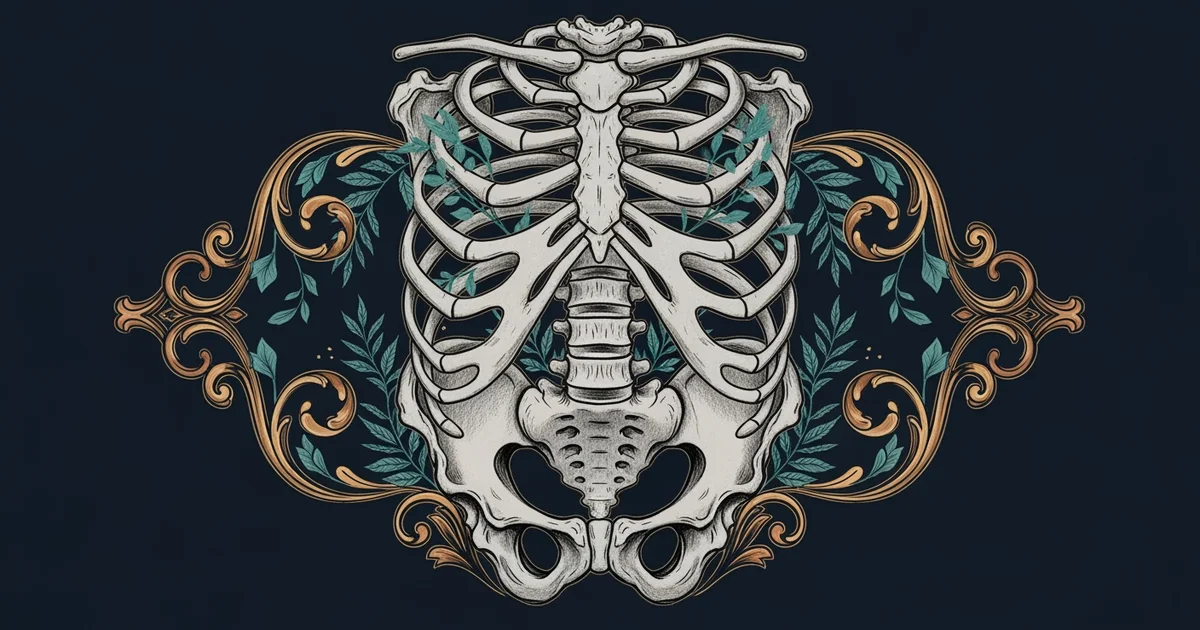
When you start a drawing, you should think of the skeleton as the structural blueprint for your figure. Artists often treat the cranium, the rib cage, and the pelvis as the three main masses of the body. These bones do not just sit there; they provide the anchor points for all the muscles that move your limbs. If you ignore these shapes, your drawings will likely look like they are made of rubber or lack a clear sense of gravity. Think of these bones like the sturdy wooden frame inside a house that supports the drywall and the roof. By drawing these shapes first, you ensure that your character has a firm foundation before you add any skin or clothing.
Key term: Anatomy — the study of the physical structure of living organisms and their internal parts.
Landmarks for Accurate Proportions
Once you establish the main masses, you must identify the landmarks that help you measure the body. Landmarks are specific points where the bone sits close to the surface of the skin. You can easily feel these points on your own body, such as your elbows, your knees, or your collarbones. Using these points allows you to map out the limbs with much greater accuracy than guessing by eye. If you know where the joints are, you can effectively predict how the limbs will bend and rotate in space. Using these fixed points is like using a map to navigate a new city instead of walking around aimlessly. The following list explains why these specific landmarks are essential for your figure construction:
- The shoulder blades act as the base for arm movement and define the width of the upper back.
- The hip points serve as the pivot for the legs and dictate how the weight shifts when standing.
- The ankle bones provide the connection to the ground and anchor the weight of the entire body frame.
Mapping the Skeletal System
To master figure drawing, you must understand how these bones connect to form a cohesive, functional unit. The skeleton is not just a collection of static parts, but a dynamic system designed for movement. When you draw a figure, you are essentially drawing a machine that is capable of walking, running, or sitting still. By focusing on the connections between the major joints, you create a sense of motion that makes your art feel more realistic. The table below compares how different skeletal sections support your drawing process by providing specific structural information for your figure.
| Skeletal Section | Primary Purpose | Drawing Benefit |
|---|---|---|
| Spinal Column | Maintains posture | Creates the main curve |
| Pelvic Girdle | Balances weight | Anchors the lower limbs |
| Rib Cage | Protects organs | Defines the upper torso |
By viewing the body as a series of connected shapes, you move away from copying outlines and start building volume. This method helps you solve problems with foreshortening because you know exactly how long each bone segment is. As you practice this technique, you will notice that your figures begin to look more grounded and natural on the page. You will soon find that you can draw any pose from your imagination because you understand the underlying structure.
Understanding the skeleton provides the essential structural framework that allows artists to build realistic, balanced, and dynamic human figures.
By mastering these skeletal foundations, you will be prepared to layer muscles and surface features onto your figures in the next stage of your creative journey.
This path provides you with the complete technical knowledge needed to construct professional-grade figure drawings from the ground up.