
The Mechanics of Entanglement
Imagine two magic coins that always land on opposite sides no matter how far apart they sit. If you flip one coin in your house and it shows heads, the other coin instantly shows tails even if it is across the galaxy. This strange connection happens in the world of quantum mechanics through a process called entanglement. It challenges our common sense because it suggests that objects can stay linked across vast distances without any physical wire or signal. Scientists use this link to create powerful systems for processing data in ways that standard computers cannot achieve today.
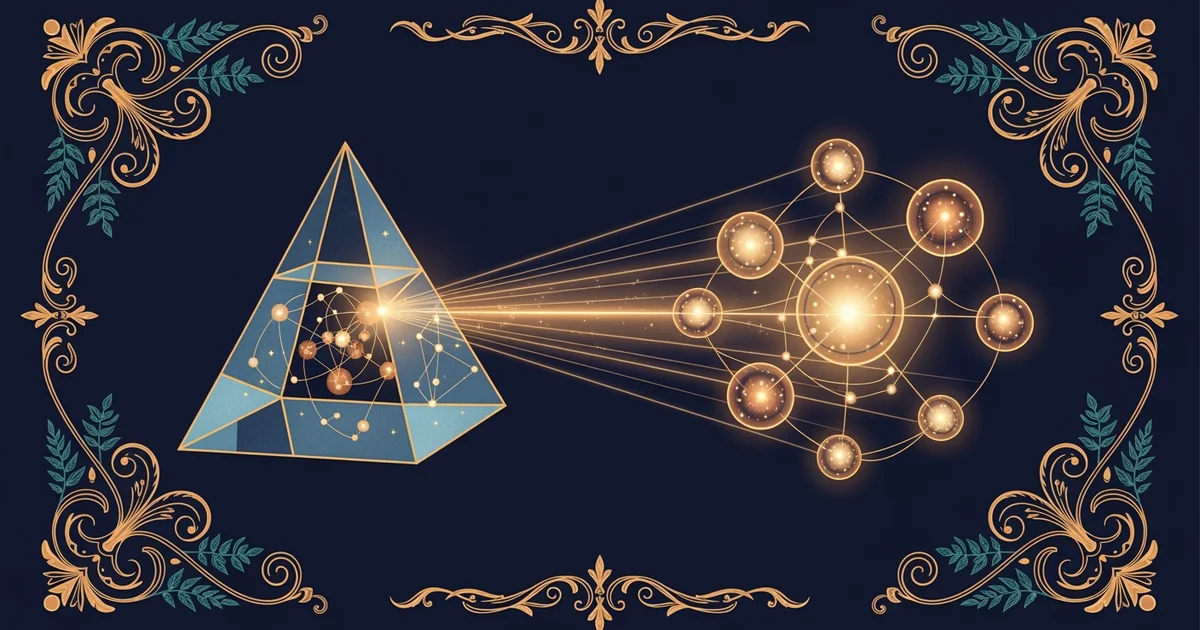
The Nature of Quantum Correlations
When two particles become entangled, they lose their individual identity and form a single shared state. You can think of them like a pair of identical twins who share a secret language. Even when they are separated by thousands of miles, their physical properties remain perfectly correlated. If we measure the state of one photon, we instantly know the state of its partner. This happens because the particles exist in a superposition of all possible states until the moment we observe them. Our act of observation forces the system to choose a specific value, which settles the state for both particles simultaneously. This effect does not depend on the distance between the particles at all.
Key term: Entanglement — a physical phenomenon where two or more particles share a single quantum state so that measuring one particle instantly determines the state of the other.
This behavior might seem like it breaks the rules of speed, but it does not actually transmit information faster than light. Because the outcome of the measurement is random, we cannot force a specific result to send a message to a distant observer. We only see the correlation after we compare our results with the other person. Think of it like buying two matching socks and putting them in separate boxes. If you open your box and find a left sock, you know the other box contains the right sock. The information was always there, but the quantum version is more complex because the state was not decided until you opened the box.
Mechanics of Particle Interaction
To create these entangled pairs, physicists often use a special crystal that splits a single high-energy photon into two lower-energy photons. These two new photons are born from the same source, which links their properties like polarization or spin. We rely on these correlations to perform complex calculations in photonic computing. If we can maintain this delicate link, we can process massive amounts of data in parallel. This efficiency is the core advantage that quantum computers hold over the binary machines we use today. We must protect these particles from outside interference, as even a small interaction with the environment can break the entanglement. This process, known as decoherence, remains the biggest challenge for building stable quantum hardware for the future.
| Feature | Classical Bit | Quantum Entangled Pair |
|---|---|---|
| State | Zero or One | Shared superposition |
| Linkage | Independent | Perfectly correlated |
| Distance | Local | Non-local connection |
We can organize these interactions into three main categories of research:
- Quantum state distribution ensures that we can send entangled photons across fiber optic networks to create secure communication channels that cannot be intercepted by outside observers.
- High-fidelity measurement allows us to extract information from the entangled system without destroying the delicate quantum link, which is essential for running long computation tasks.
- Error correction protocols help us identify when the environment has disturbed our entangled particles, allowing us to reset or fix the system before the data is lost forever.
These steps allow us to build a foundation for reliable quantum systems that can solve problems in seconds that would take standard computers millions of years to calculate. As we master these mechanics, we move closer to a new era of technology where light itself performs the heavy lifting of global computation.
Entanglement links the physical states of distant particles so that observing one immediately defines the properties of the other within a shared system.
The next Station introduces binary logic gates, which determine how these correlated states are manipulated to perform meaningful calculations in a computer.