
The Hidden Forces of Home
Imagine your coffee mug sitting perfectly still on the kitchen counter while the world spins rapidly. You might assume the mug is doing absolutely nothing, but it is actually locked in a fierce struggle against invisible forces. These fundamental interactions occur in every room of your house, shaping how you move, sit, and exist within your living space.
The Invisible Pull of Gravity
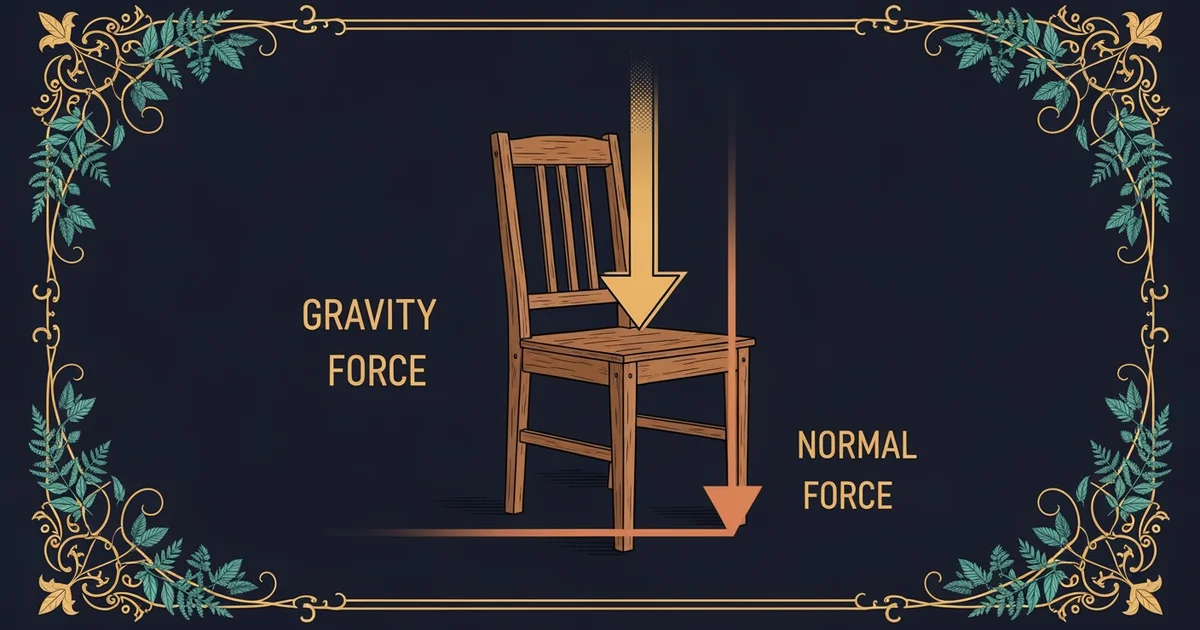
Every object in your home experiences gravity, which acts as a constant downward pull toward the center of the earth. This force gives your belongings weight and keeps your furniture pressed firmly against the solid floorboards. If gravity suddenly vanished, your books, chairs, and lamps would float away into the ceiling like balloons in a breeze. You can think of gravity like a strict landlord who demands that everything stays grounded at all times. This persistent force creates a stable environment where you can predict exactly where your items will remain when you return to a room.
Key term: Gravity — the fundamental force of attraction that pulls objects with mass toward the center of the planet.
To understand how this works, consider the way an object interacts with a surface. Gravity exerts a force of , where is the mass of the object and is the acceleration due to gravity. Because the table pushes back with an equal force, your mug stays stationary instead of falling through the wood. This balance of forces ensures that your domestic life remains predictable and safe throughout your busy day.
The Resistance of Surface Friction
While gravity pulls things down, friction acts as the silent mediator that prevents your objects from sliding away uncontrollably. Friction is the force generated when two surfaces rub against each other, creating resistance that opposes motion. Without this essential force, you would slide across your kitchen floor every time you tried to walk toward the refrigerator. It acts like a budget constraint in your personal economy, limiting how far things can move before they are forced to come to a complete stop.
When you place a heavy box on a rug, the tiny bumps on both surfaces interlock to hold the box in place. The following table highlights how different surfaces interact to create varying levels of resistance for your household items:
| Surface Type | Friction Level | Effect on Movement |
|---|---|---|
| Polished Tile | Very Low | Objects slide easily |
| Finished Wood | Moderate | Objects stay stable |
| Thick Carpet | High | Objects resist pushing |
These interactions are vital for maintaining order in your home. If you push a chair across a hardwood floor, the friction between the legs and the wood eventually slows the chair down until it stops. If you push that same chair across a rough carpet, the increased friction causes it to stop much faster. This resistance allows you to control the placement of your furniture and prevents your belongings from shifting every time you walk past them.
By observing these forces, you gain a better understanding of why your home looks and feels the way it does. Gravity creates the vertical structure of your life, while friction provides the horizontal stability needed for daily tasks. Together, these forces form the hidden framework that supports every single object you own. By the end of this path, you will possess a complete mental map of the physical laws governing your personal environment.