
Boundary Layer Dynamics
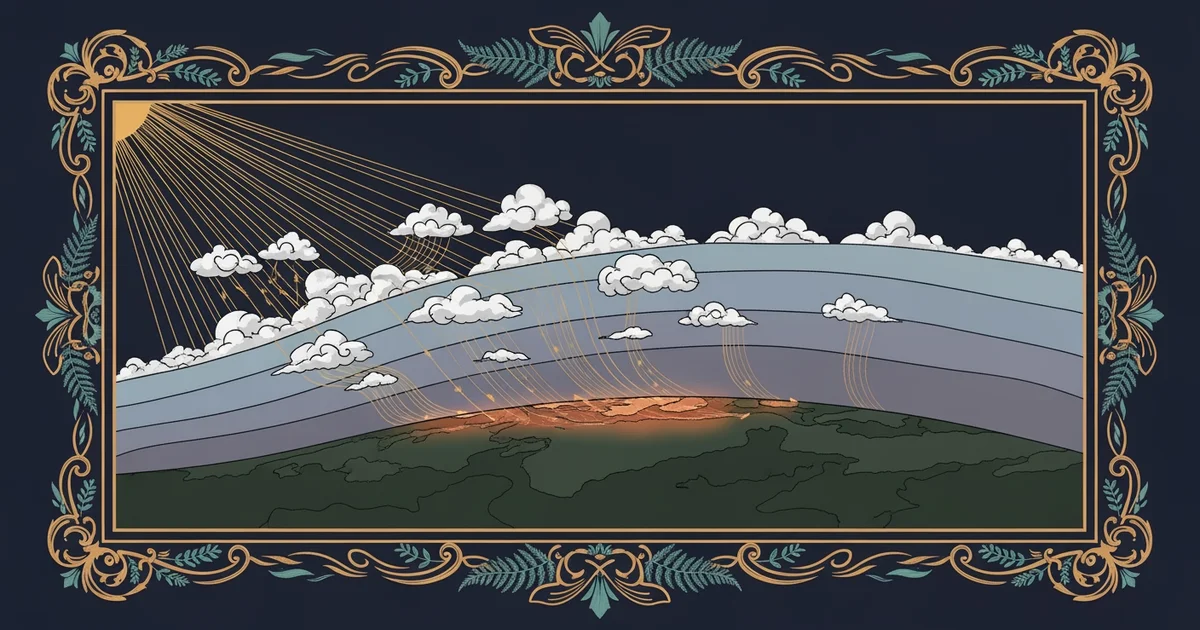
Imagine you are trying to run through a dense forest while wearing a large, heavy backpack. Your speed drops significantly because the trees and branches create constant resistance against your movement. This same phenomenon happens to air moving across the earth as it encounters obstacles like hills, buildings, and trees. These surface features create a region known as the boundary layer where wind speed changes drastically. The air near the ground feels a strong drag force from the rough surface below it. This friction prevents the air from moving as fast as the air high above the surface. Physics governs this interaction through the transfer of momentum between the moving gas and the solid ground. You can visualize this as a series of sliding layers where the bottom layer sticks to the ground while the top layers slide over it.
Understanding Surface Friction and Velocity
When air flows over a surface, the roughness of that surface dictates how much the wind slows down. A smooth surface like a frozen lake allows air to glide with very little friction. A dense city or a thick forest creates high levels of drag that disrupt the airflow significantly. This disruption is measured by the surface roughness length, which describes the height at which the wind speed effectively drops to zero. If you place a sensor near the ground, you will see the wind speed increase as you move higher up. This vertical change in wind velocity is called a wind profile. Engineers must account for this profile when they design tall structures or wind turbines. Without understanding these layers, our models of weather and energy production would fail to predict real conditions.
Key term: Boundary layer — the thin region of the atmosphere directly above the earth where surface friction significantly alters the speed and direction of wind flow.
To better understand how this works, think about a busy store during a sale. People walking near the exit must slow down because they bump into others or navigate around displays. People further away from the exit move much faster because they have a clear path without obstacles. The atmosphere acts the same way when it encounters the planet surface. Air molecules near the ground are like the shoppers near the exit who must slow their pace. Air molecules higher up are like the shoppers in the open aisle who move at full speed.
Measuring Wind Profiles and Dynamics
Scientists use specific mathematical tools to describe how wind speed changes at different heights above the ground. We often represent this relationship using a power law equation that links height to velocity. The equation is expressed as follows: . In this formula, represents the wind speed at a specific height , while is the reference speed. The exponent depends on the roughness of the terrain.
| Terrain Type | Roughness Value | Typical Wind Impact |
|---|---|---|
| Open Water | Very Low | Minimal drag effect |
| Grassland | Moderate | Predictable slowing |
| Dense Forest | High | Strong turbulence |
This table shows how different environments change the way wind behaves near the surface. You can see that higher roughness values lead to more significant energy losses for the wind. By studying these values, we can predict how much power a turbine might generate in a specific location. This knowledge helps us place energy infrastructure in areas where the wind is most consistent and reliable. The interaction between the atmosphere and the surface is a constant dance of energy exchange. Friction ensures that the air does not simply slide over the earth without any consequence. Every object on the ground plays a role in shaping the local climate and weather patterns.
The boundary layer acts as a friction-based filter that regulates the speed of air as it interacts with the physical features of the earth surface.
But what does it look like in practice when these waves travel through different fluid environments?