
The Greenhouse Effect Physics
Imagine you are wearing a thick wool blanket on a sunny afternoon while sitting outside. Even if the sun feels warm on your face, the blanket traps your body heat, making you feel much hotter than the air around you. The Earth experiences a similar phenomenon every single day because of the gases in our atmosphere. This process keeps our planet at a temperature that allows life to thrive instead of freezing in the vacuum of space. Understanding how this works requires us to look at the way energy moves through the air.
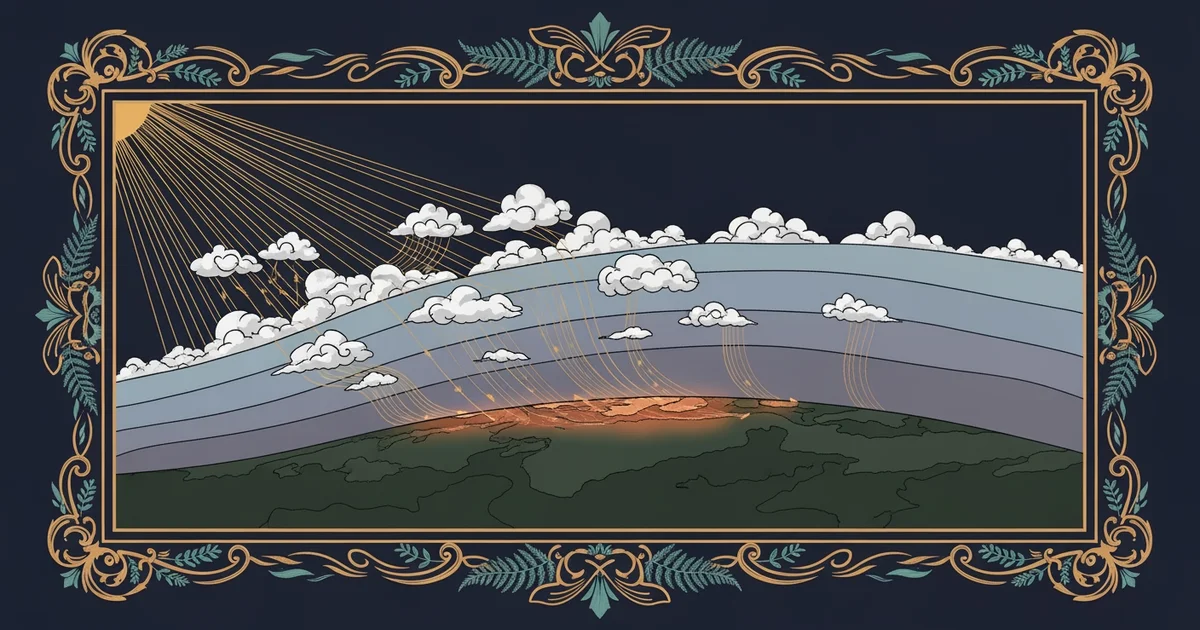
The Mechanism of Infrared Absorption
When sunlight reaches our planet, it travels as short-wave radiation that passes easily through the atmosphere. The surface of the Earth absorbs this light and warms up, then releases that energy back toward space. This outgoing energy is not visible light anymore, but rather infrared radiation, which we feel as heat. Certain gases in our atmosphere, such as carbon dioxide and methane, act like a one-way filter for this energy. They are transparent to incoming sunlight but opaque to the outgoing heat waves. These molecules absorb the energy, vibrate, and then release it in all directions, including back toward the ground.
Key term: Greenhouse effect — the process where atmospheric gases trap infrared heat near the surface of the planet.
This trapping of heat is essential for maintaining a stable climate on our world. Without these gases, the heat would simply escape into space, leaving the planet far too cold for most life forms. Think of the atmosphere like a smart thermostat in a large house. It allows energy to enter during the day but prevents too much of it from leaving at night. This balance is delicate because adding more of these gases changes how much heat the system can hold. If the blanket gets thicker, the planet must warm up to push enough heat out to match the energy coming in.
Comparing Energy Wavelengths
To understand this process better, we must distinguish between the types of light involved in the cycle. Sunlight consists mostly of visible light, which carries high energy and short wavelengths that zip through the air. In contrast, the Earth emits lower energy radiation that has much longer wavelengths. The following table highlights the differences between these two types of energy and how they interact with our atmosphere.
| Energy Type | Source | Wavelength | Atmospheric Interaction |
|---|---|---|---|
| Visible Light | The Sun | Short | Passes through easily |
| Infrared Heat | Earth Surface | Long | Absorbed by gases |
| Ultraviolet | The Sun | Very Short | Blocked by ozone layer |
This interaction happens because of the physical structure of molecules in the air. When an infrared photon hits a molecule like carbon dioxide, the molecule begins to bend and stretch. This movement is a physical manifestation of the energy being captured. The molecule then sends that energy in a random direction, which often means it heads back down to the surface. This constant cycle of absorption and re-emission is what maintains the warmth we experience every day.
It is important to remember that this is a natural process that has supported life for millions of years. The physics of these molecules is fixed, meaning they will always react to infrared energy in this specific way. By studying these interactions, we gain a clear picture of how our planet manages its energy budget. We can observe these patterns using sensors that detect heat signatures from space. These measurements confirm that our atmosphere is indeed acting like a thermal blanket for the entire globe.
The greenhouse effect occurs because specific atmospheric gases trap outgoing infrared heat while letting incoming sunlight pass through to the surface.
The next Station introduces Convection and Heat Transfer, which determines how air currents move this trapped energy around the planet.