
Convection and Heat Transfer
Imagine a hot air balloon rising slowly into the sky while the ground below stays cool and still. This silent dance of rising gas happens because of the way energy moves through our atmosphere every single day.
The Mechanics of Buoyancy
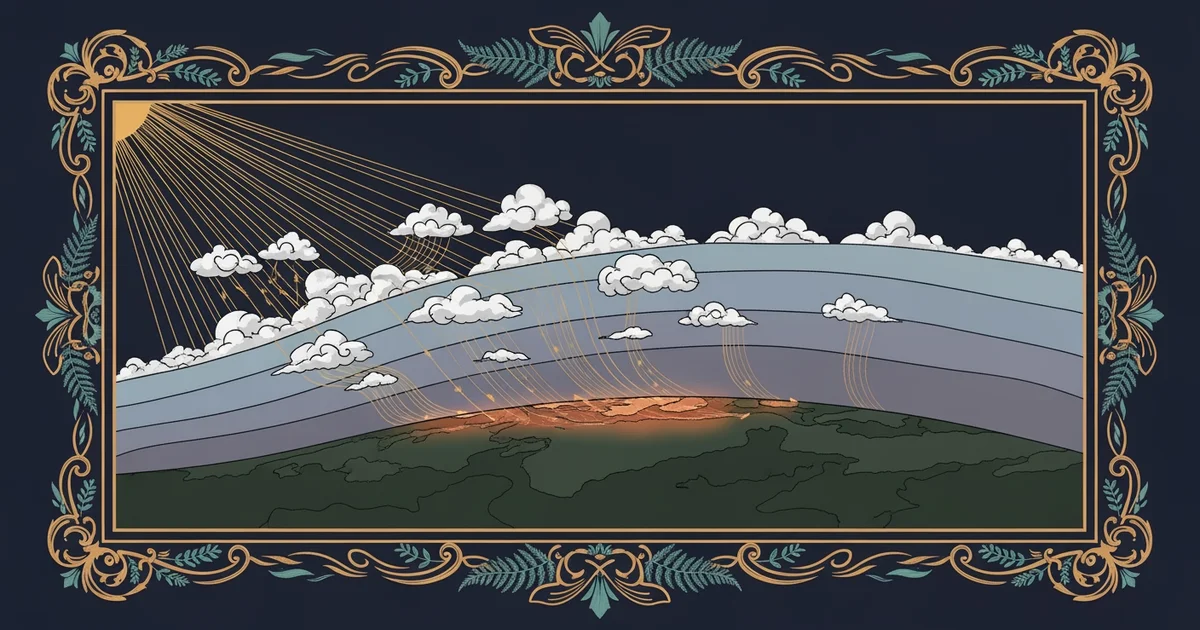
Heat transfer through moving liquids or gases is known as convection. This process happens when a fluid becomes warm and starts to move upward due to lower density. When air molecules near the warm surface absorb energy, they vibrate faster and push each other further apart. Because the same number of molecules now occupies a larger space, the air becomes lighter than the cooler air sitting above it. This difference in density creates an upward force called buoyancy that drives the air toward the cooler upper atmosphere. Think of this like a crowded room where people start moving around to find more space; they naturally spread out until the crowd becomes less dense than the surrounding area. This movement is the primary way that heat travels vertically through the thick layers of our planet's atmosphere.
Key term: Convection — the transfer of thermal energy through the physical movement of a fluid or gas caused by density differences.
Surface Heating and Large Scale Flow
Large scale convection currents form when the sun heats the Earth's surface unevenly across different regions. Dark surfaces like asphalt or deep soil absorb much more solar radiation than light surfaces like ice or water. As these surfaces warm up, they transfer that energy to the thin layer of air resting directly on top of them. This localized heating creates a bubble of warm air that eventually breaks away and rises high into the sky. As this air rises, it begins to cool down and eventually sinks back toward the surface to repeat the cycle. This creates a continuous loop of movement that transports heat from the ground to the higher parts of the sky. We can compare this cycle to a conveyor belt in a factory that moves raw materials from one side of the building to the other side. The air acts as the belt, constantly carrying thermal energy away from the surface to keep the lower atmosphere in a state of balance.
| Process Stage | Physical Action | Resulting Effect |
|---|---|---|
| Surface Absorption | Solar energy hits ground | Ground temperature rises |
| Air Expansion | Molecules spread apart | Density of air decreases |
| Buoyant Ascent | Lighter air moves up | Heat moves to atmosphere |
| Cooling Cycle | Air loses heat energy | Air becomes dense and sinks |
This cycle of heating and cooling happens constantly across the entire surface of the planet. The movement is essential for regulating global temperatures and distributing heat from the equator toward the polar regions. Without these massive convection cells, the equator would be far too hot for life while the poles would remain frozen solid. The efficiency of this heat transfer depends on the temperature difference between the surface and the air above it. When the gap in temperature grows larger, the speed of the convection current increases to compensate for the imbalance. This process also plays a major role in shaping our daily weather patterns by moving moisture and energy across vast distances. Understanding these currents helps scientists predict how changes in surface temperature might alter our climate over long periods of time.
Convection acts as a natural engine that transports heat from the Earth's surface to the upper atmosphere through the movement of buoyant, low-density air.
The next Station introduces Phase Changes in Water, which determines how thermal energy is stored and released during evaporation and condensation.