
Crystal Lattice Structures
Imagine walking through a massive, perfectly organized warehouse where every single shipping crate sits in an identical, repeating position. If you shift your view even slightly, the pattern remains exactly the same because the structure is perfectly uniform across the entire space. This visual regularity is how scientists describe the microscopic architecture of solid materials like metals and salts. These materials are not just random clumps of matter, but highly ordered systems held together by strong, invisible bonds. Understanding these patterns helps us predict how materials will behave when we bend, heat, or stretch them in our daily lives.
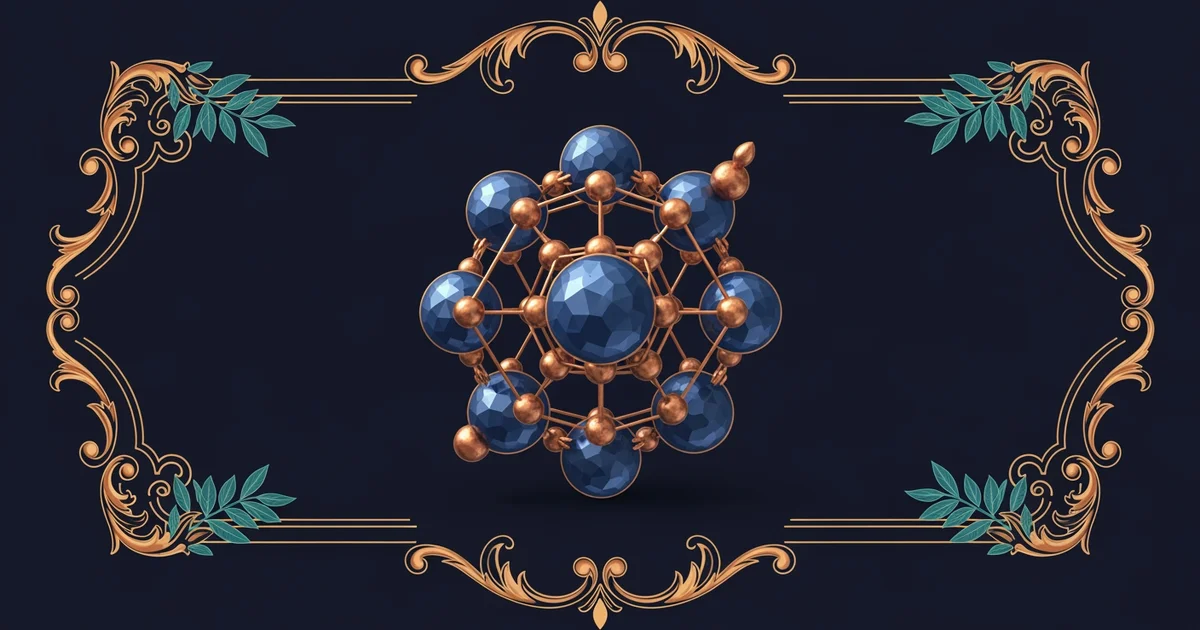
The Geometry of Atomic Order
When atoms arrange themselves into a solid, they often form a crystal lattice, which acts as a repeating three-dimensional grid of points. Think of this lattice like a massive brick wall where every single brick occupies a specific, predictable coordinate in space. In this analogy, the individual atoms function as the bricks, while the empty space between them represents the bonds that keep the structure stable. This specific arrangement determines the physical properties of the material, such as how hard it feels or how well it conducts electricity. If the atoms were arranged in a messy, chaotic pile, the material would lack the strength and predictable nature that we observe in common metals like copper or iron.
Key term: Crystal lattice — a highly ordered, repeating geometric arrangement of atoms or molecules that defines the internal structure of a solid material.
Because these structures repeat perfectly, we describe them using a smaller, repeating unit known as the unit cell. You can imagine the unit cell as the smallest possible box that contains all the information about the entire crystal system. By studying just one unit cell, scientists can understand the properties of the entire object, whether it is a tiny grain of sand or a massive steel beam. This efficiency allows physicists to model complex materials without needing to map out every single atom in the entire sample. The symmetry within these cells is what gives crystalline materials their sharp edges and flat faces.
Symmetry Types in Metallic Elements
Many simple metallic elements rely on specific, highly symmetrical arrangements to maintain their structural integrity under various pressures. These metals typically follow one of three primary patterns, which dictate how densely the atoms are packed together within the material. The way these atoms pack determines if a metal will be soft and malleable or hard and brittle. By identifying these patterns, engineers can choose the right materials for building bridges, airplanes, or tiny electronic components. The following table highlights the common types of symmetry found in these simple, repeating metallic structures:
| Lattice Type | Arrangement Description | Packing Efficiency |
|---|---|---|
| Simple Cubic | Atoms at corners of a cube | Very low density |
| Body-Centered | Atoms at corners plus center | Moderate density |
| Face-Centered | Atoms at corners plus faces | Very high density |
These patterns are not just theoretical shapes, but physical realities that force atoms into specific locations. In a face-centered structure, for example, the atoms are packed as tightly as possible to maximize the strength of the metallic bonds. This high density is why some metals feel much heavier and more solid than others when you hold them. If you were to zoom in on a piece of pure gold, you would see this face-centered pattern repeating millions of times in every direction. This extreme level of order is what allows us to shape and manipulate metals into the complex tools we use every single day.
The structural integrity of solid materials arises from the repeating, highly symmetrical geometric patterns of atoms known as crystal lattices.
The next Station introduces electron energy bands, which determine how these lattice structures influence the flow of electricity through a solid.