
Acoustic Reflection Mechanics
Imagine you are standing in a large, empty stone cathedral while clapping your hands loudly. You notice the sharp sound does not stop immediately but instead lingers in the air for several seconds. This lingering effect happens because sound waves behave like bouncy balls hitting hard surfaces inside an enclosed space. When you understand how these waves bounce, you can predict how a room will sound before you even build it.
The Physics of Sound Travel
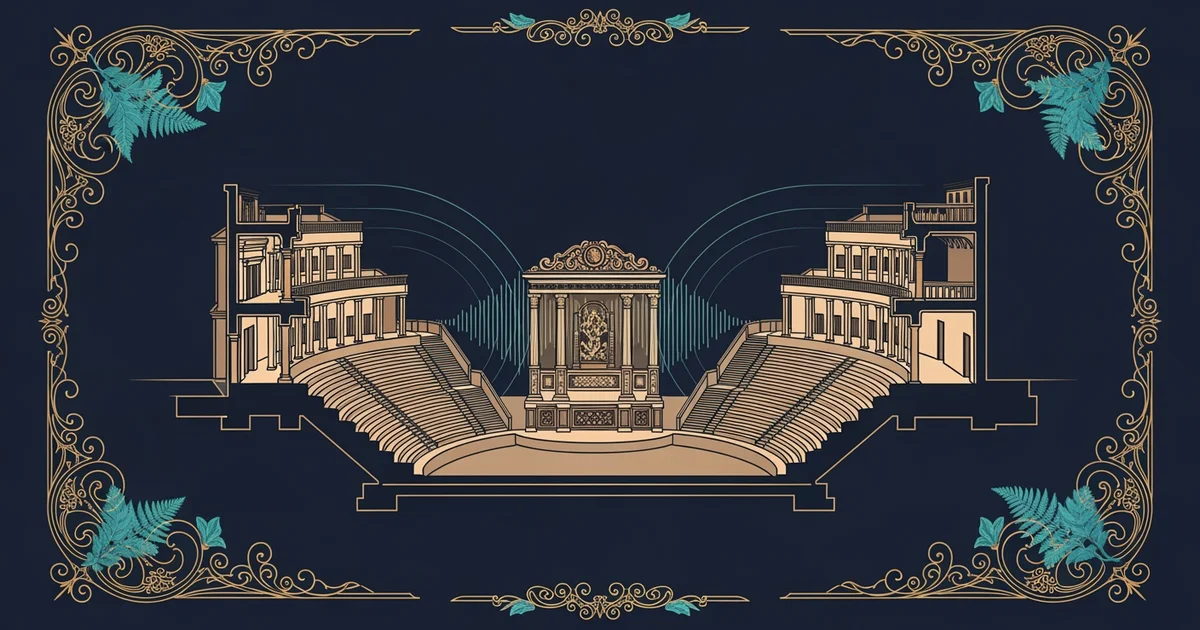
Sound travels through the air as invisible waves that expand outward from a source like ripples in a pond. When these waves strike a wall, floor, or ceiling, they do not simply vanish into the structure. Instead, the energy of the sound wave undergoes acoustic reflection, where the wave bounces off the surface like a mirror reflecting light. Hard, flat surfaces like concrete or glass reflect almost all the sound energy back into the room. This creates an environment where sounds overlap and become muddy because the original note is still bouncing around when the next one arrives.
Think of this process like an economy where sound energy is currency being spent within a room. If the walls are hard and reflective, the sound energy stays in the room and keeps circulating, which makes the space feel loud and crowded. If the walls are soft and absorbent, they act like taxes that pull energy out of the system, leaving the room feeling quiet and controlled. You must balance these reflective surfaces with absorbent ones to ensure the audience hears a clear performance rather than a chaotic wall of noise.
Controlling Reflection Patterns
Designers use specific materials to manage how sound waves behave in a performance venue to ensure clarity for every listener. By placing reflective panels at specific angles, they can direct sound toward the audience rather than letting it scatter randomly. This technique is often used to boost the volume of a speaker or a singer without using any electrical amplification. The following table shows how different surface materials typically influence the sound energy within a performance space:
| Material Type | Reflective Quality | Typical Usage |
|---|---|---|
| Polished Stone | Extremely High | Reflecting sound to the back of a hall |
| Heavy Velvet | Very Low | Absorbing echoes to prevent muddiness |
| Perforated Wood | Moderate/Diffusing | Scattering sound to soften sharp peaks |
When sound waves hit a surface, their behavior follows a simple rule that mirrors the geometry of light. The angle at which the sound wave hits the wall is exactly the same as the angle at which it bounces away from that wall. This concept, known as the law of reflection, allows architects to map out exactly where sound will travel after it leaves the stage. If the walls are curved, they can focus sound into a single point, which might create a "hot spot" where the audio is far too loud for the listener.
Sound reflection management involves several key strategies to ensure the acoustic environment supports the performance:
- Hard surfaces are positioned to bounce sound toward the seating area, ensuring that energy is preserved and directed to the audience instead of being lost in the rafters.
- Soft materials are applied to the back walls to prevent sound from bouncing back toward the stage, which stops the performer from hearing an annoying echo of their own voice.
- Diffusing panels are used to break up large sound waves, which prevents the build-up of standing waves that can cause certain musical notes to sound unnaturally loud or distorted.
By carefully choosing the materials for each surface, designers can sculpt the sound of a room to match the needs of the performance. A space designed for a choir needs different reflection patterns than a room designed for a fast-paced rock concert, as the choir needs the room to add depth and sustain to their voices. Managing these reflections allows the venue to act as an instrument that enhances the quality of the live art experience for everyone in the room.
Managing acoustic reflection allows designers to control how sound energy travels through a space to ensure clarity and balance for the audience.
Since we can control where sound waves go using reflection, how do we use geometry to make sure every single person in the room has a clear view of the stage?
Want this with sources you can check?
Premium Learning Paths for Music & Performing Arts are researched against open-access libraries — PubMed, arXiv, government databases, and more — with their distinctive claims cited to real sources and independently checked.
See what Premium includes