
The Web of Everything
Imagine your morning coffee ritual involves a complex chain of farmers, shippers, roasters, and local shop baristas. Each person represents a single point in a vast, invisible structure that keeps your cup full. You are not just drinking coffee; you are participating in a massive system of connections that spans the globe. This simple daily habit acts as a tiny window into the complex web that defines our modern existence. Understanding these patterns reveals how small actions ripple outward to create global outcomes that touch every single human life.
The Anatomy of Connected Systems
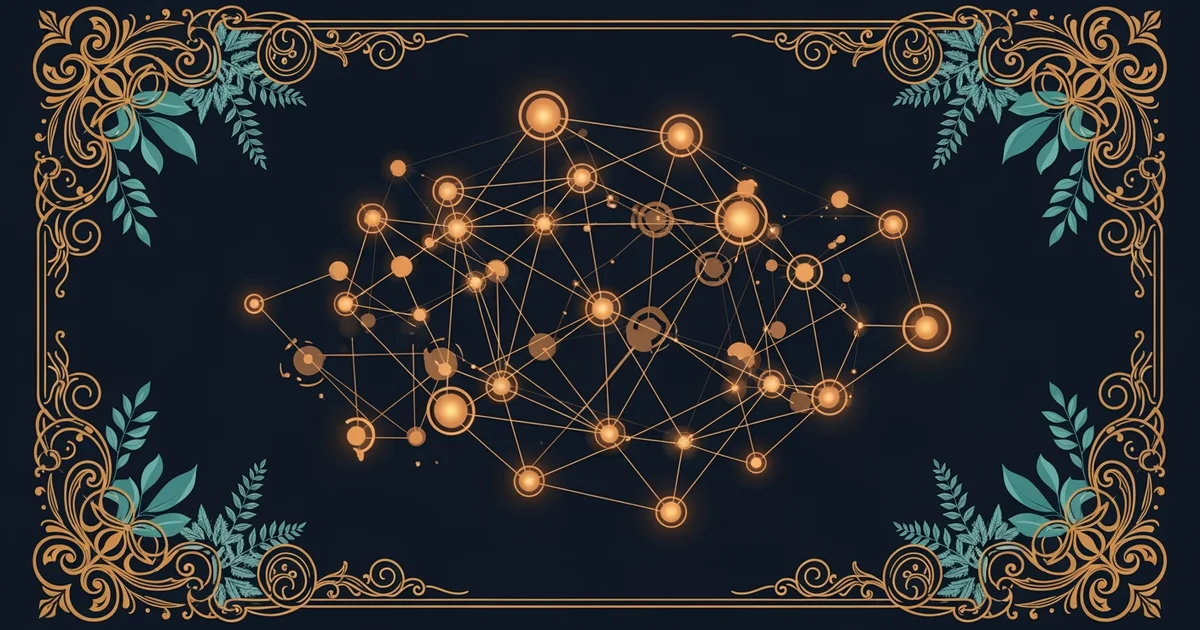
Every large network consists of two fundamental parts that work together to create structure. We call these individual entities nodes, which represent the people, computers, or physical locations within the system. Connecting these nodes are the links, which represent the relationships, data cables, or transit routes that bind them together. Think of a subway map where stations are the nodes and the colored tracks are the links. Without the links, the stations are just isolated points on a map with no way to travel between them. Without the nodes, the tracks have nowhere to go and serve no purpose for the passengers.
Key term: Network — a collection of nodes and links that represent how parts of a system interact.
When we look at these systems, we observe how the arrangement of links changes the way information moves. In a simple chain, information must pass through every single node to reach the final destination. If one node breaks, the entire chain fails and the message stops moving forward entirely. However, most real systems use a mesh structure where many links exist between nodes to prevent total failure. This design ensures that if one path is blocked, the system finds another route to keep the data flowing. This resilience is exactly why the internet remains stable even when specific servers go offline during a busy day.
Visualizing Complex Patterns
To see how these connections function, we must compare the different ways that nodes can be linked. The following table highlights the primary ways that systems organize their internal connections for better efficiency:
| Network Type | Link Structure | Primary Benefit | Common Example |
|---|---|---|---|
| Centralized | Single hub | Simple control | Airport hubs |
| Decentralized | Multiple hubs | High stability | Power grids |
| Distributed | All connected | Total redundancy | Peer networks |
When you analyze these structures, you quickly realize that the density of links determines the strength of the system. A system with very few links is fragile and prone to breaking under minor stress. Conversely, a system with high connectivity can handle massive amounts of traffic without slowing down or collapsing. This balance between node count and link density explains why cities grow in specific patterns based on road and transit access. When more roads are added, the city becomes more connected and creates more opportunities for local trade and movement.
Consider how your own social circle functions as a personal network of nodes and links. You are a node, and your friends are nodes connected to you by links of shared history. When you introduce two friends to each other, you are effectively creating a new link in the network. This simple act changes the structure of your group and allows information to flow much faster than before. These small, daily adjustments to your personal web are exactly how large-scale social trends begin and spread across the wider population. By studying these basic rules of connection, you gain the power to understand how everything from viral videos to global economies functions.
Simple connections between individual nodes create complex patterns that dictate how information and resources flow across our world.
By mastering these foundational concepts, you will gain the tools to map and analyze the invisible networks that shape your future.