
Evolution of Written Communication
You check your phone to see a quick text message from a friend across town. This simple act relies on thousands of years of human progress in recording our thoughts.
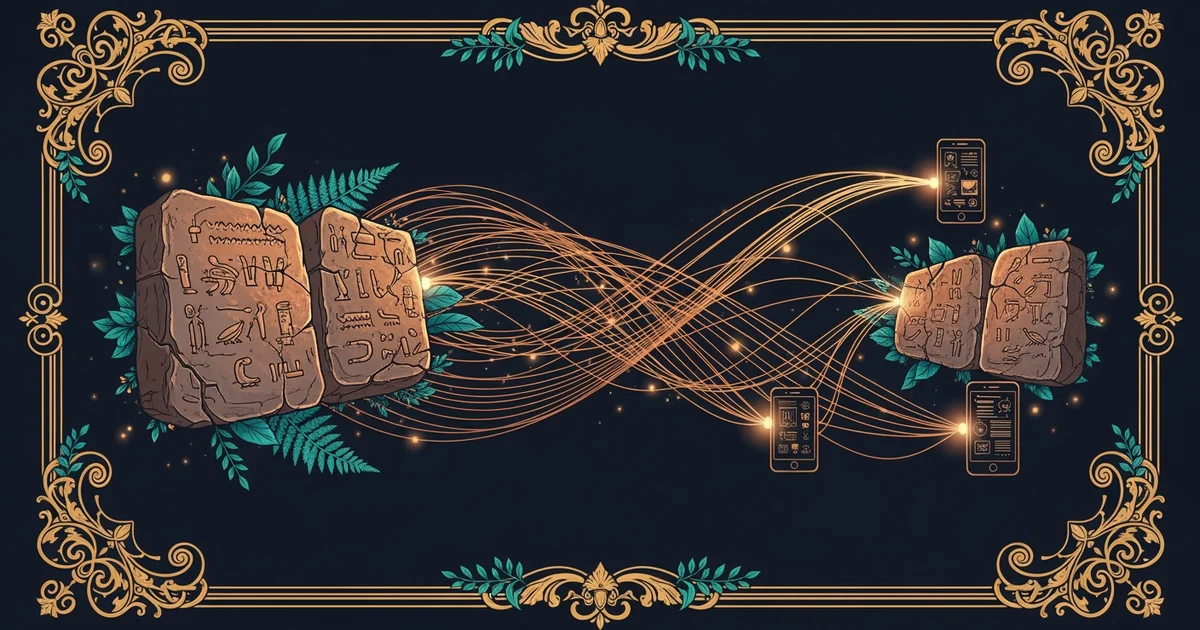
The Shift from Physical to Digital
Human communication began with spoken words that vanished the moment they left our lips. Early humans needed a way to preserve information beyond their own limited memory spans. They turned to pictographs which acted like tiny pictures representing objects or simple actions. These carvings on cave walls allowed people to share knowledge across different generations without needing to be present. This transition from sound to sight fundamentally changed how our species stores and shares complex ideas. Think of this process like saving a file to a permanent drive instead of keeping data only in your computer's temporary memory. When you write something down, you essentially externalize your cognitive load to free up space for new thoughts.
As societies grew more complex, simple pictures could no longer capture the nuance of laws or trade. Humans developed cuneiform scripts to represent specific sounds rather than just concrete objects or basic ideas. This innovation allowed for the recording of abstract concepts like justice, time, or complex mathematical calculations. By moving toward phonetic symbols, people could record any spoken word with much higher precision. This shift was a massive leap forward in our ability to organize large groups of people efficiently.
Key term: Cuneiform — an ancient system of writing that uses wedge-shaped marks to represent sounds and concepts.
Tools and the Evolution of Thought
Every new tool for writing changes the way we interact with information and our peers. We can categorize these historical leaps by looking at how the medium dictates the message.
| Medium | Primary Use | Impact on Society |
|---|---|---|
| Stone | Permanent records | Established lasting laws |
| Papyrus | Portable letters | Enabled trade and diplomacy |
| Digital | Instant sharing | Created global communication networks |
The digital environment we inhabit today acts as a massive amplifier for our collective human voice. When we use digital tools, we are not just writing; we are participating in a global conversation.
- Digital Encoding allows us to transmit vast amounts of data across the world in milliseconds.
- Interactive Platforms enable us to edit and refine our messages in real time with others.
- Cloud Storage ensures that our written legacy remains accessible from any location on the planet.
These advancements mean that the barrier to entry for sharing ideas has never been lower. We no longer need to carve rocks to leave a mark on the world around us. Instead, we use light and electricity to send our thoughts instantly to anyone with a screen. This speed changes our expectations for how quickly we should receive information and respond to others. We have moved from a world of slow, deliberate record-keeping to one of rapid, fluid interaction. Understanding this history helps us see that our current digital habits are just the latest chapter in a long story. We are not just using technology; we are constantly shaping how we think through the tools we choose to use.
The evolution of writing is a transition from storing information in our limited human memory to using external tools that expand our cognitive capacity.
By the end of this path, you will understand how digital spaces influence the way we communicate and process information in our modern lives.