
Structural Kinematics Integration
Imagine you are wearing a heavy backpack that slides around your shoulders while you walk. If the straps do not align with your actual joints, the weight pulls your body in directions it was not meant to move. Wearable robotics face this same challenge when connecting a rigid frame to a moving human limb. If the machine pivot does not match your biological joint, the metal frame fights against your bones. This constant struggle creates friction, discomfort, and potential injury for the person wearing the mechanical suit.
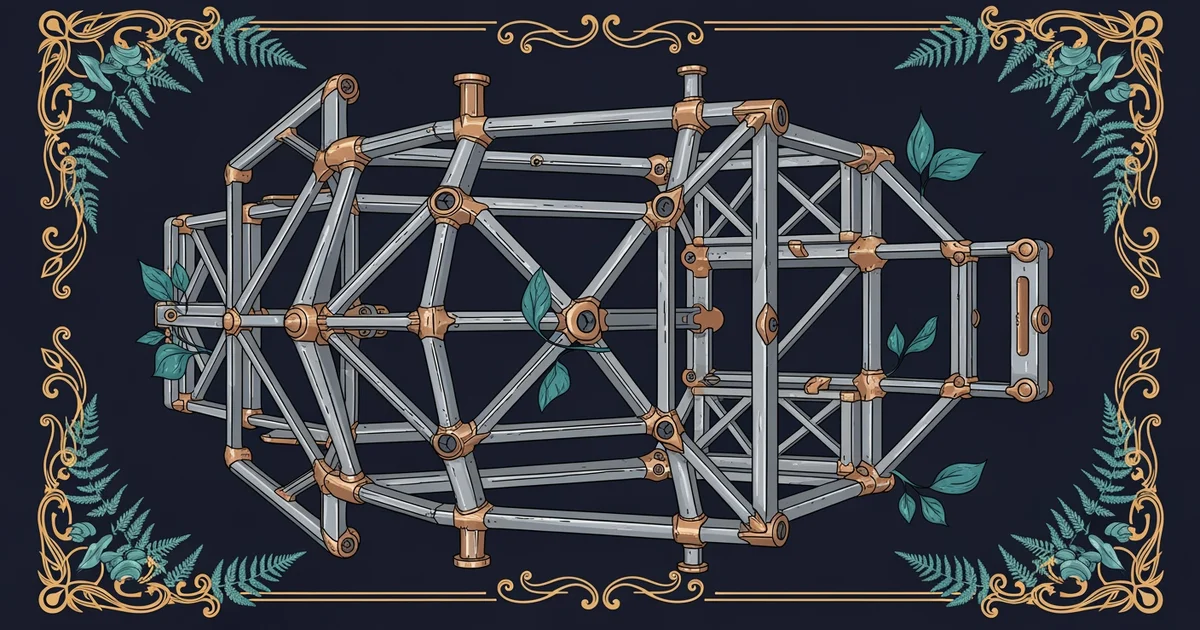
Aligning Mechanical and Biological Pivots
When engineers design these exoskeletons, they must achieve precise structural kinematics integration to ensure the machine moves with the user. Your knee is not a simple hinge because it slides and rotates slightly as you bend your leg. If a robot hinge is perfectly fixed in one spot, it will push your leg out of its natural path. Engineers solve this by using floating pivot points that mimic the complex motion of human anatomy. By accounting for the shifting center of rotation, the suit stays in sync with your limbs during every step. Think of this like a well-fitted suit jacket that allows you to reach forward without the fabric pulling at your back. If the shoulder seams of the jacket do not match your own shoulders, you feel restricted and stiff. A robotic suit must offer that same freedom of movement so the user can focus on the task rather than the machine.
Key term: Structural kinematics integration — the process of aligning robotic joint axes with human skeletal joints to ensure natural and fluid movement.
To manage this alignment, designers use specific mechanical features that allow for minor adjustments during active use. These features ensure that the suit remains comfortable even as the user changes their posture or speed. The following list outlines how engineers maintain this vital connection between the machine and the human body:
- Self-aligning joints use sliding tracks to shift the axis of rotation as the human limb moves through its full range of motion.
- Flexible load-bearing links act as shock absorbers that compensate for slight misalignments between the metal frame and the wearer's bone structure.
- Adjustable tension straps secure the frame to the body to prevent the suit from slipping or shifting away from the intended joint center.
Optimizing Kinematic Performance
Once the joints are aligned, the system must maintain this state while the user performs demanding physical tasks. If the frame shifts during heavy lifting, the user loses efficiency and feels the weight of the suit. Engineers use a combination of rigid materials and soft interfaces to keep the frame locked in its optimal position. This balance keeps the mechanical power transfer direct and smooth, which reduces the effort required by the human wearer to operate the device. When the kinematics are perfectly integrated, the suit feels like an extension of the body rather than an external load.
| Feature | Purpose | Benefit to User |
|---|---|---|
| Sliding Pivot | Mimics natural joint shift | Reduces joint pressure |
| Soft Padding | Distributes mechanical force | Increases daily comfort |
| Rigid Struts | Supports external weight | Prevents muscle fatigue |
By monitoring the way the frame interacts with the body, engineers can refine the design to suit different leg lengths and body shapes. This customization is essential because no two people have the exact same skeletal geometry. If the frame is too long or too short, the pivot points will drift away from the biological joint. When this drift occurs, the mechanical advantage of the suit decreases because the force is no longer applied in the most efficient direction. By testing these alignments in various scenarios, engineers ensure that the suit remains a helpful tool rather than a restrictive barrier to natural human motion.
Successful exoskeleton design relies on matching the mechanical rotation points of the device with the complex, shifting nature of human joints.
But what does it look like when we choose the materials that connect these joints to the rest of the suit?
Want this with sources you can check?
Premium Learning Paths for Engineering & Robotics are researched against open-access libraries — PubMed, arXiv, government databases, and more — with their distinctive claims cited to real sources and independently checked.
See what Premium includes