
Remote Area Microgrids
In 2021, the remote village of Ocracoke Island faced a total grid failure after a major storm severed the main undersea transmission line. Because the island relied entirely on a single cable from the mainland, the entire community lost electricity for several days while repair crews struggled to reach the site. This failure highlights the fragility of centralized power systems when they operate in isolation from the main grid infrastructure. We must design better systems to prevent such disasters by using local power resources that function independently during emergencies. This is the core concept of microgrids from Station 11 working in real conditions to ensure local resilience.
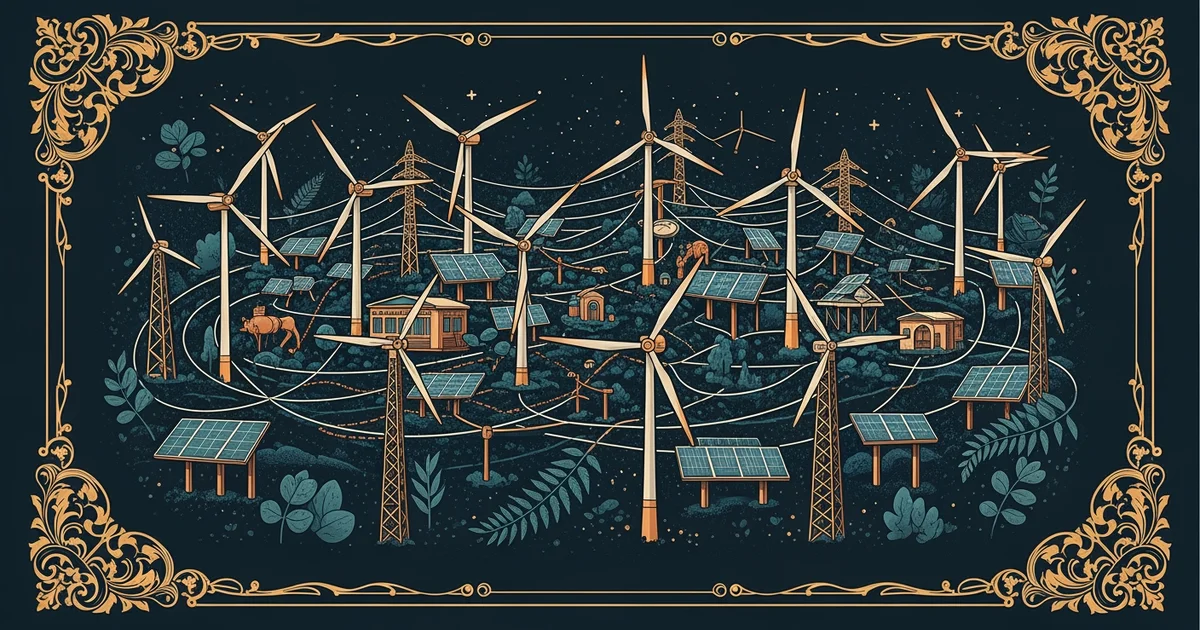
Designing Autonomous Power Systems
When engineers design a remote microgrid, they must prioritize local energy generation to ensure the system remains stable without external help. An isolated microgrid acts like a small, self-contained bank account where the community only spends the energy that it earns through local production. If the local production drops, the system must immediately reduce non-essential power usage to prevent a total collapse of the grid voltage. Engineers use an energy management system to balance these supply and demand fluctuations by constantly monitoring real-time data from solar panels and battery storage units. By automating these decisions, the system maintains a steady flow of electricity to critical infrastructure like hospitals and water pumps even when the main connection remains down.
To understand how these systems balance power, consider the analogy of a household budget during a sudden job loss. Just as a family must stop buying luxury items to save money for food and rent, a microgrid must cut power to non-essential loads during a generation deficit. The system prioritizes essential services to keep the community safe while it waits for renewable sources like wind or solar to recharge the batteries. This process requires precise control software that can disconnect secondary circuits in milliseconds to preserve the remaining energy for the most important needs.
Infrastructure Components and Control Logic
Building a robust microgrid requires specific hardware components that work together to manage energy flows across the local area. These systems rely on three primary technologies to function effectively in remote locations where maintenance teams cannot easily visit for repairs.
- Battery energy storage systems provide the necessary buffer to smooth out the variable output of solar and wind energy sources, ensuring that electricity remains available even when the sun sets or the wind stops blowing.
- Smart inverters convert the direct current produced by solar panels into the alternating current used by household appliances, while also communicating with other grid components to adjust voltage and frequency levels in real time.
- Automated transfer switches act as the gatekeepers of the microgrid, physically disconnecting the local system from the main grid during a failure to prevent damage and allowing the local system to operate in isolation.
| Component | Primary Function | Operational Role |
|---|---|---|
| Solar Array | Energy Capture | Primary generation source |
| Battery Bank | Energy Storage | Load balancing and backup |
| Controller | System Logic | Decision making and safety |
These components allow a microgrid to function as an independent island of power, which is essential for remote regions that cannot rely on a central utility company. The controller acts as the brain of the operation, receiving signals from sensors and directing the power flow to ensure that the battery banks never drop below a critical threshold. By using these modular parts, engineers can scale the system to meet the specific energy needs of any remote population, regardless of their geographic location or the availability of traditional fuel sources.
Key term: Microgrid — a localized grouping of electricity sources and loads that normally operates connected to a traditional grid but can disconnect to function autonomously.
Reliable remote power requires autonomous control systems that prioritize essential loads while balancing local energy generation with storage capacity.
But this model breaks down when the system faces prolonged weather events that deplete all available battery reserves.