
Global Supply Chains
When you pick up a smartphone, you hold a complex puzzle of parts sourced from across the entire globe. Each tiny component travels thousands of miles before reaching your hands in a local retail store today. This intricate journey represents the modern global supply chain, a vast network connecting raw material suppliers to final consumers. Understanding how these pieces move helps explain why some regions thrive while others struggle to keep pace with demand. Businesses must coordinate these flows across borders to ensure that products arrive exactly when and where they are needed most.
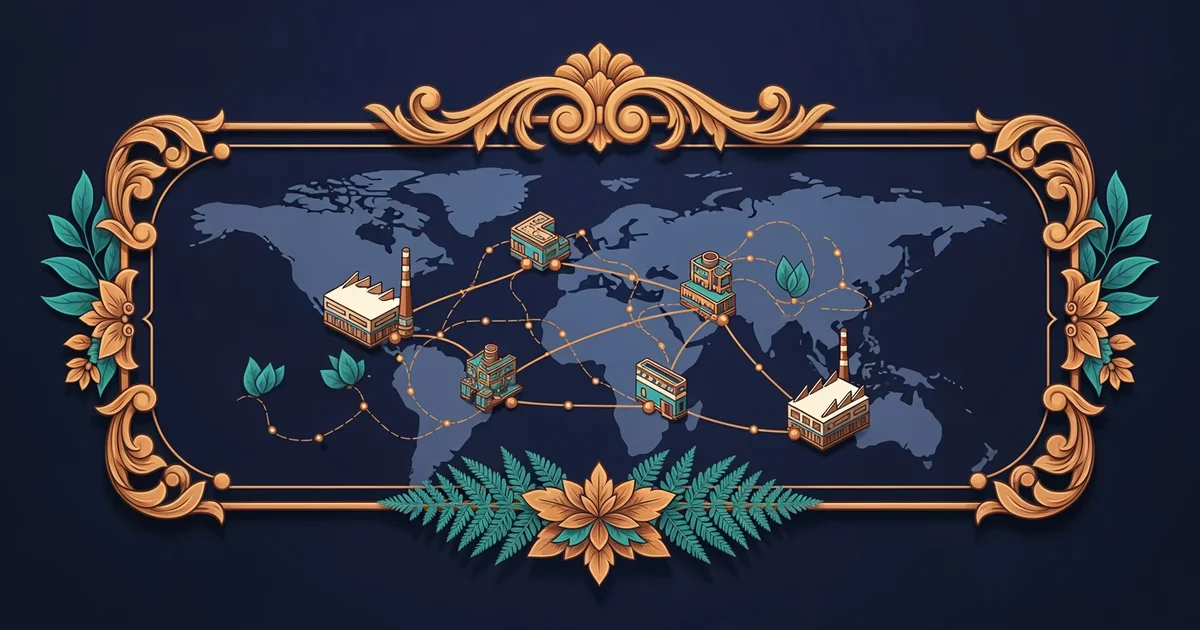
Mapping International Production Networks
Companies build these networks by breaking down production into smaller, manageable tasks located in different countries. A single product might have its design finalized in one nation, its parts manufactured in another, and final assembly completed elsewhere. Think of this process like a professional kitchen where different chefs handle specific duties to prepare a large banquet. One team chops vegetables while another prepares the main course, ensuring that everything is ready for service at the exact same moment. If one chef fails to deliver their portion on time, the entire meal plan suffers because the timing is critical to success.
Key term: Global supply chain — the interconnected system of organizations, people, activities, and resources involved in moving a product from origin to the final consumer.
This division of labor allows firms to lower costs by placing specific tasks in regions with the best resources. Factories often cluster in areas that offer low labor costs or proximity to raw materials like steel or plastic. By leveraging these regional advantages, companies can produce goods more efficiently than if they tried to do everything in one place. These decisions are not random but follow strict economic logic to maximize output while minimizing the total cost of production. Managing these long-distance connections requires advanced technology to track every single movement of parts across oceans and borders.
Visualizing Trade Flows and Logistics
Trade flows act as the arteries of the global economy, carrying goods between nations through a series of complex logistical nodes. Major ports, airports, and rail hubs serve as critical checkpoints where goods change hands or modes of transport before continuing their journey. These hubs must operate with extreme precision because even minor delays can cause massive backups throughout the entire system. Understanding these flows requires looking at how raw materials move from extraction sites to factories and finally to warehouses.
To manage this complexity, firms rely on specific strategies to keep their operations running smoothly:
- Just-in-time delivery systems minimize storage costs by ensuring that parts arrive at the factory floor only when they are needed for assembly, reducing the need for expensive warehouse space.
- Multi-modal transport networks combine ships, trains, and trucks to ensure that goods move across different terrains and oceans efficiently, optimizing the speed and cost of every single leg.
- Digital tracking platforms provide real-time data on the location of every shipping container, which allows managers to adjust their plans instantly if a storm or strike disrupts a scheduled route.
These strategies ensure that the global market remains stable even when faced with unexpected disruptions or sudden shifts in consumer demand. The efficiency of these networks determines which regions gain wealth by acting as essential hubs in the global trade landscape.
| Transport Mode | Best Use | Main Benefit |
|---|---|---|
| Ocean Freight | Bulk goods | Lowest cost |
| Air Cargo | High value | High speed |
| Rail/Trucking | Last mile | Flexibility |
This table shows how companies choose different ways to move items based on the type of product and the urgency of delivery. High-value electronics often fly by air to avoid long delays, while heavy raw materials travel by sea to keep total costs low. Every choice reflects a balance between speed and expense, which dictates the final price of the item you buy. When these systems work well, they create wealth by connecting local production to the massive global market.
Wealth creation in modern economics depends on how effectively a region integrates itself into the logistical networks that move goods across international borders.
But what does it look like in practice when these networks face a sudden disruption or failure? This content is educational only and does not constitute financial or investment advice.
Want this with sources you can check?
Premium Learning Paths for Economics & Finance are researched against open-access libraries — PubMed, arXiv, government databases, and more — with their distinctive claims cited to real sources and independently checked.
See what Premium includes