
The Invisible World of Microbes
You brush your teeth every single morning, yet you share your mouth with millions of tiny, unseen inhabitants. These living entities exist everywhere around you, from the air you breathe to the very soil beneath your feet.
The Diversity of Microscopic Life
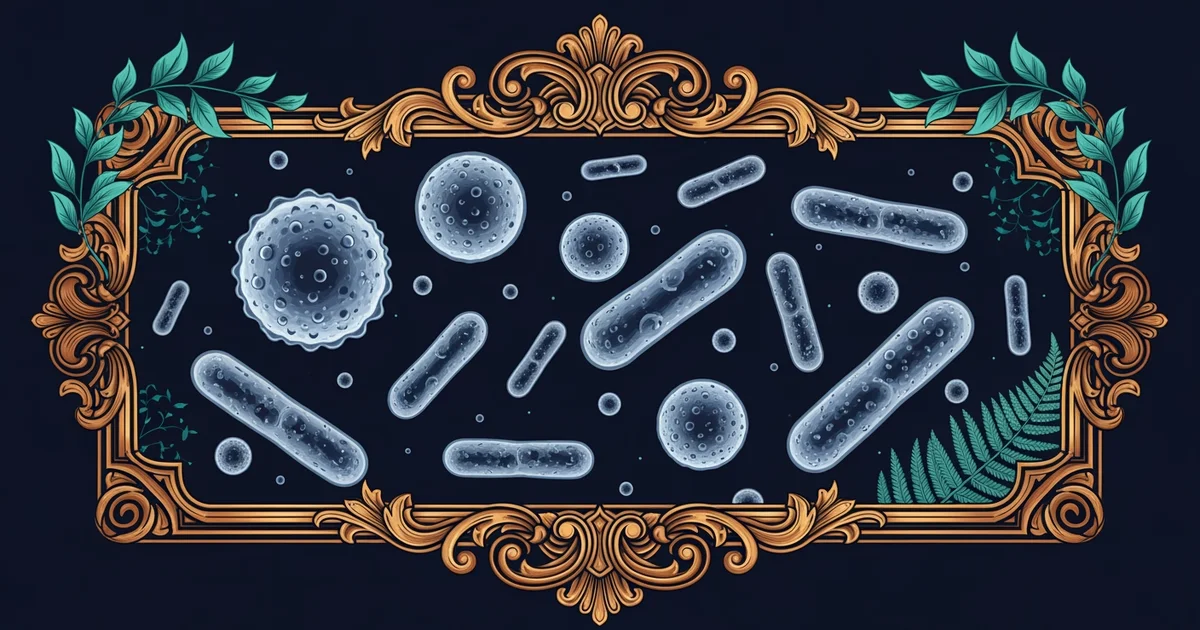
Microbes are small organisms that you cannot see without using a powerful lens or a microscope. You might think of them as simple, but they represent a vast range of complex life forms. The primary groups include bacteria, viruses, fungi, and protists, each with unique ways of surviving. Bacteria are single-celled organisms that can live in almost any environment on our planet. Viruses are even smaller particles that require a host cell to replicate their own genetic material. Fungi can be microscopic, like yeast, or grow into large structures that you recognize as mushrooms. Protists comprise a diverse group of mostly single-celled organisms that often live in water. Understanding these distinct groups helps you see how different life strategies allow them to thrive in varied conditions.
Key term: Microbes — microscopic living organisms that are too small to be seen with the naked eye.
Think of these organisms like the different departments within a massive, bustling city or a large corporation. Just as a city needs sanitation, construction, and power departments to function, these organisms perform different roles in nature. Some microbes act like the city waste management by breaking down dead matter into nutrients. Others act like the power grid by converting sunlight or chemicals into energy for other life forms. This division of labor ensures that the environment remains balanced and capable of supporting larger life. Without these invisible workers, the natural cycles that sustain our food and water would simply grind to a halt.
Classifying the Invisible World
Scientists organize these tiny life forms based on their structure and how they obtain their energy. This organization allows researchers to track how different groups interact with human health and global environments.
| Organism Type | Primary Characteristic | Typical Environment | Energy Source |
|---|---|---|---|
| Bacteria | Single-celled structure | Everywhere on Earth | Organic matter |
| Viruses | Needs a host cell | Inside living hosts | Genetic hijacking |
| Fungi | Complex cell walls | Damp, dark places | Absorbing nutrients |
| Protists | Diverse cell types | Water or moist soil | Varied strategies |
These categories help you distinguish between life forms that might help you and those that cause illness. For example, bacteria are often misunderstood because some are essential for your digestion, while others cause infections. Viruses function differently because they cannot survive long without hijacking the machinery of another living cell. Fungi and protists fill specialized niches that keep ecosystems stable by recycling elements like carbon and nitrogen. By learning these basic groups, you gain a clearer picture of the biological landscape that exists right under your nose.
Learning about these organisms is like learning the rules of a complex, invisible game played on a global scale. Every time you wash your hands or eat a meal, you are interacting with these tiny players. This knowledge forms the foundation for understanding how we stay healthy in a world filled with constant biological activity. By the end of this learning path, you will understand how these organisms shape your health and the world around you.
Microbes are diverse, invisible life forms that maintain global ecosystems by performing essential roles in nutrient cycling and energy transformation.
You are now prepared to explore how these invisible entities transition from neutral neighbors into the specific agents of disease known as pathogens.