
Quantum Basics for Space
Imagine trying to send a secret digital letter that vanishes the moment someone else tries to read it. Our current internet relies on complex math puzzles that powerful computers could eventually solve with enough time and effort. Quantum mechanics offers a different path by using the strange properties of light particles to protect our data from prying eyes. By moving this technology into space, we can build a secure network that spans the entire globe without needing physical cables.
The Strange Rules of the Quantum World
Quantum mechanics describes how the smallest particles in the universe behave when they are isolated from large objects. Unlike a standard light switch that is either on or off, a quantum particle can exist in a state of superposition. This means the particle holds multiple possible states at the same time until someone observes or measures it. When we measure the particle, it instantly settles into one definite state, which changes the information it carries. This fragile nature allows us to detect if a third party has intercepted our data. If an intruder attempts to observe the transmission, the state collapses, and the receiver immediately knows the message was compromised.
Key term: Superposition — the ability of a quantum system to exist in multiple states simultaneously until a measurement forces it into one outcome.
Think of this like sending a sealed envelope made of special glass that shatters if anyone touches it. You would know someone tried to peek because the glass would be broken when it arrives at the destination. In the quantum world, the act of measuring the particle acts like that touch, leaving a clear mark on the data. This physical law provides a level of security that mathematical puzzles simply cannot match. We do not rely on the complexity of the math but on the fundamental laws of nature that govern light itself.
Using Satellites for Secure Global Links
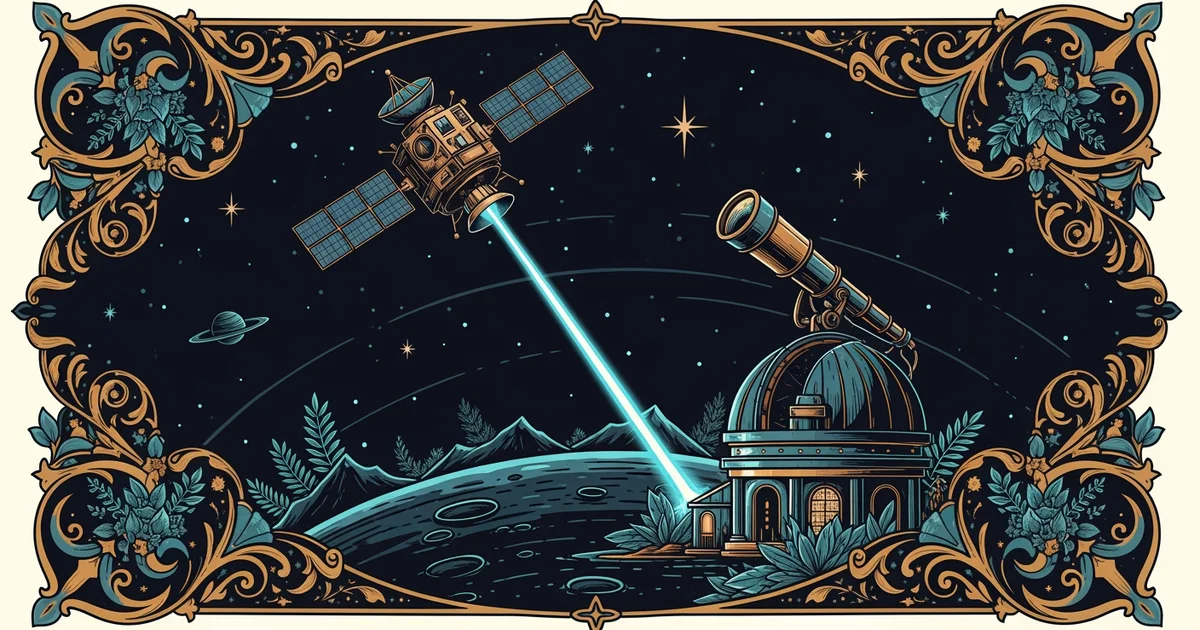
Transmitting these delicate quantum states over long distances on Earth is difficult because fiber optic cables absorb light. As the signal travels through glass fibers, it becomes weaker and eventually disappears before it reaches the other side. By placing our quantum transmitters on satellites, we can beam these particles through the vacuum of space instead. The vacuum of space is nearly empty, which means the particles do not bump into anything or get absorbed during their journey. This allows us to send secure keys across vast distances that would be impossible to cover using traditional underground cables.
| Feature | Fiber Optic Cables | Space-based Links |
|---|---|---|
| Medium | Solid glass fiber | Vacuum of space |
| Loss | High over distance | Very low over distance |
| Range | Limited by absorption | Global coverage |
We must coordinate the timing of these signals perfectly to ensure the receiver knows exactly when to look for the incoming particles. The satellite orbits the Earth at high speeds, so the ground stations must track the satellite with extreme precision. This setup creates a bridge between the quantum world and our daily digital needs. By mastering these space-based connections, we can eventually create a network that is physically impossible to hack without detection.
This path provides you with the knowledge to understand how we secure the future of global communication through the power of space-based quantum technology.
Quantum physics uses the fragile nature of light particles to detect intruders and guarantee that digital information remains private during transmission.
The next station explores why our current digital security methods are becoming outdated and why we need these new quantum solutions.