
The Evolution of Vertical Motion
Imagine standing before a massive skyscraper, looking up at the clouds while considering how to reach the top. Early builders faced this same challenge, relying on simple ropes and pulleys to lift heavy stones for construction projects. These basic tools were the ancestors of modern vertical travel, establishing the fundamental logic of moving weight against gravity. Without reliable mechanical systems, human ambition was trapped at the ground level, limited by the height of stairs that people could safely climb.
The Shift to Mechanical Power
Early builders quickly realized that manual labor could not sustain the needs of growing urban centers. They turned to steam power to drive rudimentary hoisting systems, which were essentially modified factory equipment. These systems relied on heavy chains or thick hemp ropes to pull platforms upward through open shafts. This process was often jerky and unpredictable, lacking the smooth control required for comfortable human transport. Think of it like a primitive freight cart that moves heavy goods but lacks the suspension needed for a smooth ride.
Key term: Vertical transit — the organized movement of people or materials between different levels of a building through mechanical means.
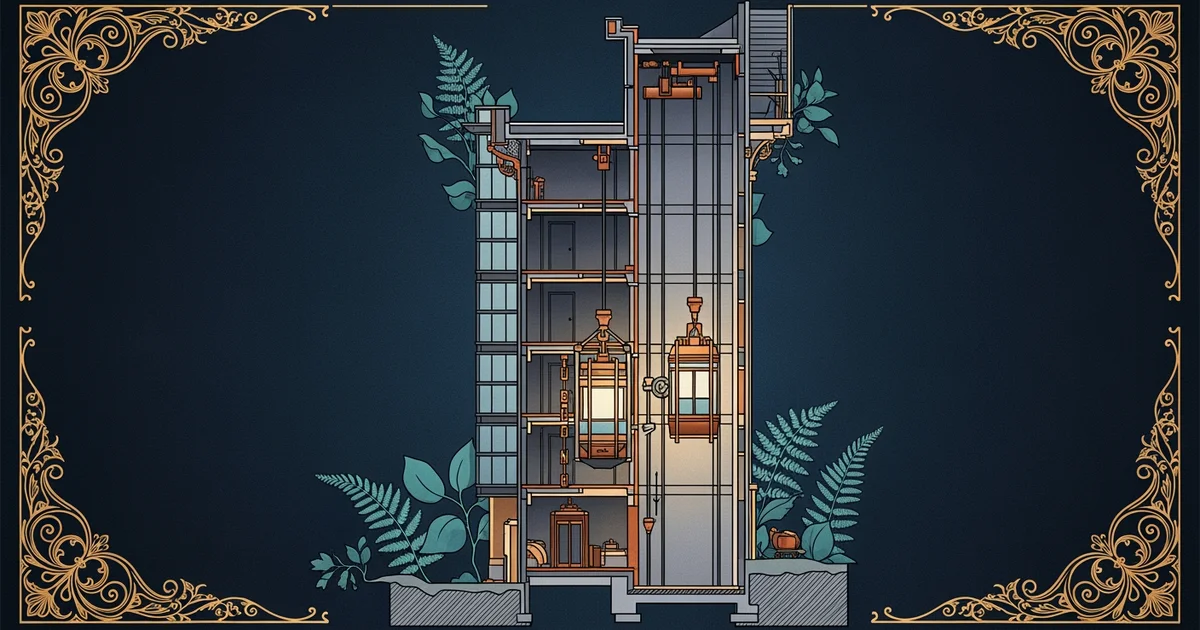
As cities expanded, engineers needed to replace these rough methods with more refined mechanical solutions. They introduced the traction elevator to provide a safer and more consistent experience for building occupants. This system uses steel cables draped over a rotating wheel to create friction, allowing for controlled movement. By balancing the weight of the car with a heavy counterweight, engineers reduced the total energy required to move people. This simple economic trade-off allows the motor to focus on moving the load rather than fighting the total mass of the cabin.
Refined Engineering for Modern Heights
Modern vertical motion depends on sophisticated control systems that manage speed and position with extreme precision. These systems ensure that the cabin stops exactly level with the floor, preventing the awkward gaps that once plagued early designs. Engineers now use advanced sensors to monitor the tension of steel cables constantly, ensuring they remain within safe operating limits. This transition from basic ropes to high-strength steel cables represents a massive leap in architectural capability. The following table highlights the evolution of these core components over the last century:
| Technology Era | Primary Power Source | Load Management | Safety Focus |
|---|---|---|---|
| Early Era | Manual / Steam | Simple Rope | Basic Braking |
| Mid Era | Electric Motor | Counterweights | Cable Tension |
| Modern Era | Digital Sensors | Smart Systems | Active Control |
These advancements allow architects to design buildings that reach higher into the sky than ever before. The evolution of vertical motion is essentially a story of managing energy and force with increasing efficiency. Every improvement in the motor or the cable system provides a direct benefit to the building users. We have moved from dangerous, manual hoists to automated systems that prioritize speed and comfort. Engineers continue to refine these systems, ensuring that even the tallest structures remain accessible to everyone who works or lives inside them. As we look at these machines today, we see the result of centuries spent solving the problem of gravity.
The history of vertical motion shows how we transformed simple lifting tools into complex systems that enable the existence of modern tall buildings.
Next, we will examine the critical safety protocols and braking mechanisms that prevent these systems from failing during daily operation.