
Geometric Illusions
Look at a tiled floor that seems to ripple like water under your feet. Your eyes insist the surface is uneven, yet your hand feels a perfectly flat plane.
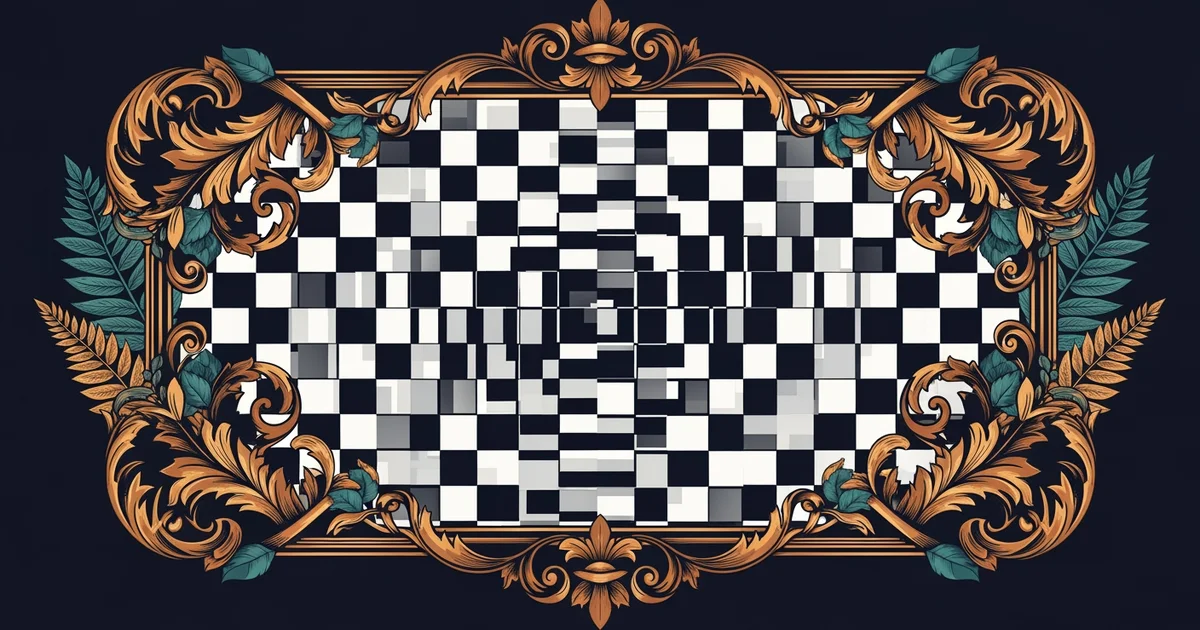
The Mechanics of Geometric Distortion
When we view two-dimensional shapes, our brain works hard to translate them into three-dimensional space. This process relies on cues like overlapping lines, perspective, and vanishing points. When an image contains conflicting data, the brain struggles to decide which depth cue is most accurate. It often chooses an interpretation that fits a common real-world scenario, even if that scenario is impossible. Think of your brain like a busy accountant who tries to balance a ledger using limited data. If the numbers do not add up, the accountant forces a solution to finish the job. Your visual system does the same thing when it encounters geometric illusions. These patterns distort our perception by forcing the mind to assign distance to lines that are actually equal. By manipulating angles and intersections, these illusions trick the visual cortex into seeing depth where only flat lines exist.
Consider how an architect draws a building on a flat sheet of paper. They use lines that converge at a single point to mimic the way real structures look from a distance. If you draw two parallel lines that never meet, the brain recognizes them as equidistant. However, if you add smaller lines that intersect these parallels at specific angles, the brain becomes confused. It interprets the intersecting lines as depth markers, which makes the parallel lines appear to tilt or bend. This is the core of spatial distortion. The brain prioritizes the angle information over the parallel information because angles often signal depth in our natural environment. By choosing the most likely physical explanation, the brain creates a false sense of spatial depth.
Analyzing Spatial Depth Triggers
To understand why we see things that do not exist, we must look at how the brain processes patterns. It looks for shortcuts to save energy and time during visual processing. These shortcuts are usually helpful, but they fail when the visual input is intentionally misleading. Geometric patterns trigger this failure by presenting contradictory spatial cues.
Key term: Geometric illusions — visual patterns that use lines and angles to trick the brain into perceiving depth or distortion.
When you examine such patterns, you can categorize the ways they manipulate your vision:
- Converging line triggers work by forcing the brain to assume that objects getting closer together must be moving further away in space.
- Contrast-based distortions rely on the size of surrounding shapes to make a central object appear larger or smaller than its true dimensions.
- Angle-based misdirection uses sharp intersections to convince the brain that a straight line is actually curved or slanted relative to the background.
These triggers function because the brain is constantly scanning for structural consistency. If a pattern looks like a hallway, the brain expects the walls to shrink toward a point. If you disrupt that pattern with a slight shift in angle, the brain tries to "fix" the image to maintain that hallway logic. This effort to maintain consistency is why your brain creates a fake depth, even when you know the image is flat. It is a classic case of the brain prioritizing its own internal model over the actual sensory input provided by your eyes. The visual system is simply too committed to its own rules to accept that the world is flat.
Perception relies on the brain applying logical spatial rules to visual patterns, which results in errors when those rules encounter artificial, conflicting geometric data.
The next Station introduces color constancy failures, which determine how lighting changes alter our perception of object surfaces.