
Historical Roots of Voting
Imagine standing in a crowded town square where your only way to voice an opinion is to shout until your lungs ache. You might win the argument if you are the loudest person present, but this method fails to capture the true preference of the entire group. Early voting systems evolved from this chaotic need to measure collective will without the constant risk of physical conflict or total disorder. By shifting from shouting matches to structured tallies, societies began to build the foundations of modern democracy that we recognize today.
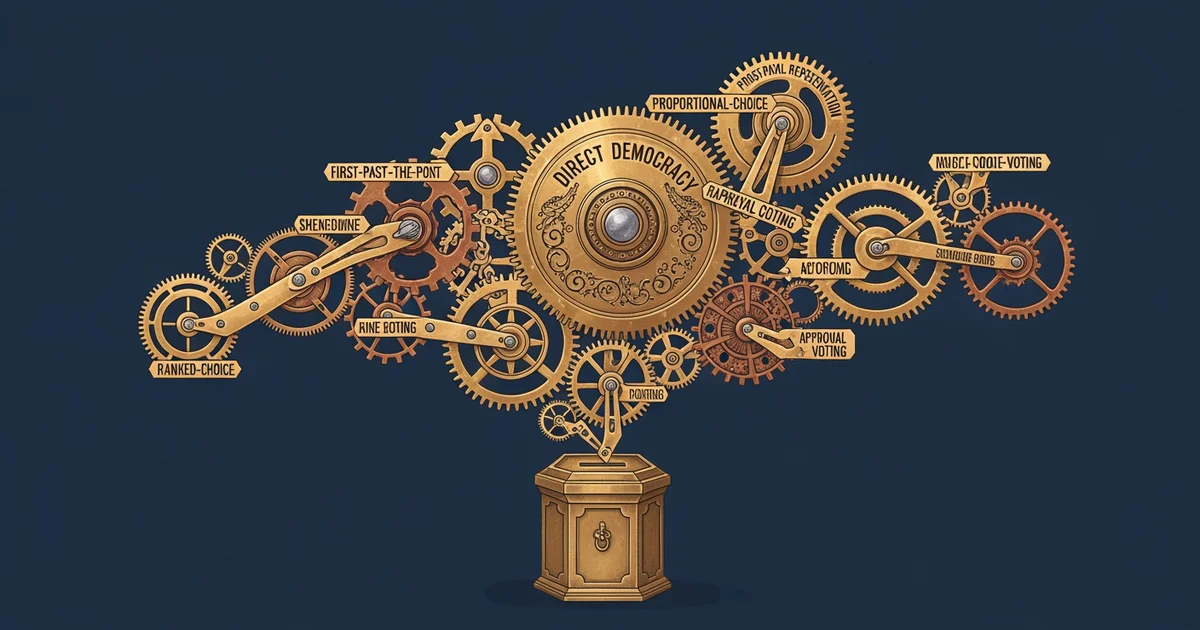
The Evolution of Selection Methods
Early societies often relied on simple consensus models where the most respected members of a group made decisions for everyone else. This approach functioned well in small tribes but became impossible as populations grew and diversified across larger geographic regions. As communities expanded, they required formal mechanisms to translate individual voices into a singular, binding choice for the public good. Think of this transition like moving from a family dinner where the parents decide the menu to a restaurant where every guest orders their own specific meal. This shift protects the individual choice while still allowing the group to function under a unified set of rules.
Key term: Suffrage — the legal right to participate in a public election by casting a formal vote.
Historically, the right to vote was strictly limited to specific groups, such as land-owning men or those with significant social status. This exclusion meant that early elections rarely represented the diversity of the population living under those governing laws. Over time, the concept of suffrage expanded as people demanded more inclusive systems that acknowledged the value of every citizen. This evolution was not a smooth path but rather a series of intense struggles between those holding power and those seeking a fair seat at the table.
Comparing Historical Voting Models
Different cultures developed unique ways to record these public preferences based on their available technology and social values. Some civilizations used physical objects to represent choices, while others relied on public voice counts or written tallies. The following table illustrates how different methods of recording a vote shaped the way power was distributed among the people:
| Method | Primary Tool | Advantage | Limitation |
|---|---|---|---|
| Voice Vote | Verbal shout | Immediate feedback | Prone to bullying |
| Ballot Stone | Physical pebble | Secret selection | Hard to transport |
| Written Slip | Paper record | Easy to count | Requires literacy |
These methods show that the mechanics of voting are never just technical details but are instead reflections of societal priorities. A society that values speed might choose a voice vote, even if it risks silencing the minority. A society that values privacy might invest in paper ballots, even if that process takes much longer to complete. Every system creates a specific set of incentives that influence how people behave during an election cycle. Understanding these historical roots helps us see why modern systems still struggle with the balance between accessibility, security, and true representation.
When we look back at these early systems, we see a recurring pattern of tension between the desire for efficiency and the need for fairness. If a system is too complex, citizens may stop participating because the barrier to entry is simply too high. If a system is too simple, it may fail to prevent fraud or ensure that every valid vote is counted accurately. The history of voting is essentially the history of refining these trade-offs to create a more stable and representative outcome for all members of the political community.
Democratic systems evolve by replacing informal or exclusionary practices with structured, inclusive rules that aim to balance individual choice with collective stability.
The next step in our journey explores how modern plurality systems use these historical lessons to determine winners in a competitive election environment.