
The Purpose of Electoral Systems
Imagine you are choosing a game to play with a group of friends where the winner gets to decide the restaurant. If you pick a game based on speed, the fastest person always wins every single time. If you pick a game based on luck, everyone has a fair chance regardless of their actual skill level. The rules you choose for the game change who walks away with the prize before the game even begins. Electoral systems work in this exact same way for our government and society.
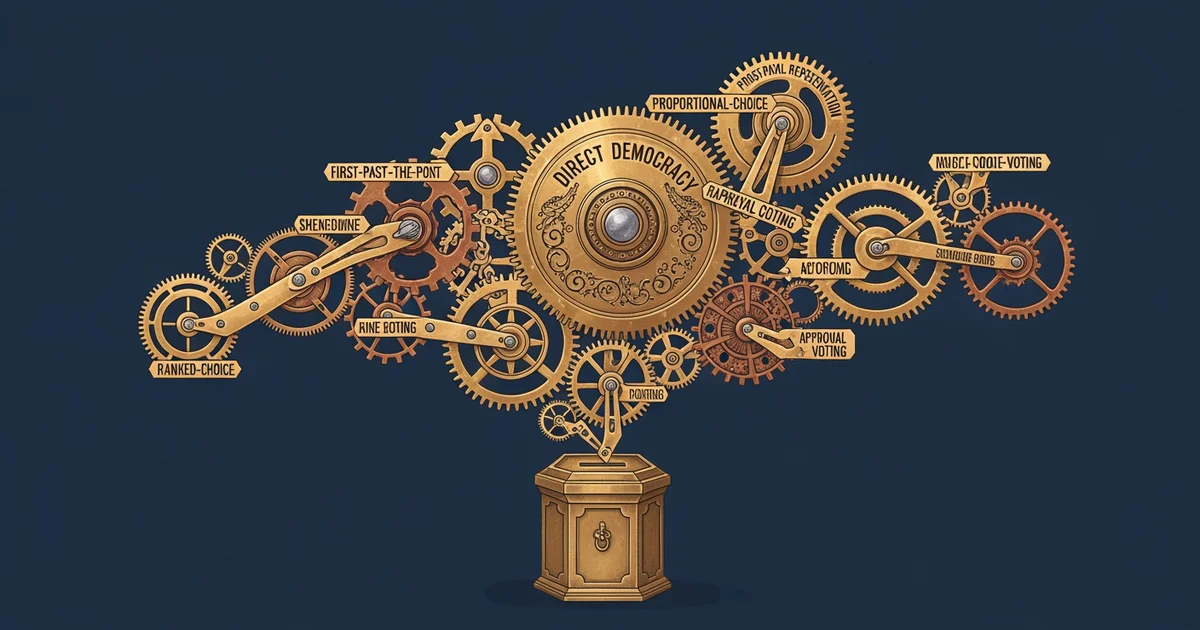
The Mechanics of Voting Rules
Every country uses a specific set of rules to turn individual votes into actual government power. These rules are known as an electoral system and they act like the rulebook for a high-stakes competition. When people cast their ballots, they often assume that the process is neutral and simply counts preferences. In reality, the specific structure of the ballot and the math used to count the votes create different incentives for candidates. These incentives change how politicians campaign and how they treat different groups of people in the country.
Key term: Electoral system — the set of formal rules that determine how votes are cast and how those votes translate into seats in a government.
If you use a system that rewards the candidate with the most votes in one area, parties will focus only on those specific regions. If you use a system that counts every single vote across the whole country, parties will try to appeal to everyone everywhere. This is why the design of the system is the most important part of any democracy. It acts as the underlying architecture that supports the entire political building above it.
Shaping Political Outcomes
Because these rules are so powerful, they often dictate which voices get heard and which ones stay quiet. A system might encourage two large groups to dominate the space, or it might allow many smaller groups to share the stage. When you look at different countries, you can see how these rules change the way their leaders govern. The following table shows how different design choices affect the way a political system functions:
| Feature | Majoritarian System | Proportional System | Mixed System |
|---|---|---|---|
| Goal | Clear winners | Diverse representation | Balanced approach |
| Parties | Usually two parties | Many different parties | Varies by design |
| Focus | Local district needs | Broad national issues | Local and national |
These systems do not just count votes, but they also filter the political interests of the entire population. In a system where only the winner gets a seat, voters often feel that they must pick the most popular choice to avoid wasting their vote. This creates a pressure toward stability but might leave some voters feeling ignored. In contrast, a system that shares seats based on the percentage of total votes makes every single vote feel like it matters for the final outcome.
Understanding these rules is essential because they define the boundaries of what is possible in a democratic society. When citizens know how their system works, they can better understand why their government acts the way it does. The rules are not just technical details, but they are the foundation of our collective decision-making process. By learning these concepts, you will gain the tools to evaluate how our society makes its most important choices. This path will guide you through the anatomy of ballots, the logic of representation, and the impact of these systems on your daily life.
The rules of an electoral system function as the primary filter that determines which political voices are amplified and which ones are muted within a democratic society.
By exploring how these rules function, we will move forward to examine the specific anatomy of a ballot and how its design influences voter behavior.