
The Quantum Reality
Imagine you are watching a flickering candle flame that suddenly turns into a solid, glowing marble. This strange transformation happens at the tiny scale of atoms where nature refuses to choose between being a wave or a particle. Our previous look at the Observer Effect showed us that looking at the world changes what we see. Now we must synthesize why light and matter exist in this dual state. The universe does not pick a form until a measurement forces a decision to occur. This tension defines the core of modern physics and our path toward understanding reality.
The Nature of Quantum Duality
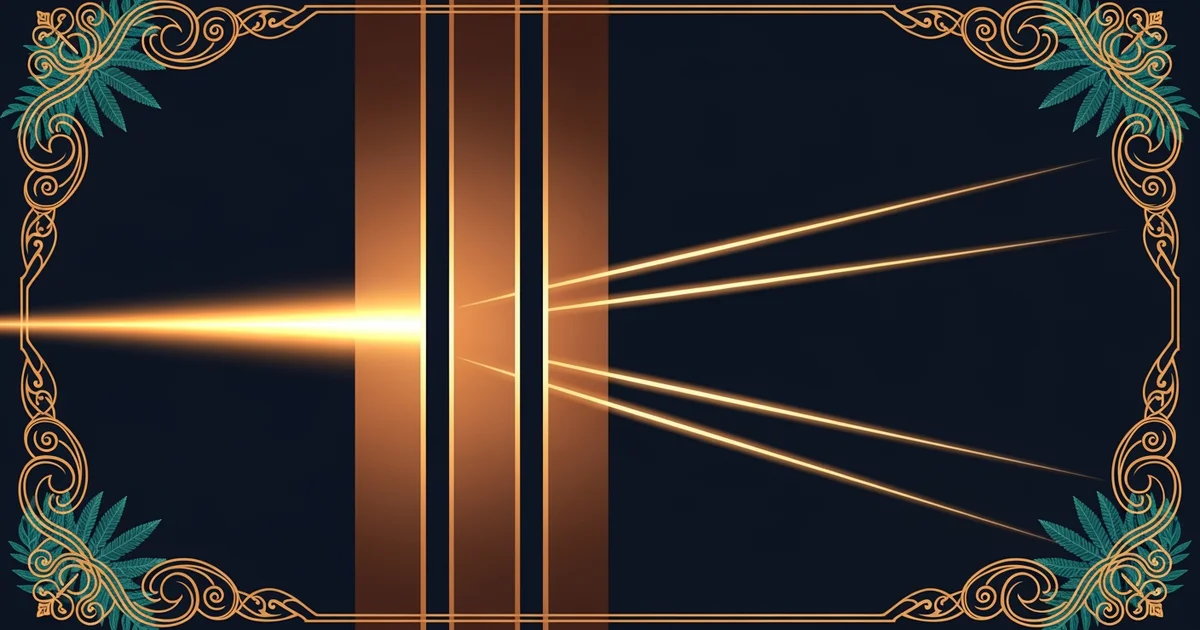
We often think of waves as ripples in water and particles as solid, tiny balls. In the quantum world, these two categories blend together into a single, confusing identity. Light behaves like a wave when it travels through space, spreading out and interfering with itself like ocean waves meeting at a pier. Yet, when light hits a sensor, it strikes like a single, localized bullet hitting a target. This duality suggests that our everyday labels for objects are simply too limited to describe the fundamental building blocks of everything around us.
Key term: Wave Particle Duality — the concept that every quantum entity exhibits both wave-like and particle-like properties depending on the experimental setup.
Think of this like a professional actor who plays two different roles in a single play. When the actor is on stage, they are the character they portray, but when they leave, they return to their true self. The quantum object is the actor, while the wave and particle states are the roles it performs. The environment acts as the director, telling the particle which role to play during a specific observation. Without a director, the actor remains in a state of potential, holding the possibility of both roles simultaneously until the final performance begins.
Resolving the Quantum Paradox
When we ask how the universe decides between these states, we must look at the interaction between the system and the detector. The act of measurement is not a passive observation, but an active engagement that forces a choice. Before this interaction, the object exists in a Superposition, which is a mathematical state representing all possible locations and forms at once. Once we measure the position, the wave function collapses into a single, definite point. This process explains why we never see a wave and a particle at the same time.
| Feature | Wave State | Particle State |
|---|---|---|
| Spread | Dispersed | Localized |
| Motion | Interference | Trajectory |
| Detection | Probability | Certainty |
These properties illustrate the shift from potential to reality:
- The wave state exists as a cloud of probability, defining where a particle might be found if we look.
- The particle state represents the collapse of that cloud into one specific spot, which happens the moment we measure it.
- The energy exchange during detection acts as the trigger, forcing the quantum system to abandon its wave-like spread and commit to a single point.
Understanding this duality requires us to accept that the universe is not made of "things" but of "interactions." The foundation question asked how the universe decides which form to take. It does not decide based on a rule, but rather based on the physical constraints of the experiment we perform. If we design an experiment to detect waves, the system manifests as a wave. If we design one to detect particles, the system manifests as a particle. The reality we observe is a direct consequence of how we choose to interrogate the natural world.
The universe does not possess a fixed form, but instead manifests as either a wave or a particle based on the specific interaction we choose to perform.
Quantum mechanics teaches us that reality is a fluid, interactive process rather than a static collection of solid objects.