
Young's Double Slit
Imagine you are standing at a busy intersection where two separate paths merge into one wide road. If you toss two handfuls of sand into the air, the grains land in a simple pile that matches the shape of your hands. However, if you drop two stones into a calm pond, the ripples from those stones interact in a complex way that creates new peaks and valleys. Light behaves much like those water ripples when it passes through two narrow slits in a barrier. This experiment reveals that light is not just a stream of solid particles, but a wave that can interfere with itself.
Understanding Wave Interference
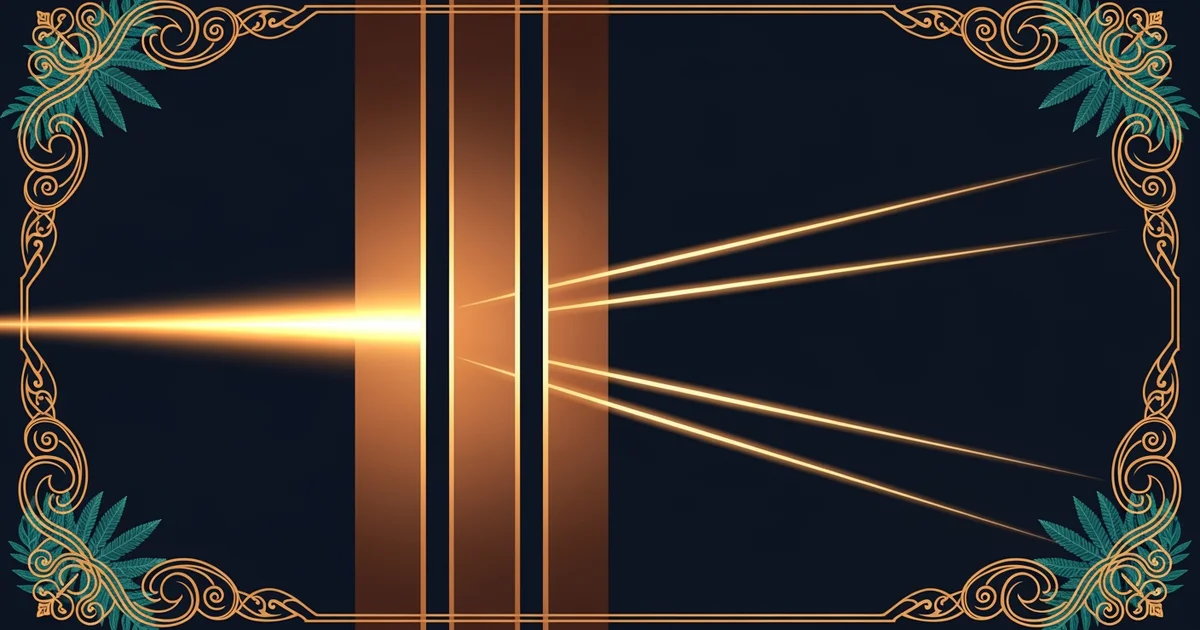
When we shine a light source at a screen with two thin, parallel slits, the light spreads out as it passes through each opening. This behavior is called diffraction, which allows the light to bend around the edges of the slits like water flowing around a pier. Because the light waves emerge from two distinct points, they overlap on the other side of the barrier. In areas where the peak of one wave meets the peak of another, they combine to create a brighter spot on the wall. This specific phenomenon is known as constructive interference, where the waves reinforce one another to produce a more intense light signal.
Conversely, when a peak from one wave meets the trough of another wave, they cancel each other out entirely. This result is called destructive interference, which leaves a dark patch on the screen where no light appears. By repeating this process, the light creates a clear pattern of alternating bright and dark lines across the back wall. This pattern is definitive proof that light must travel as a wave, because particles would simply pass through the slits and form two separate, solid lines. If light were only a particle, it would not be capable of cancelling itself out in this specific manner.
The Analogy of Traffic Flow
To visualize this, imagine two lanes of traffic merging into a single tunnel entrance during a busy morning rush. If the cars acted like light waves, they would not form two simple lines entering the tunnel side by side. Instead, they would spread out and weave through each other, creating a complex rhythm of gaps and clusters. The bright lines on our screen are the clusters where traffic flows smoothly, while the dark gaps represent the empty spaces where no cars are currently passing. Just as the rhythm of traffic depends on how the cars interact at the merge point, the light pattern depends on the distance between the slits and the screen.
| Feature | Wave Behavior | Particle Behavior |
|---|---|---|
| Passage | Spreads out | Moves in straight lines |
| Result | Interference pattern | Two distinct bands |
| Interaction | Can cancel out | Cannot cancel out |
This table summarizes the core differences between how light waves and solid particles behave when they encounter a physical barrier with small openings. While particles would simply hit the back wall in two distinct spots, the wave nature of light forces it to spread and overlap. This creates the unique pattern that we observe in the laboratory setting. By measuring the distance between these lines, scientists can calculate the exact wavelength of the light they are using. This measurement is a fundamental tool for understanding the nature of electromagnetic radiation in our modern world.
The interference pattern proves that light acts as a wave because it can overlap to create regions of both increased and decreased intensity.
The next Station introduces the Photoelectric Effect, which determines how light particles interact with matter at the atomic level.