
The Nature of Light
When you flip a light switch, the room fills with energy that travels instantly across the space. This common act hides a complex secret about how the universe manages its smallest building blocks.
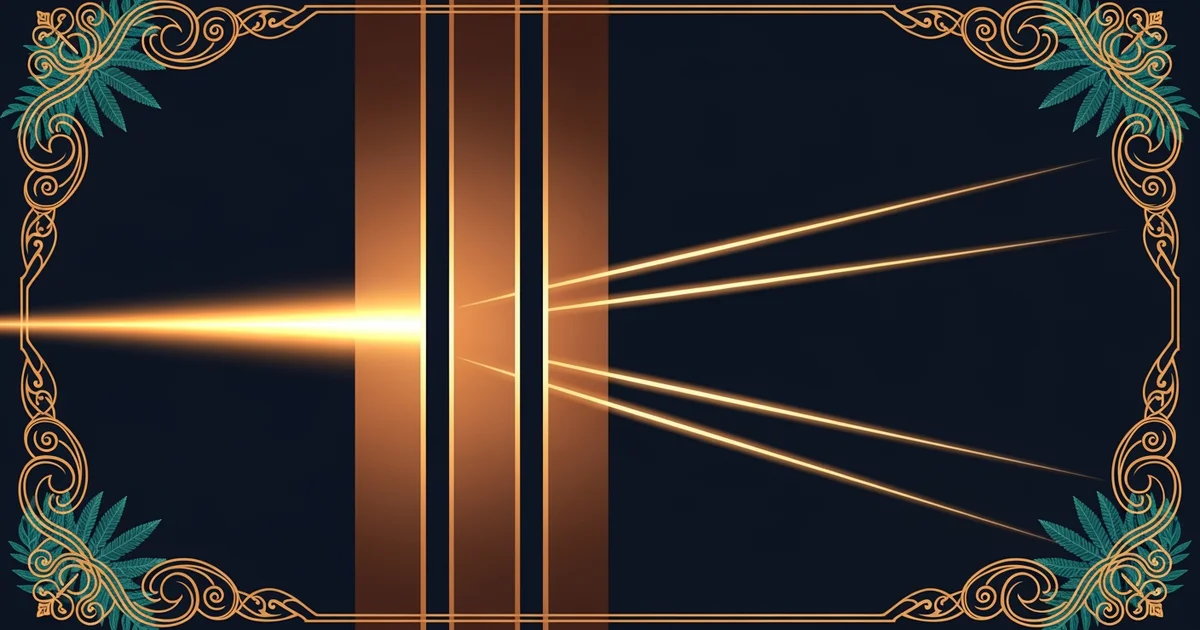
The Nature of Electromagnetic Waves
Light behaves like a ripple moving across a calm pond when we observe its broad patterns. We call this movement an electromagnetic wave because it consists of oscillating electric and magnetic fields. These fields move through space at a constant speed that defines the cosmic limit for information. Scientists describe this movement using the variable to represent the speed of light in a vacuum. Just as a water wave carries energy from the center of a pond to the shore, light carries energy from a source to your eyes. This wave nature explains why light can bend around corners or spread out when passing through tiny holes. Understanding this wave property allows us to predict how light interacts with lenses, mirrors, and our own eyes.
Key term: Electromagnetic wave — a rhythmic disturbance in electric and magnetic fields that carries energy through space without needing a physical medium.
To visualize how these waves move, imagine a rope tied to a wall that you shake up and down. The wave travels along the rope, but the individual fibers of the rope only move in place. Light works in a similar way, where the energy moves forward while the fields vibrate perpendicular to that path. This oscillation happens at different rates, which we perceive as different colors or types of radiation. High-frequency waves carry more energy than low-frequency waves, much like a fast-moving rope carries more tension than a slow one. These oscillations allow light to act as a carrier for information across vast distances in our universe.
Wave Properties and Measurement
Because light travels as a wave, we can measure its physical characteristics using precise mathematical tools. The distance between two consecutive peaks of the wave is known as the wavelength, which we represent with the Greek letter . The number of peaks that pass a single point each second is the frequency, denoted by . These two values share a strict relationship defined by the speed of light constant . We express this relationship through a simple equation that connects the wave speed to its physical shape:
This formula shows that if the wavelength grows longer, the frequency must drop to keep the speed constant. You can see this relationship in the following table which compares different types of light energy:
| Type of Light | Relative Wavelength | Relative Frequency | Energy Level |
|---|---|---|---|
| Radio Waves | Very Long | Very Low | Very Low |
| Visible Light | Medium | Medium | Medium |
| Gamma Rays | Very Short | Very High | Very High |
Every form of light follows these rules, whether it is the heat from a stove or the signal from a satellite. By measuring these properties, we can determine the distance to stars or the chemical makeup of distant planets. This systematic approach to measuring light waves provides the foundation for all modern physics and communication technologies. As you master these basics, you will build a complete toolkit for understanding how matter and energy interact at the smallest scales.
Light functions as a rhythmic oscillation of energy that travels through space at a constant speed while carrying distinct physical properties.
This foundation prepares you to explore how these waves sometimes act like solid particles in the next station.