
Magnetic Moments
Imagine a tiny spinning top that creates its own invisible force field while it dances on a desk. Just like that spinning top, every electron in our universe possesses an intrinsic property that generates a microscopic magnetic field. This phenomenon is known as the magnetic moment, and it serves as the foundation for modern data storage and computer memory technologies. By understanding how these tiny particles behave like magnets, we can harness their power to build faster and more efficient electronic devices for the future.
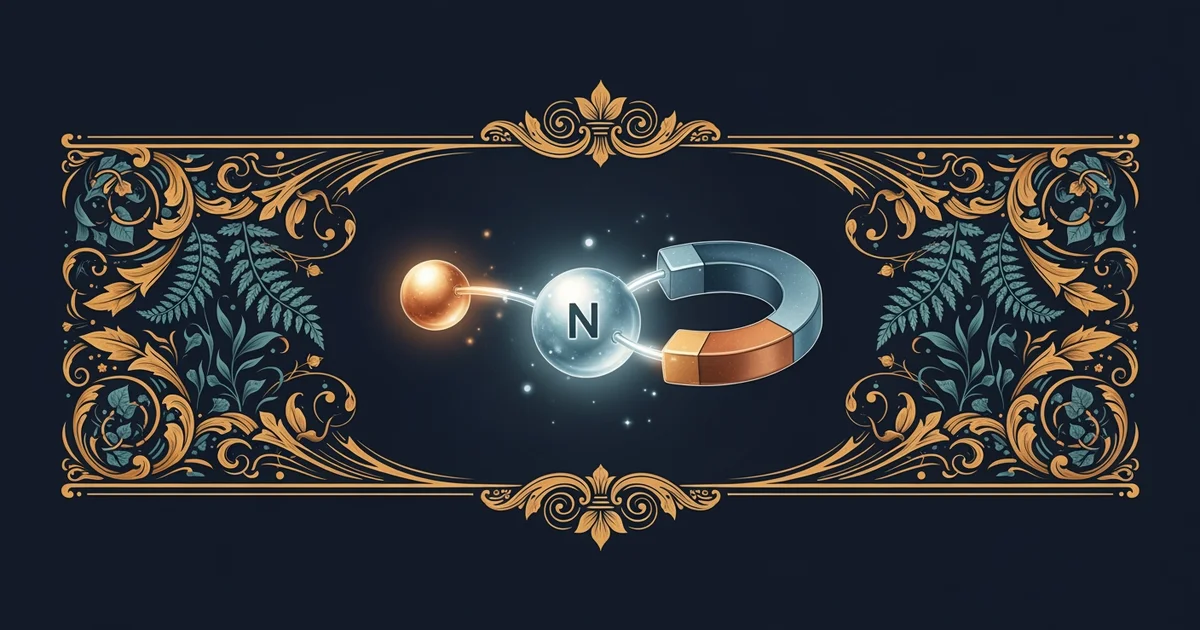
The Origin of Magnetic Behavior
When we look at an electron, we find that it carries a property called spin that relates to its angular momentum. Even though the electron does not physically rotate like a planet, it acts as if it has a permanent internal rotation. This spinning motion creates a small current loop because the electron also carries a negative electric charge. According to the laws of electromagnetism, any moving electric charge creates a magnetic field around its path of motion. Because the electron is a charged particle with spin, it functions as a miniature bar magnet with a north and south pole.
Key term: Magnetic moment — the measure of an object's tendency to align with an external magnetic field, caused by the internal spin of an electron.
This magnetic property is not just a random feature of nature, but a fundamental aspect of how matter interacts with magnetic forces. If we place these electrons inside an external magnetic field, they will attempt to align themselves with that field. This alignment process is similar to how a compass needle points toward the magnetic north pole of the Earth. In the context of computing, we can control this alignment to represent binary data, where one direction of spin indicates a zero and the opposite direction indicates a one.
Analogy for Electron Spin
Think of each electron as a tiny, individual dancer on a massive, crowded stage. Each dancer holds a small glowing lantern that points either up toward the ceiling or down toward the floor. The direction of the lantern represents the orientation of the electron's magnetic moment. If you want to send a message to the entire audience, you can ask all the dancers to coordinate their lanterns to face the same way. This collective action creates a powerful, unified signal that is much easier to detect than the light from a single, isolated dancer.
We can organize these electron states into a table to show how their orientation affects their interaction with external forces:
| State Type | Spin Orientation | Magnetic Alignment | Energy Level |
|---|---|---|---|
| Spin Up | Positive Z-axis | Aligned with field | Lower energy |
| Spin Down | Negative Z-axis | Opposite to field | Higher energy |
| Neutral | No net field | Random orientation | Unstable state |
This table illustrates that the energy of an electron depends heavily on its orientation relative to the environment. Electrons naturally prefer the lower energy state, which is why they align with external fields whenever possible. By applying specific pulses of energy, engineers can flip these electrons between states to store information. This process is the core mechanism that allows your computer to save files or run programs without needing constant power.
Harnessing Tiny Fields
As we refine our control over these magnetic moments, we move closer to creating hardware that consumes far less energy than current systems. Traditional computers move large amounts of electrical charge around, which creates heat and wastes precious energy. Spintronics avoids this problem by using the magnetic spin of electrons rather than their physical movement through wires. Since the spin state can be changed with very little effort, the system stays cool and operates at much higher speeds. This shift in design is essential for the next generation of portable devices and supercomputers.
The magnetic moment is a fundamental property of electrons that allows us to store and manipulate information by controlling the orientation of their tiny, intrinsic magnetic fields.
The next Station introduces quantum superposition, which determines how electrons can exist in multiple states at the same time to increase processing power.