
Introduction to Topology
Imagine you have a piece of soft clay shaped like a ball that you stretch into a long, thin snake. Even though the shape changed from round to long, the fundamental, underlying object remains exactly the same in its basic structure. This simple idea forms the heart of topology, which is a branch of mathematics that ignores exact distances and angles to focus on how shapes connect. By studying these properties, we can find hidden patterns in data that would otherwise look like random noise.
Understanding Continuous Deformation
To understand how shapes work in this field, you must think about what happens when you bend or stretch an object without tearing it. In mathematics, we call this process a continuous deformation, which allows an object to change its appearance while keeping its core structure intact. Think of a rubber band that you can twist into a figure-eight or pull into a square shape without ever breaking the material. Because you did not tear or glue the rubber, the object retains its essential topological identity throughout the entire process.
This perspective helps us ignore small, messy details that often distract us when we look at complex data sets. If we focus only on these flexible properties, we can classify objects into groups based on how many holes they have or how they are connected. A shape that has one hole is fundamentally different from a shape with no holes, regardless of how much you stretch it. This logic allows researchers to simplify massive amounts of information into basic geometric shapes that reveal the true structure of the data.
The Mug and the Donut
When we apply this logic to everyday objects, we find some surprising connections that challenge our normal intuition about shapes. A classic example involves a coffee mug and a donut, which are actually the same object in the eyes of a topologist. You can see this by imagining the mug is made of soft clay that you can mold into any form you want. If you push the handle of the mug down and smooth out the cup part, you eventually end up with a single, circular loop.
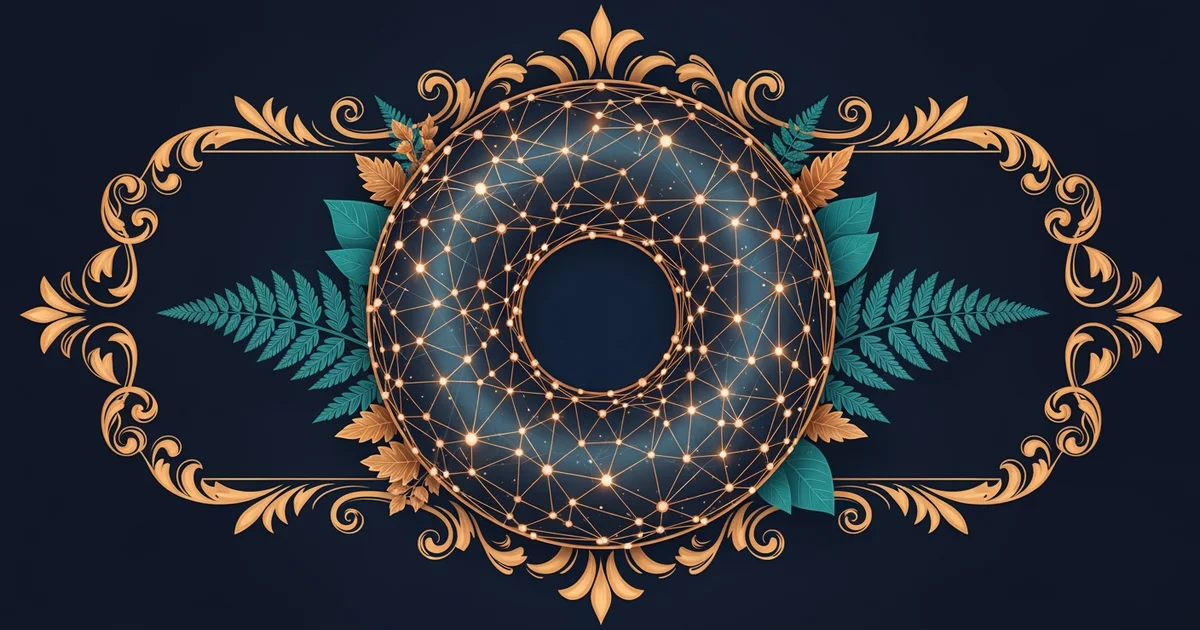
This loop is exactly the same shape as a donut, which also has a single hole running through its center. Because you only stretched and bent the clay without creating new holes or sealing existing ones, the two objects are topologically equivalent. This concept of equivalence is powerful because it tells us that the surface area or the volume of the object does not matter. What truly matters is the number of holes, which serves as a stable identifier for the shape.
| Object | Number of Holes | Topological Category |
|---|---|---|
| Ball | Zero | Solid Sphere |
| Donut | One | Torus |
| Mug | One | Torus |
| Plate | Zero | Solid Disk |
This table shows how different items can be grouped together based on their structural features. By categorizing data into these simple groups, we can identify meaningful patterns that stay the same even when the data is noisy or distorted. This way of thinking prepares you to see data as a geometric landscape where the connections matter more than the individual points. By the end of this path, you will understand how to map complex data into stable shapes to reveal the secrets hidden within large information sets.
Topology identifies the fundamental properties of shapes that remain unchanged even when those shapes are stretched or bent into new forms.
You will now explore how these geometric principles allow us to visualize and analyze complex data sets as if they were physical objects in space.