
Historical Roots of Logic
Imagine you are standing at a busy intersection where traffic lights decide who moves forward. These lights act like tiny gatekeepers that follow a strict set of rules to keep cars moving safely. Computers function in much the same way by using a rigid system of logic to process every single task. Long before modern chips existed, thinkers searched for a way to turn human thought into a mechanical process. They wanted to build a system where complex ideas could be broken down into simple choices.
The Birth of Symbolic Reasoning
Early philosophers realized that human arguments often followed predictable patterns of truth and falsehood. They sought to map these patterns using symbols rather than relying on messy or ambiguous language. By representing statements as variables, they could manipulate logic like numbers in a basic math equation. This shift allowed them to strip away the emotional weight of words to find the underlying structure of an argument. When you treat a statement as either true or false, you create a binary foundation that machines can eventually understand. This method transformed logic from a subjective debate into an objective tool for clear calculation.
Key term: Boolean algebra — a branch of mathematics that uses binary variables to represent logical operations like true or false.
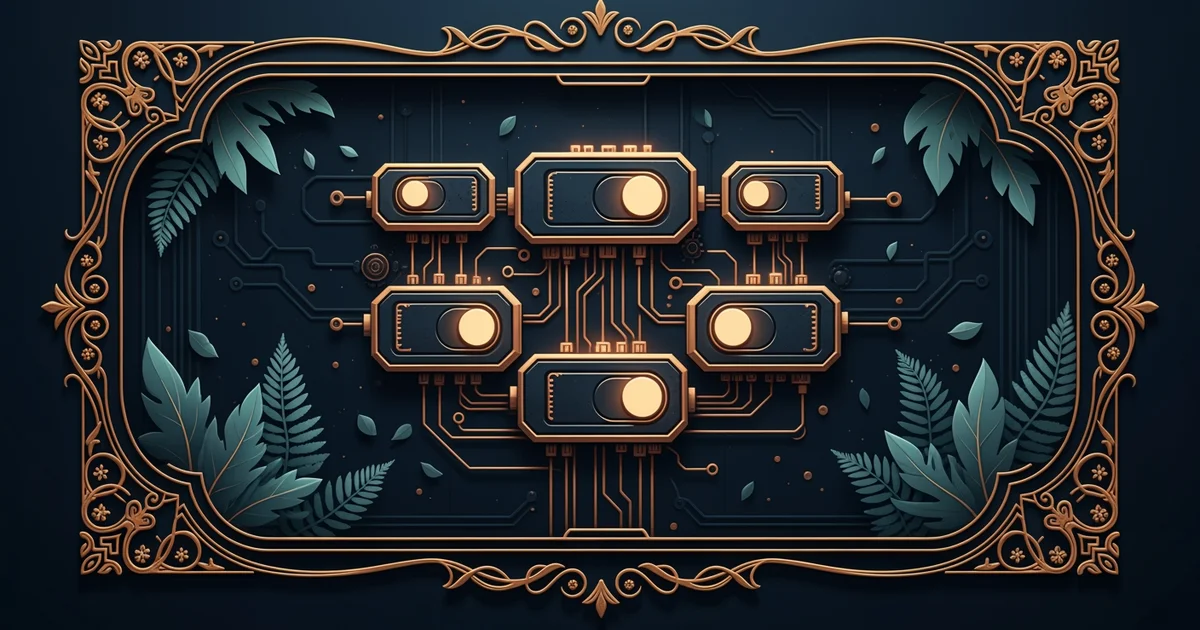
This system works much like a light switch in your home that can only be either on or off. If you think of the switch as a variable, you can combine multiple switches to create complex outcomes. For example, if you have two switches, you can decide that the light only turns on when both are flipped up. This simple rule creates a logical gate that mimics the way a computer makes a decision. By chaining these simple gates together, you can build a device that solves complicated problems through basic steps.
From Philosophical Concepts to Electronic Circuits
Engineers eventually realized that these abstract logical laws were perfect for controlling electricity in small circuits. They replaced the old mechanical gears with electronic switches that could flick between states at incredible speeds. This transition allowed machines to perform millions of logical operations every second without needing any human help. The physical design of these circuits maps directly to the rules of logic that were developed centuries ago. Every time a computer processes data, it is essentially running a long string of these ancient logical tests.
To understand how these components differ in their logical function, consider the following common gate types:
- The AND gate requires two separate inputs to be true before it will produce a single true output signal.
- The OR gate creates a true output if at least one of the input signals provides a true value.
- The NOT gate acts as a simple inverter that turns a true input into a false output signal.
These gates act as the building blocks for every digital device you use in your daily life. A smartphone or laptop is simply a massive collection of these gates working in perfect harmony. By layering these gates, engineers can build memory and complex processors that handle everything from video games to weather models. The history of logic is not just a dusty chapter in a book but the living blueprint for our digital world. Each gate represents a tiny decision made by the machine to reach a final, useful result.
| Logic Gate | Input Requirement | Output Result |
|---|---|---|
| AND | Both inputs must be true | True only if both match |
| OR | One input must be true | True if either is active |
| NOT | Single input is inverted | Opposite of the input |
We now see how these historical ideas evolved into the hardware that powers our current technological landscape. The path from ancient philosophy to modern silicon chips shows that logic is the universal language of machines. By mastering these basic patterns, you gain a clearer view of how your digital devices actually think.
The development of logical systems allowed human thought to be translated into the binary language of electronic switches.
Now that we understand the history behind these logical rules, we will examine how physical switches translate these ideas into real electricity.