
The Anatomy of a Poker Deck
Imagine you are holding a deck of cards and trying to predict the future with only fifty-two simple pieces of paper. This collection of cards acts as the fundamental building block for every complex strategy you will ever use at the poker table.
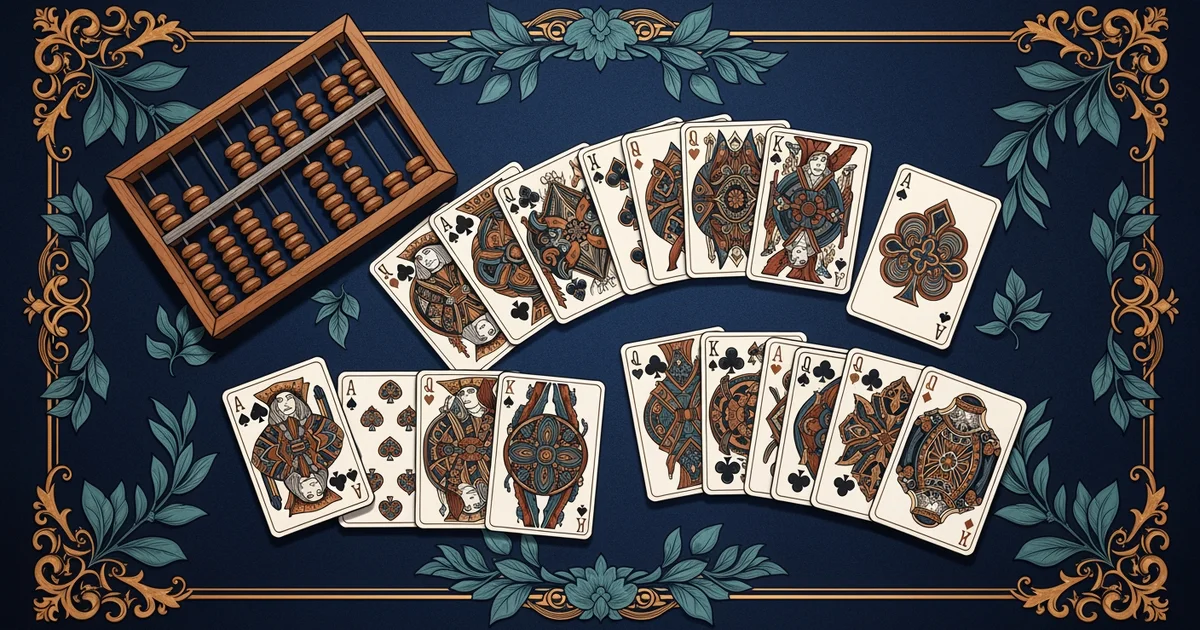
The Mathematical Structure of a Standard Deck
When you analyze a standard deck, you see a highly organized system designed to create predictable outcomes through random selection. The deck contains fifty-two unique cards, which are divided into four distinct suits: hearts, diamonds, clubs, and spades. Each of these four suits contains exactly thirteen ranks, ranging from the two up to the ace. Because every suit has the same number of cards, the probability of drawing any specific suit remains constant at one out of four. This balance ensures that no single suit holds more statistical power than the others during a game. Think of the deck like a balanced budget where every category must equal the same total share. If you spend too much on one area, you must cut from another to keep the math working. In this deck, the math is always perfectly balanced because each suit is identical in its composition and total count.
Key term: Sample space — the set of all possible outcomes that can occur when you draw a card from a standard deck.
To understand your odds, you must first recognize that the sample space always contains fifty-two total possibilities for any single card draw. If you want to calculate the chance of pulling a specific rank, like a king, you look at the total number of kings in the deck. Since there are four suits, there are four kings in total. You divide the four kings by the fifty-two total cards to find your probability. This fraction simplifies to one out of thirteen, or roughly seven point seven percent. This simple division is the foundation for every complex move you will make later. By understanding these small fractions, you learn to see the deck as a map of potential outcomes rather than a collection of random images.
Analyzing Distribution and Probability
Once you master the basic counts, you can look at how these cards interact within the context of a game. The distribution of cards is not just about the individual rank but about how your hand compares to the remaining cards in the deck. When you hold two cards, you have already removed them from the fifty-two card pool, which changes the odds for every other player. This is why professional players keep a mental tally of the cards they have seen during the session. If you see many hearts on the table, the probability of someone else holding a heart decreases because there are fewer left in the deck. The following table shows the breakdown of the deck to help you visualize the distribution of ranks and suits.
| Category | Count | Probability per Draw |
|---|---|---|
| Total Cards | 52 | 100% |
| Cards per Suit | 13 | 25% |
| Cards per Rank | 4 | 7.69% |
| Red or Black | 26 | 50% |
This table illustrates how the deck is split into equal parts to maintain fairness and predictability for all participants. If you know that red cards make up exactly half the deck, you can quickly estimate your chances of hitting a specific color. This logic applies to every decision you make when you calculate your next move. You are essentially performing a quick mental calculation every time you look at your hand. While the game feels like a blur of motion, the underlying structure is rigid and unchanging. The cards do not care about your luck, your history, or your feelings, because they only follow the laws of probability. By internalizing these basic ratios, you move away from guessing and toward a model of calculated risk management. Every card removed from the deck changes the math for the remaining cards in a measurable way.
Understanding the fixed composition of a deck allows you to convert raw uncertainty into precise mathematical expectations for every hand you play.
Now that you understand the anatomy of the deck, we will explore how to identify the specific cards that help you improve your hand.