
Harmonic Series Math
When you strike a single guitar string, you hear a complex sound that seems like one clear note. This sound actually hides a series of higher pitches that stack perfectly on top of the fundamental frequency.
The Physics of Frequency Ratios
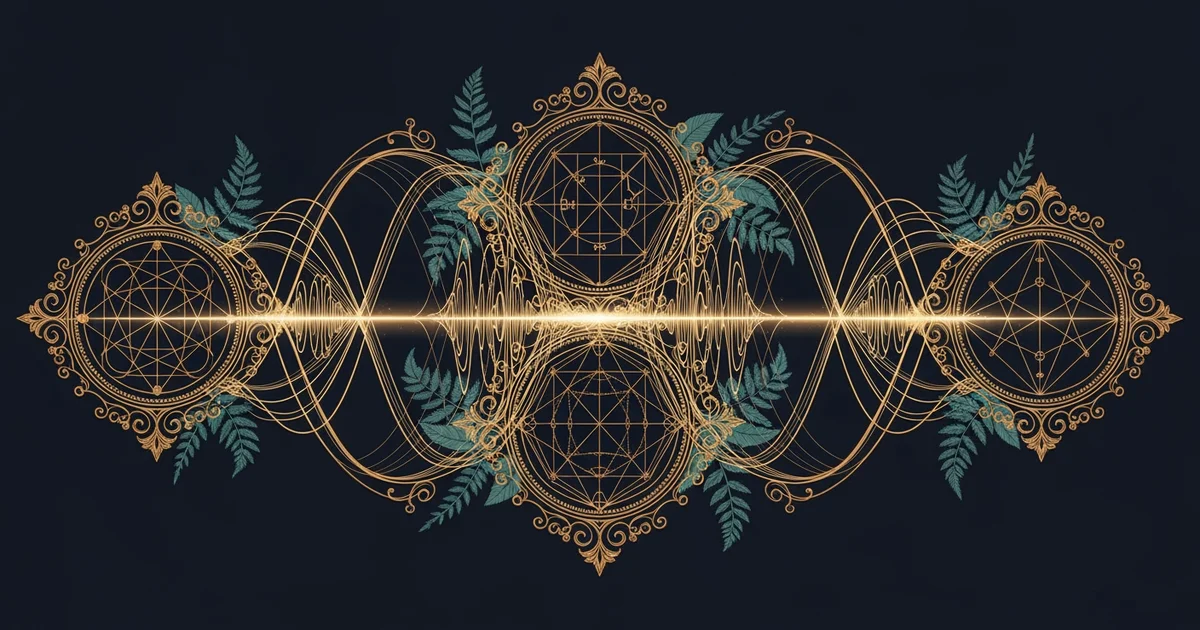
Sound travels as a wave through the air, and the speed of these waves determines the pitch we hear. When a string vibrates, it does not just move as one long arc from end to end. It also vibrates in smaller, equal segments that create higher frequencies known as the harmonic series. The first harmonic is the fundamental note, while the second harmonic vibrates at twice that frequency. Because these ratios are simple whole numbers, our ears perceive them as pleasant and stable intervals. Just as a bank divides a large loan into smaller, equal monthly payments, the string divides its total length into equal parts to produce these overtones. This mathematical division happens instantly every time the string moves, creating a rich tone color that distinguishes a guitar from a piano.
Key term: Harmonic series — a sequence of frequencies that are integer multiples of a fundamental frequency, creating the natural timbre of a sound.
When we look at the math behind these vibrations, we see a predictable pattern emerge from the string length. If the full string represents the number one, the next harmonic is exactly one half of that length. The third harmonic is one third, the fourth is one fourth, and so on. This progression follows a strict rule where the frequency of the -th harmonic is . If your fundamental note is 100 Hz, the second harmonic will be 200 Hz, and the third will be 300 Hz. This simple multiplication table defines the structure of every natural sound we hear in the world around us.
Calculating Natural Overtone Sequences
Because these frequencies rely on simple integer math, we can map them out to see how they grow in complexity. As we move higher in the series, the intervals between the notes become smaller and more crowded. This crowding explains why the lowest notes in the series define the root of the sound, while the higher notes provide the texture. Consider the following sequence for a fundamental frequency of 100 Hz:
| Harmonic Number | Frequency (Hz) | Ratio to Fundamental |
|---|---|---|
| 1 | 100 | 1:1 |
| 2 | 200 | 2:1 |
| 3 | 300 | 3:1 |
| 4 | 400 | 4:1 |
This table shows how the frequency climbs as the harmonic number increases. Each step adds another 100 Hz to the total, maintaining the same distance between each consecutive harmonic. By understanding these ratios, you can predict how any string will behave under different tension levels. This mathematical consistency provides the foundation for all acoustic instruments.
Musicians use these hidden numbers to tune their instruments and build chords that resonate with clarity. When two notes share harmonics, they sound harmonious because their wave peaks align at regular intervals. This alignment is the reason why octaves and fifths sound so stable to the human ear. If you change the length of the string, you change the fundamental frequency, but the harmonic series remains proportional to the new starting point. This rule is absolute in physics, ensuring that the relationships between overtones stay constant regardless of the starting pitch. By mastering these ratios, you gain the ability to visualize the invisible math that shapes the music you enjoy every single day.
The harmonic series uses simple integer multiplication to build complex, resonant sound structures from a single fundamental frequency.
But what happens when we try to force these natural mathematical ratios into a fixed system of twelve equal notes?
Want this with sources you can check?
Premium Learning Paths for Mathematics & Logic are researched against open-access libraries — PubMed, arXiv, government databases, and more — with their distinctive claims cited to real sources and independently checked.
See what Premium includes