
Gödel's Incompleteness
Imagine trying to build a perfect house where every single brick must be locked into place by a strict set of rules. You assume that if you follow the rules, you can eventually build any structure that you can possibly dream of. You soon discover that some walls simply cannot be built under your current rules, even if those walls seem perfectly stable and strong. This frustration reveals that your rulebook has hidden gaps, meaning your system is not as complete as you once believed.
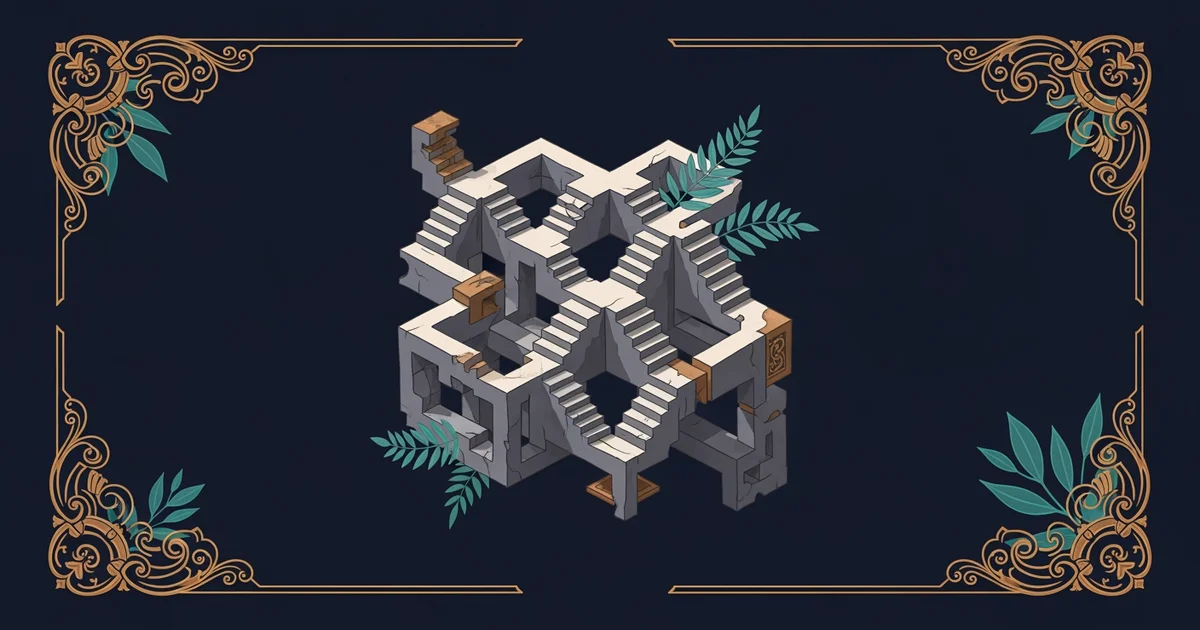
The Logic of Formal Systems
When mathematicians attempt to create a perfect foundation for all of math, they rely on a set of basic truths called axioms. These axioms act like the rules for a game, defining how numbers and symbols interact within a logical space. A formal system aims to prove every true statement using only these starting rules. For decades, many thinkers believed that any mathematical statement could be labeled as either true or false. They thought that if a statement was true, a sequence of logical steps would eventually confirm it. This dream of a perfect, complete system defined the early goals of modern logic and mathematical study.
Key term: Axiomatic system — a set of logical rules and starting assumptions used to derive all other truths within a specific field of study.
However, this dream hit a massive wall when researchers analyzed the internal limits of these systems. They discovered that no matter how complex the rules become, some statements will always exist that remain beyond the reach of those rules. These statements are true in a real sense, yet the system itself lacks the tools to prove them. This realization shifted the focus of mathematics from finding every answer to understanding why certain questions remain forever stuck in a state of uncertainty.
Understanding Unprovable Truths
To visualize this limit, think about a bank that uses a strict computer program to verify every single transaction. The program follows precise rules to ensure that every cent is accounted for and every balance is correct. If a clever user finds a way to write a transaction that says, "This specific transaction cannot be verified by this program," the system faces a crisis. If the program says the statement is true, it fails to verify it. If the program says the statement is false, it contradicts its own logic. The statement is clearly true, yet the program is structurally unable to provide a proof for it.
This core issue highlights the tension between truth and provability in any complex logical framework. The following table compares how different systems handle the relationship between the rules they follow and the truths they can reach.
| System Type | Primary Goal | Capability | Limitation |
|---|---|---|---|
| Simple Logic | Consistency | Verifies basic facts | Cannot handle complex sets |
| Formal Math | Completeness | Proves known theorems | Misses unprovable truths |
| Advanced Logic | Flexibility | Adapts to new rules | Risks internal contradictions |
When we look at these systems, we see that the complexity of the rules directly impacts the number of truths that stay hidden. A system that is simple enough to be totally complete often lacks the power to describe the full range of reality. As we add more rules to increase the power of the system, we accidentally create new ways for the system to fail to prove its own statements. This trade-off suggests that a system cannot be both perfectly powerful and perfectly complete at the same time.
- Consistency ensures that a system never produces a contradiction, meaning it will never claim that a statement is both true and false at the same time.
- Completeness implies that every single true statement within the system can be proven using the starting axioms, leaving no truth behind.
- Formalization involves turning human language into strict symbols so that machines or logic gates can process them without any room for outside interpretation or error.
These three concepts form the backbone of how we analyze any logical structure today. By testing these limits, we learn that our understanding of reality is not a single, finished puzzle. It is an ongoing process of discovering truths that live just outside the reach of our current rulebooks. We must accept that some parts of the mathematical universe are true even if we cannot build a formal bridge to reach them.
True statements exist within every complex logical system that cannot be proven using the rules of that system alone.
But what does it look like in practice when these logical limits appear inside modern computer code?