
Russell and Sets
Imagine a librarian who creates two distinct catalogs for every book found within their massive collection. The first catalog lists every book that does not mention itself in its own index or text. The second catalog lists every book that does mention itself somewhere within its own pages. Now consider the librarian needs to categorize the catalogs themselves into the library system. If the librarian places the first catalog into the first catalog, they create a logical disaster that defies standard rules. This simple scenario highlights the tension found in the foundations of modern mathematics and set theory.
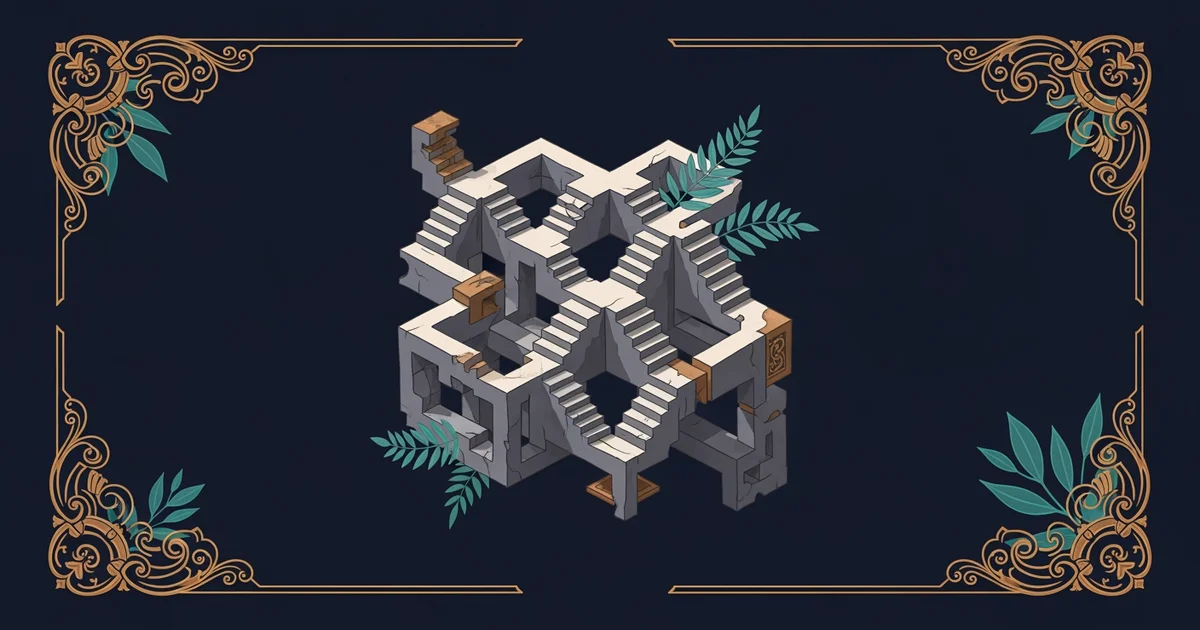
The Nature of Mathematical Sets
To understand this puzzle, we must first define a set, which acts as a collection of distinct objects. Mathematicians group items together into sets to perform operations and analyze how different groups interact with each other. For example, a set might contain all the prime numbers less than ten or all the colors found in a standard rainbow. These sets remain clear and functional as long as they contain items that are not the set itself. We assume that a collection of objects is distinct from the objects contained within it, which keeps our logic tidy and predictable.
However, some sets can technically contain themselves as a member, which creates a strange recursive loop. Think of a set containing all things that are not books; this set is not a book, so it does not contain itself. But if we define a set as a collection of all sets that are not members of themselves, we hit a wall. This specific problem forces us to ask if this new set contains itself as a member. If it does, then it fails the rule of not containing itself, yet if it does not, it must be included.
Resolving the Paradox of Self-Inclusion
This logical trap is known as a paradox, which occurs when a statement leads to two contradictory conclusions. The contradiction happens because the definition of the set requires it to follow a rule that it cannot satisfy. We can compare this to a barber who shaves everyone who does not shave themselves; if the barber shaves himself, he breaks his own rule. If he does not shave himself, he must be shaved by the barber, which means he must shave himself. This circular reasoning shows that some definitions in logic are fundamentally unstable.
To manage these issues, mathematicians developed strict rules to prevent sets from containing themselves in ways that cause these logical breakdowns. They created a hierarchy where sets must be built from previously defined elements rather than allowing sets to refer to their own existence. This prevents the formation of self-referential collections that lead to nonsense results in proofs. By restricting how sets are formed, we ensure that our mathematical systems remain consistent and reliable for complex calculations. The following table outlines how different types of sets behave when evaluated for self-inclusion:
| Set Type | Membership Rule | Self-Included | Outcome |
|---|---|---|---|
| Standard Set | Contains distinct items | No | Stable |
| Universal Set | Contains everything | Yes | Paradoxical |
| Russell Set | Contains sets not in themselves | Unknown | Contradictory |
By examining these categories, we see that the structure of the set determines its validity within a logical system. We must be careful when defining the boundaries of our collections to avoid the trap of recursion. Logic requires clear layers of definition to function without collapsing into a state of total uncertainty. We use these rules to build a solid framework for all advanced mathematics, ensuring that every operation has a defined and singular result.
The paradox of self-referential sets teaches us that logical systems require strict boundaries to prevent contradictions from invalidating the entire mathematical framework.
The next Station introduces probability puzzles, which determine how uncertainty and random chance influence our understanding of logical outcomes.