
Tension and Compression Forces
Imagine you are holding a heavy grocery bag that pulls your arm downward toward the floor. You feel the muscles in your arm stretch as they fight the weight of the bag. This simple feeling shows the basic principle of how physical objects react to forces. In the world of civil engineering, every bridge must manage these exact same forces to stay standing. Engineers study how materials stretch or squeeze to ensure that massive structures remain safe for daily use.
The Nature of Structural Loads
When we look at a bridge, we see a complex shape that spans a wide gap. Beneath the surface, the structure is constantly working to balance two opposing forces that act on every beam. One force is tension, which is a pulling force that tries to stretch a material apart. Think of a rubber band being pulled from both ends until it reaches its limit. The other force is compression, which is a pushing force that tries to crush a material inward. If you press down on a soda can with your hand, you are applying compression until the metal eventually folds.
Key term: Structural Load — the weight or force that a bridge must support, including its own mass and the traffic it carries.
Engineers must design bridges to handle these loads without breaking or bending out of shape. If a bridge design fails to balance these forces, the material will snap or buckle under the pressure. Every part of a bridge is chosen for its ability to handle either pulling or pushing. For example, steel cables are excellent at handling tension because they are strong when pulled tight. Concrete, however, is much better at handling compression because it resists being crushed by heavy weights. By combining these materials, engineers can create structures that are both light and incredibly strong.
Balancing Forces in Modern Bridges
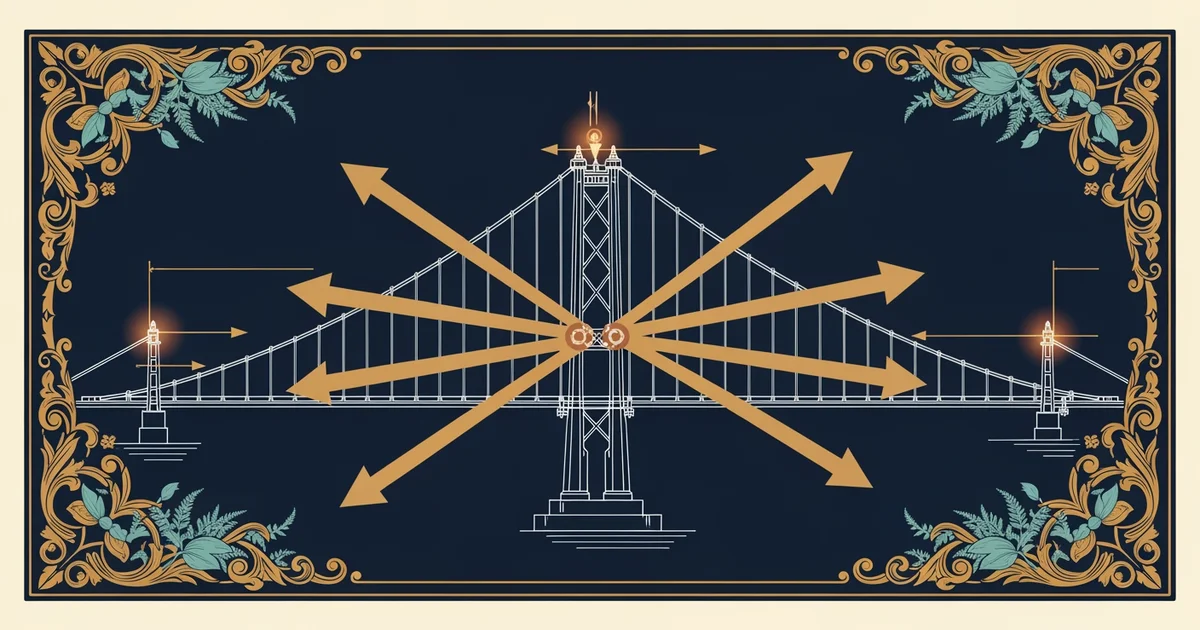
To understand how these forces work together, consider a suspension bridge as a large scale. The bridge deck hangs from vertical cables that are under constant tension from the weight of cars. These vertical cables transfer that tension upward to the main cables that curve across the towers. The main cables then pull against the anchorages at each end of the bridge span. Meanwhile, the tall towers experience heavy compression as they push back against the weight of the cables. The entire system is a delicate dance of pushing and pulling that keeps the road steady above the water.
| Force Type | Physical Action | Material Strength | Common Example |
|---|---|---|---|
| Tension | Pulling apart | High in steel | Bridge cables |
| Compression | Pushing inward | High in concrete | Bridge piers |
| Shear | Sliding past | Moderate in iron | Rivet joints |
We can visualize this flow of forces using a simple diagram to see how weight travels through the structure. The load starts on the deck and moves through the hangers to the main cables. These cables carry the force to the towers, which then push the load down into the solid ground. This path ensures that no single part of the bridge carries all of the stress alone. By spreading the load across different components, the bridge remains stable even during high winds or heavy traffic.
This diagram shows how tension works in the cables while compression works in the towers. The forces move in a continuous loop that keeps the bridge in perfect balance. Without this careful management of tension and compression, modern bridges could not span such great distances. Engineers use these concepts to build structures that last for many decades without failing. Every bridge is a testament to our ability to manipulate physical forces for human benefit.
Understanding how tension and compression interact allows engineers to design bridges that support massive loads while remaining flexible enough to withstand environmental stresses.
The next Station introduces foundation engineering basics, which determines how these structural forces are safely transferred into the earth below.