
Propulsion Systems
Imagine you are holding a heavy grocery bag that suddenly leaks and drops all your items. Gravity pulls everything down with a constant force that requires immediate energy to overcome during flight. To conquer this force, engineers design propulsion systems that push mass backward to create forward momentum. This fundamental action relies on the laws of motion that govern how objects move through space. Without a reliable way to generate thrust, any vehicle would simply remain anchored to the ground forever.
The Mechanics of Thrust Generation
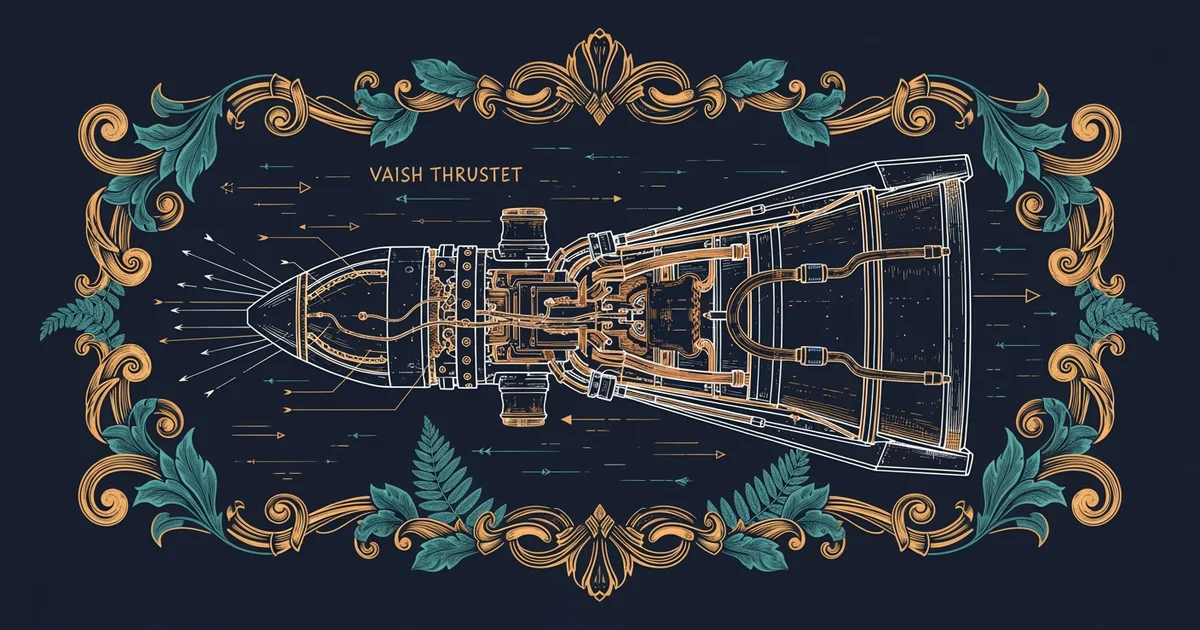
When we look at how engines function, we must understand the core principle of thrust. This is the mechanical force generated by an engine that propels a vehicle forward through the air. A jet engine operates by pulling in large volumes of air and compressing them using internal fans. This air mixes with fuel and ignites, which creates a high-pressure blast of hot gas. This gas expands rapidly through the back of the engine to provide the necessary force for lift. You can think of this process like blowing up a balloon and releasing it suddenly. The air rushing out of the nozzle forces the balloon to zip away in the opposite direction.
Key term: Thrust — the physical force generated by an engine that pushes a vehicle forward by reacting against the mass of exhausted gases.
Because jet engines require atmospheric oxygen to facilitate combustion, they are limited to flying within the thick layers of our planet. They function efficiently by cycling air continuously, which makes them ideal for long-distance travel at high speeds. In contrast, rockets carry their own oxygen supply, which allows them to operate in the vacuum of space. This difference in design dictates how far and how fast a machine can travel. Choosing the right engine type depends entirely on the mission requirements of the vehicle being built.
Comparing Engine Efficiency and Design
When engineers evaluate these systems, they look at specific metrics to determine which engine performs best for a task. One critical metric is the specific impulse, which measures how effectively an engine uses its fuel mass. A high specific impulse indicates that the engine produces more thrust per unit of propellant consumed. While jet engines excel within the atmosphere, rockets must be incredibly efficient to carry their own fuel weight. This trade-off is the primary challenge for engineers designing craft that must reach the stars.
To better understand how these systems differ, we can compare their operational requirements across various mission profiles:
- Jet engines rely on intake air for combustion, which limits their use to altitudes where the atmosphere remains dense enough to support the intake process.
- Rocket engines carry oxidizers internally, enabling consistent performance in the vacuum of space where no external air is available for the combustion cycle.
- Turbofan engines provide high efficiency at subsonic speeds by bypassing much of the air around the core, which reduces noise and fuel consumption significantly.
- Liquid-propellant rockets offer adjustable thrust levels, allowing for precise control during the complex phases of launch and orbital insertion maneuvers.
| Feature | Jet Engine | Rocket Engine |
|---|---|---|
| Oxidizer | Atmospheric air | Carried internally |
| Speed | Subsonic to supersonic | Hypersonic to orbital |
| Environment | Within atmosphere | Vacuum of space |
| Efficiency | High at low altitude | High in deep space |
By analyzing this data, we see that propulsion is a game of compromise. A jet engine acts like a runner who breathes air while sprinting, whereas a rocket engine acts like a scuba diver who brings a tank to breathe underwater. Both systems serve the same goal of moving mass, but their environments dictate their mechanical limits. Understanding these limits allows engineers to select the best technology for their specific aerospace goals.
Propulsion systems convert fuel energy into directional force by managing the intake of air or the storage of oxidizers to overcome gravity.
Now that we understand how engines generate movement, we must explore how to guide these powerful machines through complex flight paths.
Want this with sources you can check?
Premium Learning Paths for Engineering & Robotics are researched against open-access libraries — PubMed, arXiv, government databases, and more — with their distinctive claims cited to real sources and independently checked.
See what Premium includes