
Data Representation Challenges
Imagine trying to understand a complex social network by looking only at a list of names. You see the names, but you miss the friendships, the rivalries, and the group dynamics that define the whole system. This is the exact problem researchers face when they try to teach computers about our deeply interconnected world using standard data formats. Traditional tables are excellent for organizing simple lists, but they struggle to capture the complex web of relationships that define how real-world systems actually function. When we force interconnected data into rows and columns, we lose the vital context that makes the data useful for prediction.
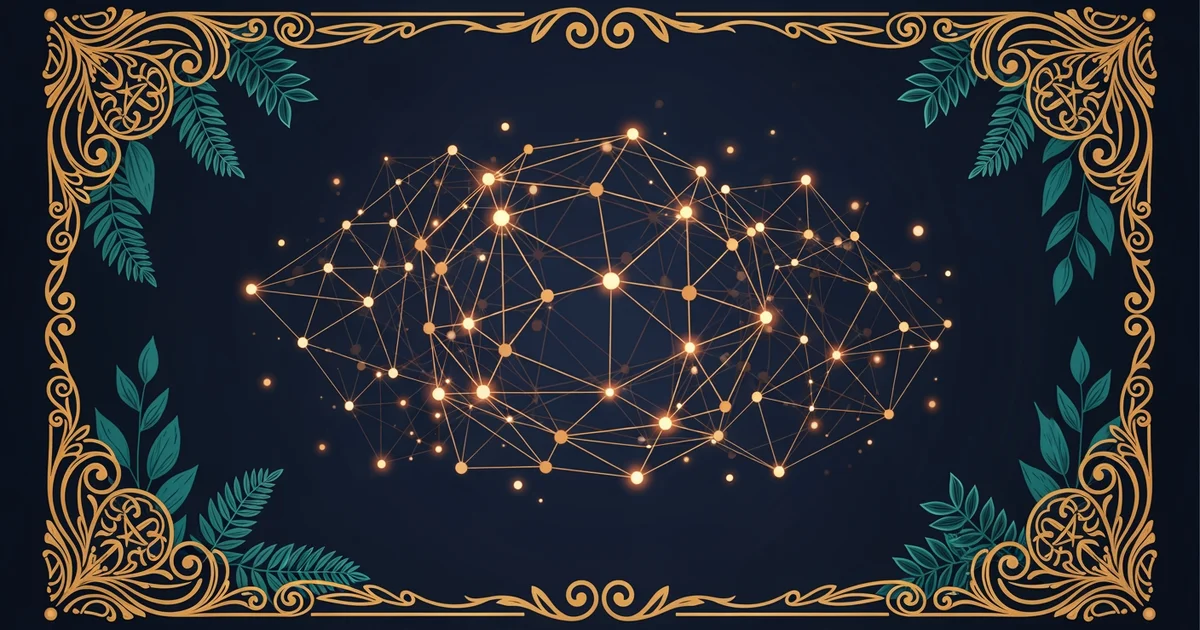
The Limitations of Traditional Data Structures
Most computer systems store information in flat files that function much like a basic spreadsheet. Each row represents a single item, and each column describes a specific attribute of that item. While this format is efficient for simple tasks like tracking inventory or user accounts, it creates a massive blind spot for complex systems. A spreadsheet cannot easily represent the way one person influences another or how a single event ripples through a network. When we try to force network data into these rigid tables, we often end up with disconnected fragments that lack the necessary structure for meaningful analysis.
Key term: Tabular Data — a rigid method of organizing information into rows and columns where each entity exists independently of others.
Think of this limitation like trying to describe a bustling city by only listing the names of its citizens in alphabetical order. You might know who lives there, but you have no idea who works together, who lives in the same house, or who attends the same school. The list provides the raw ingredients, but it fails to show the living, breathing structure of the city itself. In the world of artificial intelligence, this missing structure is exactly what prevents standard models from understanding how different pieces of data interact with one another in real time.
Moving Toward Relational Representation
To bridge this gap, we must shift our focus from individual items to the connections between them. A graph format treats both the items and their relationships as first-class citizens in the data model. By mapping these connections explicitly, we allow a computer to traverse the network just as a person might follow a chain of introductions to find a new friend. This shift requires a new way of thinking about data storage and processing that prioritizes the context of relationships over the static properties of individual points.
| Data Format | Primary Strength | Main Weakness | Best Use Case |
|---|---|---|---|
| Tabular | Fast retrieval | Lacks context | Simple lists |
| Hierarchical | Organized levels | Rigid paths | File systems |
| Graph | Captures links | High complexity | Social networks |
We can visualize this difference by looking at how different models handle information flow within a system:
- Nodes act as the individual entities in the system, such as people, locations, or products, which hold the core information we need to process.
- Edges function as the bridges that link these nodes together, representing interactions, dependencies, or shared characteristics that define the entire structure.
- Topology describes the overall shape of the network, which helps the system understand how information travels from one distant point to another.
By focusing on these three elements, we move beyond simple lists and start building models that mirror the complexity of the real world. This approach allows machines to recognize patterns that would be invisible in a standard spreadsheet, such as identifying influential nodes or finding hidden clusters within a massive dataset. This transition from static lists to dynamic graphs is the foundational step in training modern artificial intelligence to perceive the world as a web of interconnected events rather than a collection of isolated facts. As we continue this journey, we will explore how these structures enable machines to make smarter predictions about the systems we use every day.
True data intelligence emerges when we prioritize the relationships between entities rather than focusing solely on the isolated attributes of individual data points.
The next step in our journey involves learning how to turn these complex connections into mathematical representations that a computer can actually process.