
The Chemistry of Fiber Structure
Imagine you spill grape juice on a cotton shirt and a silk scarf, noticing how one stains deeply while the other resists. This simple observation reveals that fabrics are not just woven threads but complex molecular structures with different chemical personalities. The way a fabric reacts to color depends entirely on its internal architecture, which dictates how dye molecules attach or slip away. Understanding these microscopic foundations helps us predict why some materials hold vibrant hues for years while others fade quickly. By looking closely at the atomic level, we can see how nature builds the canvas for every color we wear.
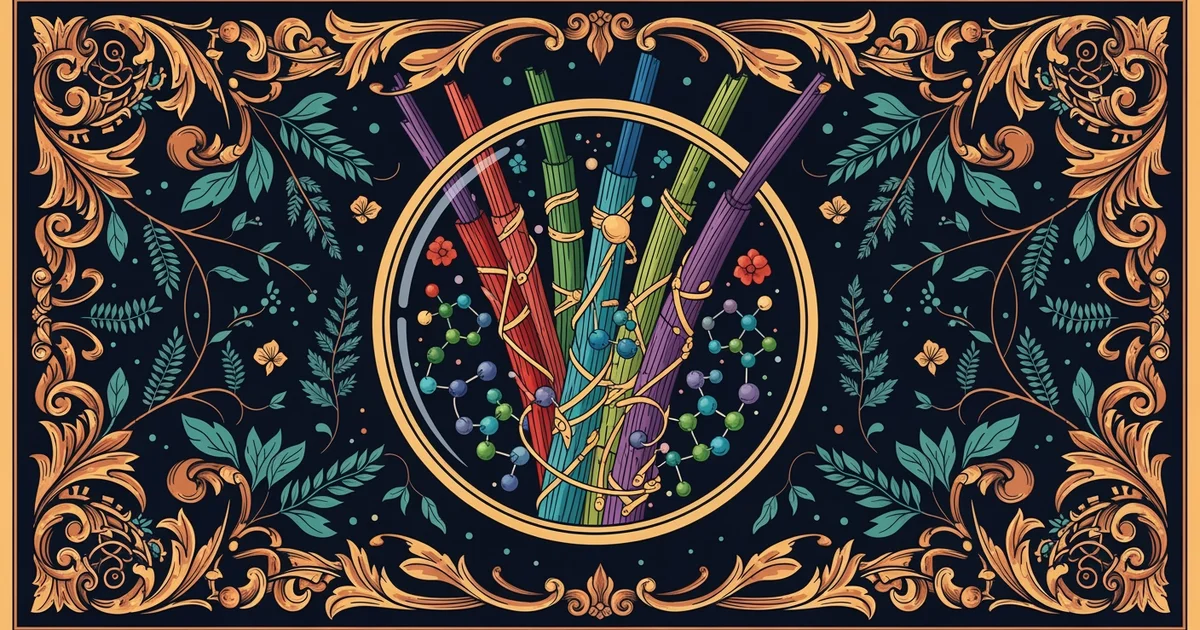
The Molecular Architecture of Natural Fibers
Natural fibers like cotton and wool rely on distinct molecular arrangements that determine their strength and their affinity for different types of dyes. Cotton consists primarily of cellulose, a long chain of glucose molecules linked together in a rigid, repeating pattern that forms strong plant cell walls. This structure creates a dense, stable lattice that provides durability but lacks natural sites for some dyes to grab onto easily. In contrast, wool is composed of protein chains, which are folded into complex shapes and held together by varied chemical bonds. These protein chains contain active groups that act like tiny magnets, drawing in dye molecules and locking them into the fiber matrix. Think of cellulose like a smooth, brick wall that is hard to paint, while protein fibers act like a sponge with many open pockets waiting to be filled.
Key term: Polymer — a large molecule composed of many repeating smaller units that link together to create long, flexible, and durable chains.
Synthetic fibers, which humans create in laboratories, differ from these natural versions because we design their architecture from the start. Scientists build these materials by stringing together specific chemical units to form long, uniform chains that resist water and heat. Because these synthetic chains lack the reactive "pockets" found in natural proteins, they often repel dyes that work perfectly on cotton or silk. We must use heat or special chemical carriers to force the dye into the tight, plastic-like structure of synthetic fibers.
Comparing Fiber Structures and Dye Potential
To see how these materials differ in their chemical makeup, we can compare their fundamental properties and how they interact with the world around them. The following table highlights the core differences between these three common types of textile materials used in clothing manufacturing:
| Fiber Type | Primary Unit | Structural Shape | Dye Affinity |
|---|---|---|---|
| Cotton | Cellulose | Rigid lattice | High for water-based |
| Wool | Protein | Folded chains | High for acid-based |
| Synthetic | Polymer | Tight filaments | Low without additives |
These differences are not just random traits but are the direct result of how atoms bond within the fiber. Cellulose fibers are packed tightly, making them very strong but also limiting how much water or dye can penetrate the core. Protein fibers are more open and flexible, allowing them to swell when wet, which creates more room for color molecules to enter. Synthetic fibers are often engineered to be hydrophobic, meaning they naturally push water away, which makes the process of adding color much more difficult than with natural materials.
- Cellulose fibers provide a stable, flat surface that requires specific chemical treatments to open up the structure for dyes.
- Protein fibers offer diverse chemical sites, such as amino groups, which allow for a wide range of bonding interactions with various pigments.
- Synthetic polymers are manufactured to be smooth and non-porous, meaning they require extreme heat or chemical swelling agents to accept permanent color.
By mastering these structural differences, we gain control over the entire dyeing process, ensuring that the right color reaches the right fabric. This foundation allows us to move beyond simple staining and into the science of permanent chemical bonding. You will finish this path knowing how to manipulate these structures to achieve professional-quality results on any fabric type.
The chemical makeup of a fiber determines its ability to accept and retain dyes through its unique molecular shape and reactivity.
By understanding these basic building blocks, we can now investigate the fascinating history of how early humans discovered and used natural dyes to transform these fibers.