
Evolutionary Relationships
Imagine standing before a massive family reunion where you must trace every single cousin back to a common great-grandparent. You would likely search for shared physical traits or family stories to map out who belongs to which specific branch. Scientists perform this same task when they examine the biological world to understand how different animals are related. They use a phylogenetic tree to represent the history of life as a branching structure of ancestors and descendants. By looking at these diagrams, we can see how species diverged from a single origin point over millions of years. This process allows researchers to organize the vast diversity of animal life into a clear, logical framework. Understanding these connections helps us see that every living creature is part of one large, interconnected family history.
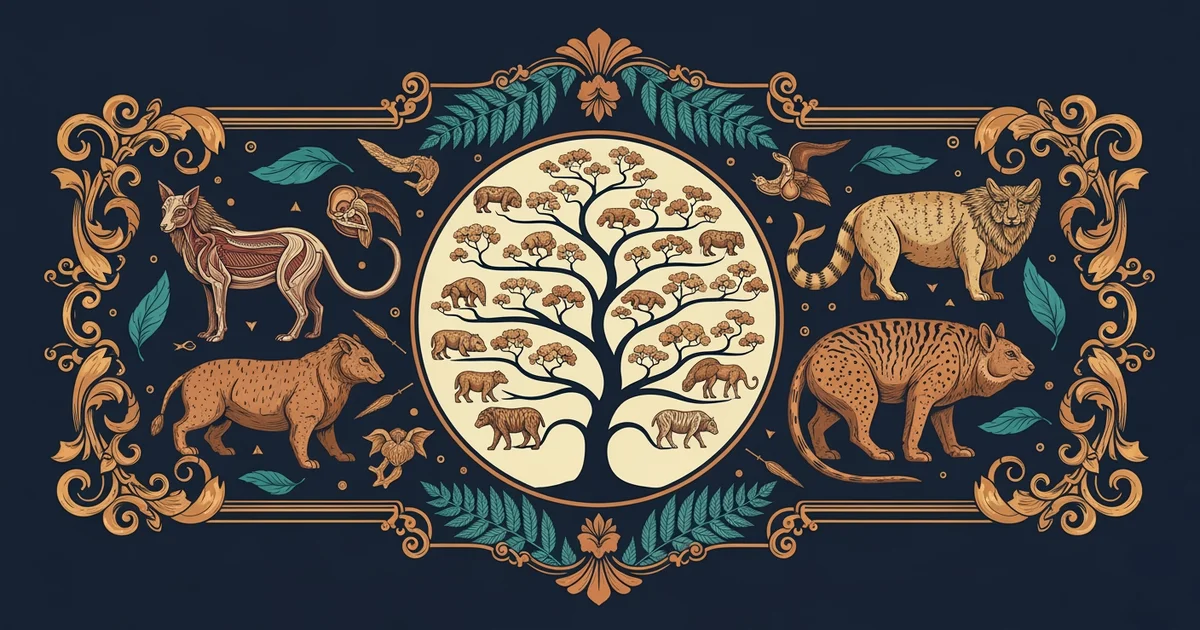
Interpreting Evolutionary Branching Patterns
When we look at a phylogenetic tree, the base of the diagram represents the earliest shared ancestor for all species in the group. As we move upward from the base, the lines split into smaller branches that represent the appearance of new, distinct species. Each split point, or node, indicates where one ancestral population divided into two or more separate groups. Think of this like an investment portfolio where one original asset splits into different funds based on changing market conditions. One branch might focus on high-growth technology while another shifts toward stable, long-term bonds to survive different environments. The longer the branch, the more time has passed since the species diverged from their common ancestor. By observing these lengths, we can estimate how much time has passed since two groups last shared a common genetic history.
Key term: Node — the specific point on a phylogenetic tree where an ancestral lineage splits into two or more separate descendant groups.
To better understand these relationships, we look at the traits that define each group. Some groups share physical characteristics that were inherited from a common ancestor, which helps us group them together. Other traits might appear independently in unrelated groups due to similar environmental pressures, which can complicate our mapping efforts. We must distinguish between these shared ancestral traits and those that evolved separately to ensure our map is accurate. This analysis requires careful observation of both internal anatomy and external features. When we identify these patterns, we can build a reliable guide that shows how different animals adapted to their unique roles. The following table highlights how scientists categorize these relationships based on different observational criteria.
| Observation Type | What it Reveals | Why it Matters |
|---|---|---|
| Genetic Data | DNA sequences | Shows deep history |
| Anatomy | Bone structure | Shows physical path |
| Development | Embryo growth | Shows early links |
Mapping Ancestral Links Between Species
Building an accurate tree requires us to synthesize data from many different sources to confirm our conclusions. We often use specialized diagrams to visualize these complex pathways of evolution across time. These diagrams help us track how specific traits emerged and changed within a population. For instance, we might map the transition from water-based life to land-based life by tracking skeletal changes. Each step in the process provides a piece of the puzzle that explains how animals conquered new environments. We must always remember that these trees are hypotheses that change as we find new evidence. Science is a dynamic field where every new discovery can refine our understanding of the past. As we gather more data, our trees become more precise and reveal the intricate ways that life has unfolded across the planet.
- Identify the common ancestor at the base of the tree to establish the starting point.
- Locate each node to track where ancestral populations split into new, distinct species groups.
- Compare the branch lengths to estimate the relative time since two species shared a common ancestor.
- Analyze shared physical or genetic traits to confirm the accuracy of the proposed branching order.
By following these steps, we can piece together the history of any animal group with greater confidence. This systematic approach ensures that our conclusions are based on evidence rather than mere speculation. Every branch on the tree tells a story of survival and adaptation in a changing world. We are essentially reading the record of life that is written in the biology of every creature. This process of discovery is what makes the study of animal relationships so compelling for modern biology students. Through these methods, we gain a deeper appreciation for the complex history that connects all living things on Earth.
Visualizing evolutionary relationships through branching diagrams allows us to trace the history of life by identifying shared ancestors and the points where species diverged.
But what does this mean for the way cells divide and pass on these traits to the next generation?