
Animal Classification Systems
Imagine you walk into a massive library filled with millions of unsorted, messy books. You would never find the specific story you need without a clear, organized filing system. Scientists face this exact problem when they study the millions of animal species on Earth. They use a system called taxonomy to group animals based on shared traits and evolutionary history. This framework acts like a digital library catalog for the natural world, allowing researchers to communicate clearly about any living creature. Without this structure, the study of animals would be a chaotic pile of names without any logical connections.
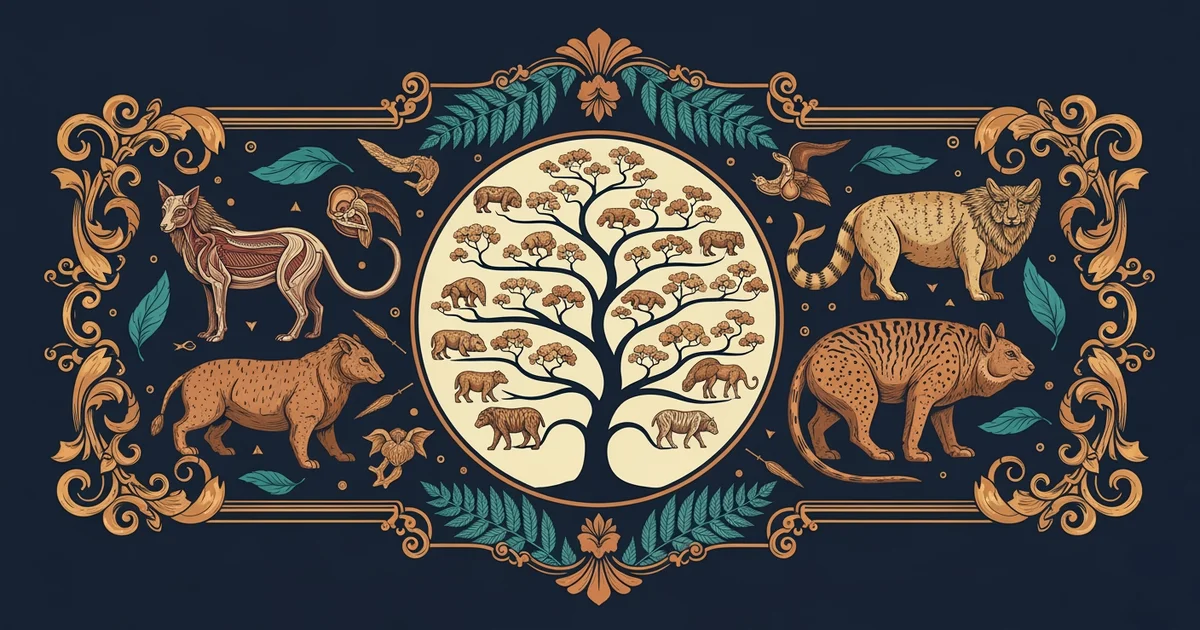
The Hierarchical Structure of Life
Biological classification organizes every living animal into a set of nested ranks. These ranks start from the broadest category and narrow down to the most specific identity. Think of this like your home address, which starts with your country and ends with your specific house number. At the top of this hierarchy sits the domain, followed by the kingdom, phylum, class, order, family, genus, and finally the species. Each step down the ladder adds more specific details about the animal. This method ensures that scientists across the world use the same name for every single organism.
Key term: Taxonomy — the scientific process of naming, defining, and classifying groups of biological organisms based on shared characteristics.
When we classify animals, we look for physical features or genetic markers that they share with others. For example, all animals in the same class share major body plans, such as having a backbone or specific limb structures. As we move down to the family level, the animals share more recent ancestors and look much more alike. This system helps us understand how different species are related to one another through time. It is a logical way to map out the entire tree of life on our planet.
Applying Taxonomic Ranks to Animals
To see how this works in practice, we can look at the classification of a common house cat. The cat belongs to the kingdom Animalia because it is a multicellular organism that consumes organic material. It falls under the phylum Chordata because it possesses a spinal cord during development. Further down, it belongs to the order Carnivora, which includes mammals that primarily hunt other animals for food. Finally, its genus and species name provide a unique identifier that separates it from all other living creatures on the earth today.
We can compare these ranks by looking at how they group organisms based on their shared traits:
- Kingdom: This is the second largest rank that separates animals from plants, fungi, and bacteria based on basic life functions.
- Class: This rank groups animals that share major structural features, such as mammals, reptiles, birds, or amphibians.
- Species: This is the most specific rank that defines a group of individuals capable of breeding and producing fertile offspring.
This system functions like an economic inventory in a large warehouse where items are sorted by type and size. If you need a specific tool, you look in the correct department, then the correct shelf, and finally the correct bin. By using this hierarchical approach, biologists can easily predict the traits of an animal they have never seen before. If they know an animal belongs to the class Mammalia, they already know it has hair and produces milk for its young. This predictive power makes classification an essential tool for every branch of modern biological research.
Biological classification provides a universal, hierarchical filing system that allows scientists to organize and understand the complex relationships between all living animal species.
Now that we have a framework for naming animals, we must look at the microscopic structures that define their basic biological functions.