
Common Ancestry Evidence
Look at your own hand and compare its shape to the wing of a bird or the flipper of a whale. While these limbs perform very different tasks like grasping, flying, or swimming, their underlying bone structures reveal a striking and unexpected similarity in their basic physical arrangement.
Understanding Anatomical Connections
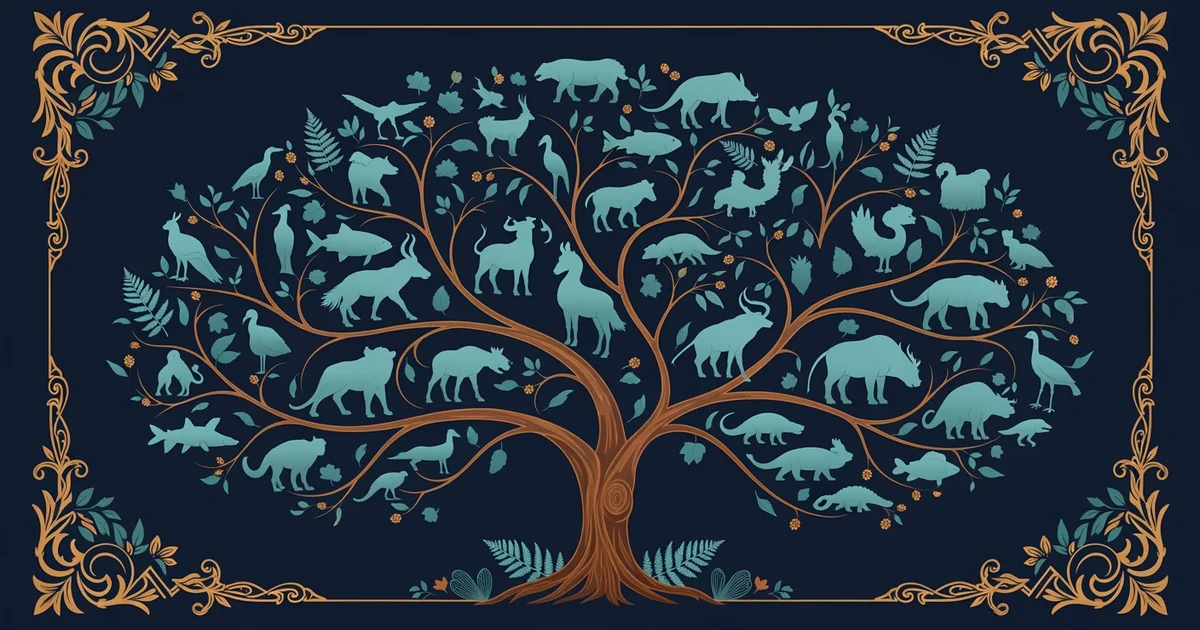
When biologists examine the internal anatomy of various vertebrates, they often find that the skeletal patterns remain remarkably consistent across species. This discovery suggests that these animals share a common ancestor who possessed a similar limb structure long ago in the distant past. Scientists call these shared features homologous structures because they represent physical traits inherited from a single lineage despite their different modern functions. Think of this like a car manufacturer that uses the same basic chassis for a heavy truck, a small sedan, and a fast sports car. Even though the final vehicles serve different purposes on the road, they all share the same foundational metal frame design. This shared design provides clear evidence that the diverse species we see today are connected by a long, branching history of evolution.
Analyzing Skeletal Patterns
To see how these connections work, we must look at the specific arrangement of bones in the limbs of mammals, birds, and reptiles. You will find a single upper arm bone connected to two lower arm bones, followed by a cluster of wrist bones and multiple digits. This specific pattern is not a coincidence, nor is it the most efficient way to build every limb for every environment. It exists because the original ancestor of these animals possessed this exact bone arrangement, and their descendants simply modified it over millions of years. The following table highlights how different animals have adapted this single ancestral blueprint to suit their specific survival needs in various environments.
| Animal | Limb Type | Primary Function | Adaptation |
|---|---|---|---|
| Human | Hand | Grasping | Flexible digits |
| Bat | Wing | Flying | Elongated fingers |
| Whale | Flipper | Swimming | Flattened bones |
This table demonstrates that while the function of the limb changes to help the animal survive in its unique habitat, the underlying blueprint remains largely the same. By observing these patterns, researchers can map out how life has branched off into different forms while keeping the core structural legacy of its ancestors intact.
The Role of Developmental Biology
Beyond just looking at adult skeletons, scientists also study how these structures develop within the embryo before the animal is even born. During the earliest stages of growth, the limbs of many different species look almost identical to one another in their basic physical form. This shared developmental pathway is known as embryonic homology, which provides even stronger proof of our deep biological connections to other living things. Just as a builder uses the same set of blueprints to construct different houses in a neighborhood, nature uses a conserved genetic toolkit to build the limbs of diverse animals. If these species did not share a common ancestry, there would be no logical reason for their embryos to start with the exact same structural plan. This early growth phase acts as a biological record that reveals the hidden history of how different animal groups diverged from a single starting point.
Evaluating Evolutionary Evidence
When we combine the evidence from adult anatomy and embryonic development, the case for common ancestry becomes very difficult to ignore in the scientific community. These shared traits are not just random accidents of nature but are instead the direct result of historical inheritance from ancestral populations. By carefully comparing these structures, we can reconstruct the family tree of life and understand how small changes accumulate over vast periods of time. This process of modification explains why we see such a wide variety of life forms on Earth today while still finding the same basic biological patterns beneath the surface. Every living creature carries the structural echoes of its past, proving that all life on our planet is part of one large, interconnected family history.
Common ancestry is evidenced by the presence of shared skeletal blueprints that have been modified over time to serve different environmental functions.
The next Station introduces population genetics, which determines how these structural variations change over time within a group.