
The Blueprint of Living Organisms
Imagine you are building a complex toy set that arrives with no instructions inside the box. You would struggle to assemble the pieces because you lack the master plan for the final shape. Living beings face a similar challenge every single day as they grow and repair their bodies. They rely on an internal set of instructions that tells every cell exactly what to do next. This biological manual ensures that your heart beats, your skin heals, and your eyes see the world around you. Without this hidden guide, life could not sustain itself or pass on traits to the next generation.
The Language of Life
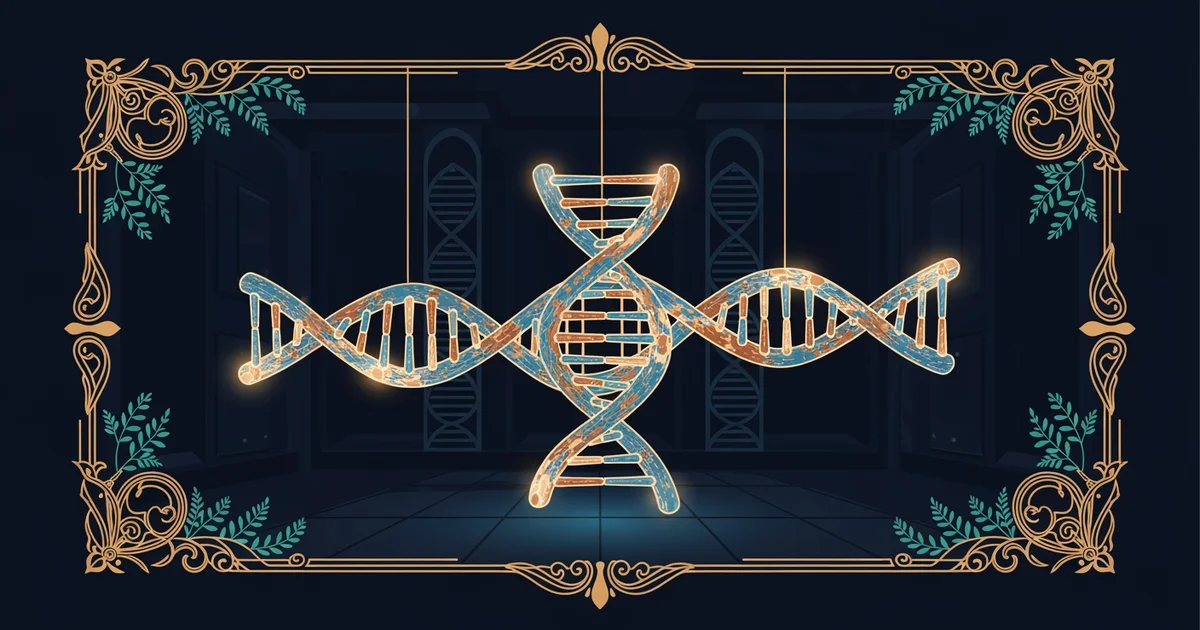
Inside the nucleus of every cell, there sits a long molecule known as DNA. This molecule acts like an instruction manual written in a very specific chemical language. It contains the complete set of blueprints required to build and maintain a living organism. Think of this molecule like a massive digital file containing the code for a complex computer game. Just as code dictates how a game character moves or interacts, this chemical code decides your height, your eye color, and your natural hair texture. This information remains safely stored in the cell, protected from damage while it waits to be read.
Key term: DNA — the molecule that carries the genetic instructions used in the growth, development, and reproduction of all known living organisms.
This system uses a simple alphabet of four chemical bases to store vast amounts of data. These bases pair up in a specific way to form the rungs of a twisted ladder structure. Scientists call this shape a double helix because of how the two strands wind around each other. The order of these bases determines the specific message that the cell reads to perform its daily tasks. If you change the order of these letters, you change the final output of the biological machine. This process is how nature ensures that every living thing remains unique while still following a reliable pattern.
Translating Instructions into Traits
Once the cell needs to perform a task, it must translate these instructions into physical actions. This happens through a process where the cell copies the code and sends it to the construction sites. These sites, called ribosomes, act like tiny factories that build proteins based on the instructions received from the nucleus. Proteins are the actual workers of the body that perform almost every job required for life. They create the structure of your muscles, help you digest your food, and keep your immune system running smoothly. The connection between your code and your physical self is direct and constant.
To understand how this works, consider the role of a master architect in a city. The architect keeps the original blueprints locked in a secure office to prevent loss or theft. If a construction crew needs to build a wall, they do not take the original document to the site. Instead, they make a temporary copy of the specific page needed for that wall and send it to the workers. The workers read the copy, gather the right materials, and assemble the wall exactly as the architect intended. Your cells follow this same logic to build your body from the ground up.
| Process Step | Location | Primary Action |
|---|---|---|
| Reading | Nucleus | Copying the master code |
| Transport | Cell | Moving the copy to the site |
| Building | Ribosome | Assembling proteins from code |
This flow of information ensures that your body functions with incredible precision every second of the day. Because the cell can access and read these instructions so quickly, you can react to your environment in real time. Your cells constantly check their internal blueprints to ensure they are fulfilling their roles correctly. When they find a mistake, they often have built-in repair mechanisms to fix the error before it causes a problem. This constant monitoring keeps you healthy and allows your body to adapt to changes in your surroundings over your entire life.
The blueprint of life provides a precise, readable code that directs the assembly of proteins to form the physical structures and functions of every living thing.
By the end of this path, you will understand how we can edit this code to address medical challenges and shape the biological future of our species.