
Refracting Telescope Mechanics
Imagine you are trying to read a tiny, faded sign from across a massive, dark field. Without any help, your eyes struggle to gather enough light to make out the letters on the distant surface. A refracting telescope acts like a giant, artificial eye that collects far more light than your pupils ever could. By bending light through glass, these devices bring faint, distant details into sharp focus for the human observer.
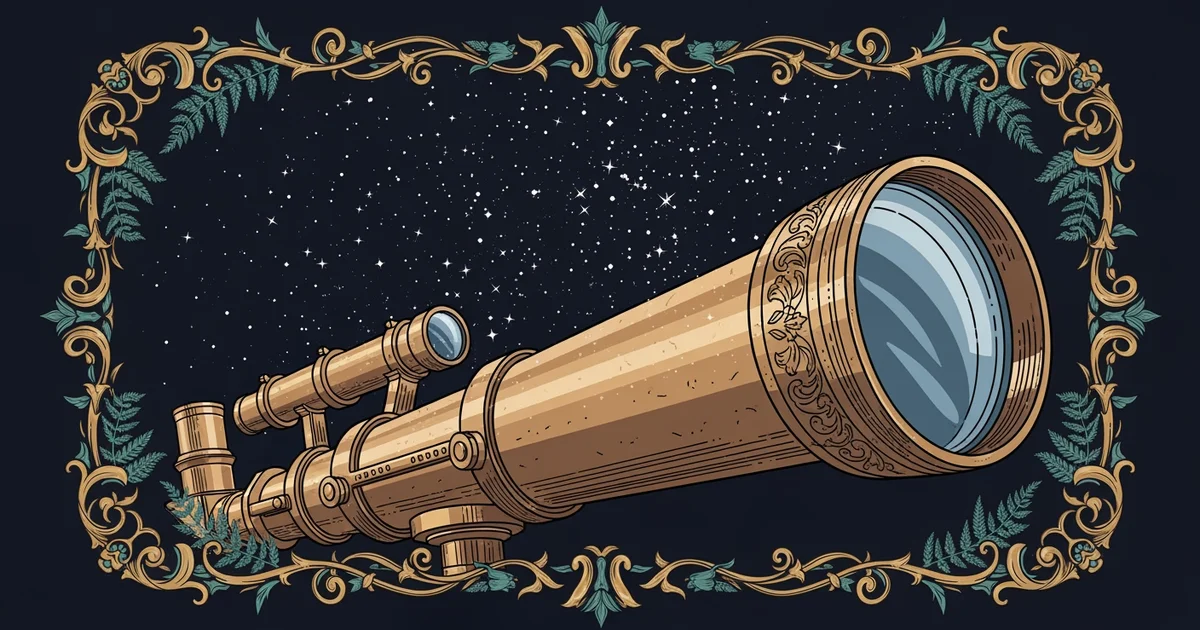
The Path of Light Through Glass
When light from a distant star enters the front of a telescope, it hits the primary lens. This large, curved piece of glass is known as the objective lens, and its job is to gather as much light as possible. As the light rays pass through this curved surface, they slow down and change direction. This process is called refraction, which causes the parallel rays to bend inward toward a central point. The lens is shaped specifically to ensure that all incoming light rays converge at one single, precise location inside the tube.
Key term: Refraction — the physical bending of light rays as they pass from the air into a denser medium like glass.
Once the light has converged, it forms a small, inverted image of the distant object at the focal point. Because the light rays cross each other during this bending process, the image appears upside down to anyone looking through the system. Think of this like a magnifying glass focusing sunlight onto a single spot on a leaf. If you hold the magnifying glass at just the right distance, the light becomes intense enough to create heat. In a telescope, we use that same focused light to create a detailed image rather than a burning spot.
Magnifying the Focused Image
After the light passes the focal point, it begins to spread out again inside the telescope tube. To make this image useful for human eyes, we place a second, smaller lens at the rear of the device. This component is called the eyepiece, and it acts as a high-powered magnifier for the light already gathered. The eyepiece takes those diverging light rays and bends them once more to make them parallel again. This final adjustment allows your eye to focus on the image as if it were sitting right in front of you.
To understand how these components work together, consider the following sequence of events:
- The objective lens captures faint light from space and forces it to converge at the focal point.
- The light passes through the focal point and begins to spread out as it travels toward the back.
- The eyepiece lens intercepts the spreading light and redirects it into a clear, magnified view for the observer.
This two-step process is essential because the primary lens alone cannot provide enough detail for the human eye to process comfortably. By using a combination of lenses, the telescope effectively increases the angular size of the distant object. This makes the dim light appear much brighter and larger than it would to the naked eye alone. The following table compares the specific roles of the two main lens types found in this system.
| Component | Primary Function | Effect on Light | Location |
|---|---|---|---|
| Objective | Light collection | Bends inward | Front end |
| Eyepiece | Magnification | Bends outward | Rear end |
| Focal Point | Image formation | Converges rays | Middle tube |
This mechanical arrangement ensures that we can see deep into the history of our universe by capturing ancient photons. Because the light takes time to travel across the vastness of space, the view we see is a snapshot of the past. When you look through the eyepiece, you are effectively watching light that left its source millions of years ago. The precision of the glass curves determines how clearly you can resolve these ancient, distant structures. If the lenses are not perfectly shaped, the image will appear blurry or distorted to the observer. Proper alignment is the final secret to unlocking the history hidden within the night sky.
Refracting telescopes use precisely curved glass lenses to gather faint light and focus it into a magnified image that the human eye can finally perceive.
But what happens when the telescope becomes too large to support glass lenses without them sagging under their own weight?
Want this with sources you can check?
Premium Learning Paths for Astronomy & Space Exploration are researched against open-access libraries — PubMed, arXiv, government databases, and more — with their distinctive claims cited to real sources and independently checked.
See what Premium includes